
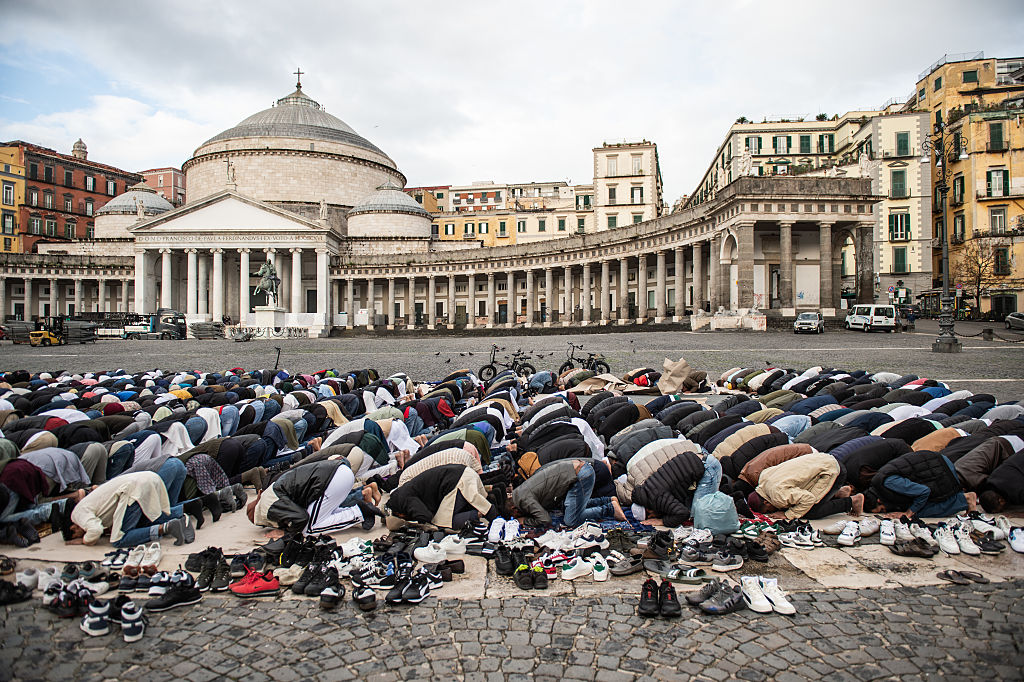
Muslims are projected to become the world’s largest religious group—overtaking Christians, who have long held that distinction—by 2035. And the gap between the two populations is set to keep steadily widening in the ensuing decades if recent trends continue, with Muslims potentially representing 3.64 billion people around the globe in 2070 compared to 2.96 billion Christians.
These projections come from a comprehensive study by the Pew Research Center, which drew on census and survey data on factors including fertility, migration, mortality, age, and “religious switching.”
As of 2020, Christians made up roughly 29% of the global population, according to Pew, while Muslims accounted for 26%. But recent years have already seen the growth in the Muslim population significantly outpace that among Christians, and that difference is only expected to compound over the next half century. Between 2020 and 2070, the number of Muslims around the world is projected to rise by 80%, compared to 30% for Christians.
In turn, Muslims would go from representing roughly a quarter of the world’s people to 36% during that period. Christians, meanwhile, would stay about on par with their current share of the global population.
For reference, that total population is expected to grow 29% in the same period. No other religious group, according to Pew, is even set to keep pace with that overall growth rate.
“A misconception that could come out of our report is that somehow Muslim growth will happen at the expense of Christians, and that would be a wrong interpretation,” Conrad Hackett, a senior demographer at Pew and co-author of the study, tells TIME.
“It's definitely not in our data a zero sum competition where one group can only go up in size if the other goes down in size,” he says. He notes that both populations are in fact “growing quite a bit,” but that “Muslims are just growing faster than Christians.”
On top of the global population growth projections for Muslims and Christians, Pew examined factors that are expected to shift where people belonging to both faiths live and how they identify in coming years.
Here’s what’s driving these expected population changes.
The main reason Muslims are projected to soon become the world’s most populous religious group is fertility rates. Over the past five years, Pew data has shown Muslim women have had an average of 3.1 children, the highest fertility rate for any religious group. While Christians have had the second highest rate in that same period, Christian women have had notably fewer children on average—at 2.5—than Muslim women.
“That's almost the whole ball game right there,” Gina Zurlow, a lecturer at Harvard Divinity School and the editor of the World Christian Database, which tracks global religion rates, tells TIME.
Especially key to these and other anticipated trends in population growth in the coming decades is sub-Saharan Africa, where more than a quarter of the world population is expected to live by 2070, according to Pew. Due to the high fertility and rising life expectancy in the region, both the Christian and Muslim populations, which represent the vast majority of its residents, are projected to grow in the coming years.
“The world's population has shifted to the global South,” Zurlow says. “Therefore, world religion has shifted to the global South, so there's just a population reality here that is happening that plays into the reality of Muslims growing larger than Christians.”
Pew estimates that more than half of the world’s Christian population will live in sub-Saharan Africa by 2070, but that the Muslim population in the region will grow at a higher rate.
This is in part because, as Hackett explains, the data show that countries with higher Muslim populations are correlated to higher fertility rates among Muslim women.
In sub-Saharan Africa, according to Pew, the fertility rate among Muslims was roughly 5.1 children per woman between 2020-2025, compared to 4 children per non-Muslim woman. And in Nigeria, for example, where there are more Muslims than Christians, Pew estimates those rates were about 5.4 children per Muslim woman versus 3.4 per Christina woman.
Other factors impacting religious populations
Migration patterns and “religious switching,” which the Pew study defined as “a change between the religious group in which a person was raised,” are also expected to contribute to shifts in religious populations around the world in the coming decades—though they’re projected to have a much less significant effect on the groups’ global growth than fertility rates.
“Natural population change”—the number of births in a population minus the number of deaths—was the primary cause for shifts in both the Muslim and Christian populations between 2020 and 2025, the Pew study found.
Growth among Christians, however, was estimated to be “offset” to a greater degree during that time by the number of people who left or “switched out” of the faith during those years. When it comes to religious retention, surveys conducted between 2008 and 2024 show that 99% of people raised Muslim still identify as such, while that figure runs at 85% for Christians, according to Pew.
That difference is expected to affect the relative growth of the two groups moving forward, too. Assuming the recent trends continue, the study estimates that by 2070, 199 million Christians are expected to switch “out” of the religion compared to 94 million switching “in,” translating into a net decline of roughly 105 million people through religious switching. The Muslim population, meanwhile, is expected to see a notably smaller net decline of about 8 million people for the same reason in that time, with 16 million people projected to switch into the religion and 23 million to switch out.
Pew also estimates that 9.2 million Muslims will become Christians and 9 million Christians will become Muslim in that period—though as those projected numbers nearly cancel each other out, they are not expected to notably impact the size of either group.
Migration rates, meanwhile, are not anticipated to significantly affect either the Muslim and Christian population worldwide in the next half century, according to Pew, though together the two religious groups make up 76% of the world’s migrants.
“Until we colonize Mars or something un-anticipated happens, everybody stays on the Earth, so migration doesn't really change the global numbers much,” Hackett says. He notes, however, that migration “can make a difference for individual countries” and their religious makeup.
For example, migration is expected to fuel a spike in the share of Europeans who are Muslim over the next 50 years. Without migration, that figure is expected to grow by 6% by 2070. But factoring migration in, Pew projects that Muslims will make up 13% of the region’s population by that year.
While migration is set to increase the share of Muslims in some regions, though, Zurlow says that the growth of those populations may slow following the movement: Muslims, she says, tend to have children at lower rates in certain parts of the world after they arrive.
“When Muslims migrate to say Western countries, fertility rates drop,” Zurlow says.
She says that this phenomenon occurs when women live in countries with higher education rates, which tend to lead to greater economic opportunities and lower birth rates. “If Muslims are moving to places where it is acceptable and encouraged for women to have education, you are going to see birth rates drop,” she says.
Christian women, meanwhile, on average live in countries with higher education levels than Muslim women, which Zurlow says contributes to lower birth rates overall for those women.
Starting a new life in a Western country can also be expensive, Zurlow says, due to higher costs of living, which creates a financial burden for many families and prevents them from being able to support multiple children.
Hence then, the article about muslims are projected to become the world s largest religious group by 2035 surpassing christians here s why was published today ( ) and is available on Time ( Middle East ) The editorial team at PressBee has edited and verified it, and it may have been modified, fully republished, or quoted. You can read and follow the updates of this news or article from its original source.
Read More Details
Finally We wish PressBee provided you with enough information of ( Muslims Are Projected to Become the World’s Largest Religious Group by 2035, Surpassing Christians. Here’s Why )


Also on site :
- Magnitude 5.0 earthquake strikes near San Benito County, USGS says
- What To Watch Friday: MobLand Finale, Yellowjackets And Percy Jackson And The Olympians Return, And More
- Prince Harry Approves of Robert Pattinson’s Bond Casting