
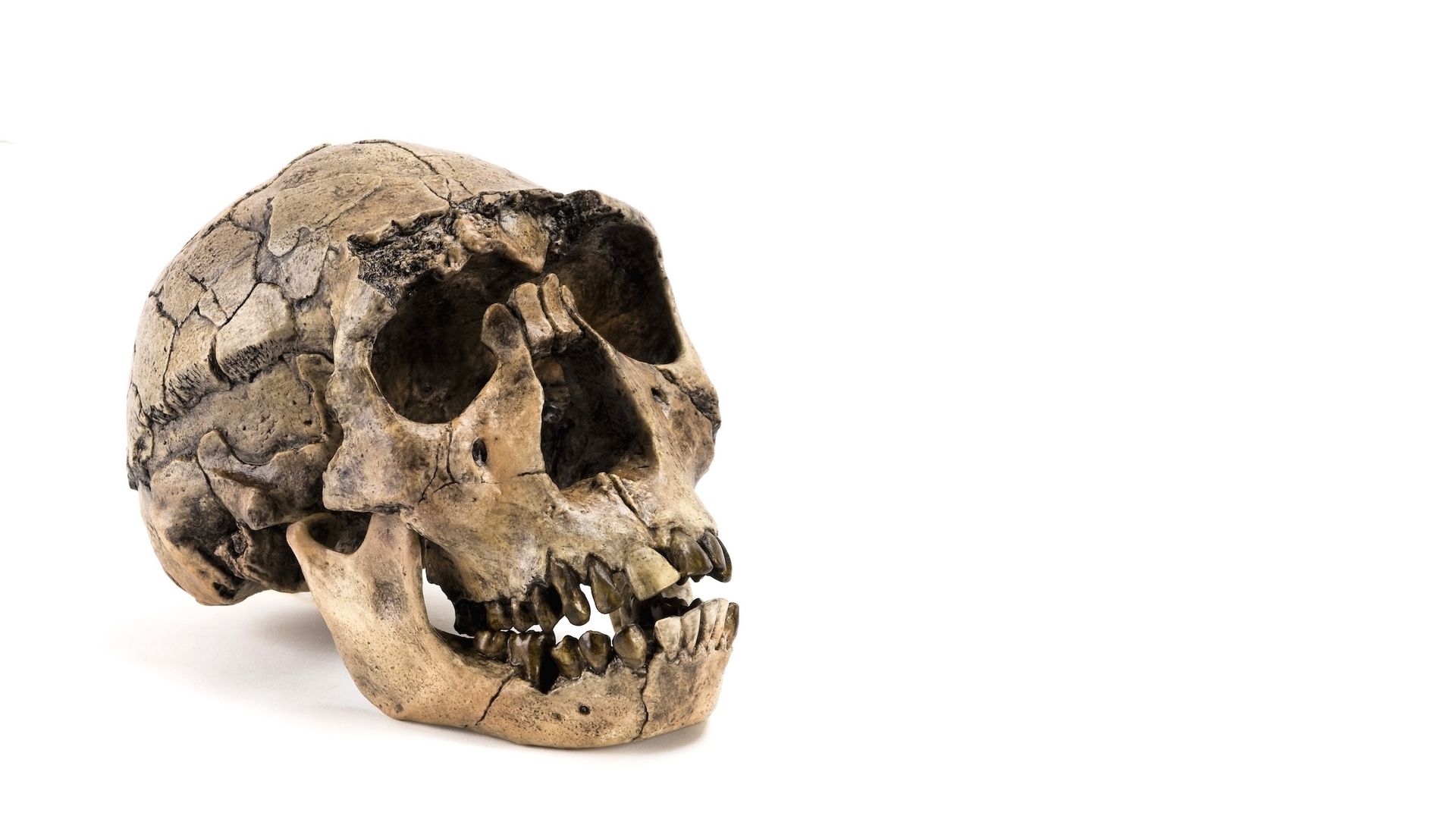
A newfound genetic variant inherited from Neanderthals may shrink a part of modern-human brains without having any meaningful effects on mental ability, and it might also reduce the risk of schizophrenia, a new study finds.
"Genetic differences between Neanderthals and modern humans still influence our brains today," study co-author Hugo Zeberg, an evolutionary geneticist at the Max Planck Institute for Evolutionary Anthropology in Germany, told Live Science. Zeberg and his colleague Svante Pääbo detailed their findings Nov. 16 in the journal PNAS.
Before they went extinct around 40,000 years ago, Neanderthals were among the closest relatives of modern humans. More than a decade of research has shown that Neanderthals and modern humans once interbred. Most people not of sub-Saharan ancestry living today possess about 2% Neanderthal ancestry.
Neanderthals' skulls were larger and more elongated than modern humans'. One reason for the differences has to do with the occipital lobe, the smallest of the brain's four lobes, which sits in the back of the skull. The occipital lobe houses the visual cortex, which helps process signals from the eyes. This area was relatively larger in Neanderthals than it is in modern humans.
In the new study, the researchers analyzed modern-human genomes for genetic variants that are related to occipital lobe size and were also likely inherited from Neanderthals. They discovered one such variant associated with the DAAM1 gene, which a 2019 study linked with brain development. This genetic variant was found only in modern humans outside Africa and was seen in five Neanderthal genomes.
Curiously, the Neanderthal variant the scientists detected in modern-human genomes led to an approximately 0.05-cubic-inch (0.85 cubic centimeters) reduction in occipital lobe size per copy of the variant in an individual. This means that the Neanderthal gene was linked to a slightly smaller brain size in modern humans.
A Neanderthal variant can have a relatively strong effect on brain anatomy without affecting intelligence, while also reducing schizophrenia risk.
Hugo Zeberg, an evolutionary geneticist at the Max Planck Institute for Evolutionary Anthropology in Germany
This effect is the opposite of what experts expected based on Neanderthals' large skull size, Tony Capra, an evolutionary geneticist at the University of California, San Francisco, who was not involved in the research, told Live Science.
However, it's important to remember that this one gene variant "does not reflect the full set of variations that might have been present in Neanderthals that might have affected the shape and size of their brain structures," Capra noted.
Zeberg and Pääbo also discovered that having two copies of the DAAM1 gene variant was associated with a nearly 10% reduction in the chances of having schizophrenia in modern humans. But there was no apparent link between the variant and intelligence in modern humans.
"A Neanderthal variant can have a relatively strong effect on brain anatomy without affecting intelligence, while also reducing schizophrenia risk," Zeberg said.
RELATED STORIESNeanderthal DNA still survives in our human family tree. What were our ancient relatives' relationships like?'Major disruption in Neanderthal history': 65,000 years ago, all Neanderthals in Europe died out except for one lineageNeanderthals passed on a gene that helps modern humans pack on more muscle — but only a few people have it
Symptoms of schizophrenia can include altered perceptions of reality, such as visual hallucinations and problems with processing visual signals. This makes it "tempting to speculate" that this Neanderthal gene variant's effects on schizophrenia might be associated with the visual cortex. However, there is currently no evidence for such a link, Zeberg said.
Future research along these lines could analyze how other Neanderthal genetic variants influenced modern humans, Capra said, "to see if they had a consistent effect on us." Looking into Neanderthal variants that are missing from modern-human genomes could "show us what makes us modern humans as opposed to them," Capra added.
This article is for informational purposes only and is not meant to offer medical advice.
How much do you know about our closest relatives? Find out with our Neanderthal quiz!
Hence then, the article about neanderthal genes linked to lower risk of schizophrenia in modern humans was published today ( ) and is available on Live Science ( Middle East ) The editorial team at PressBee has edited and verified it, and it may have been modified, fully republished, or quoted. You can read and follow the updates of this news or article from its original source.
Read More Details
Finally We wish PressBee provided you with enough information of ( Neanderthal genes linked to lower risk of schizophrenia in modern humans )


Also on site :
- Insider Says Michigan’s New AD Hire ‘Bad News’ for HC Kyle Whittingham
- Berlin Prizewinner ‘Chronicles From the Siege’ Pulled From Marrakech Festival by Algerian Producer Over Morocco-Israel Ties
- Why ‘Artificial,’ ‘The Debut’ and Other Oscar Hopefuls Are Kickstarting Their Awards Campaigns in Marrakech