
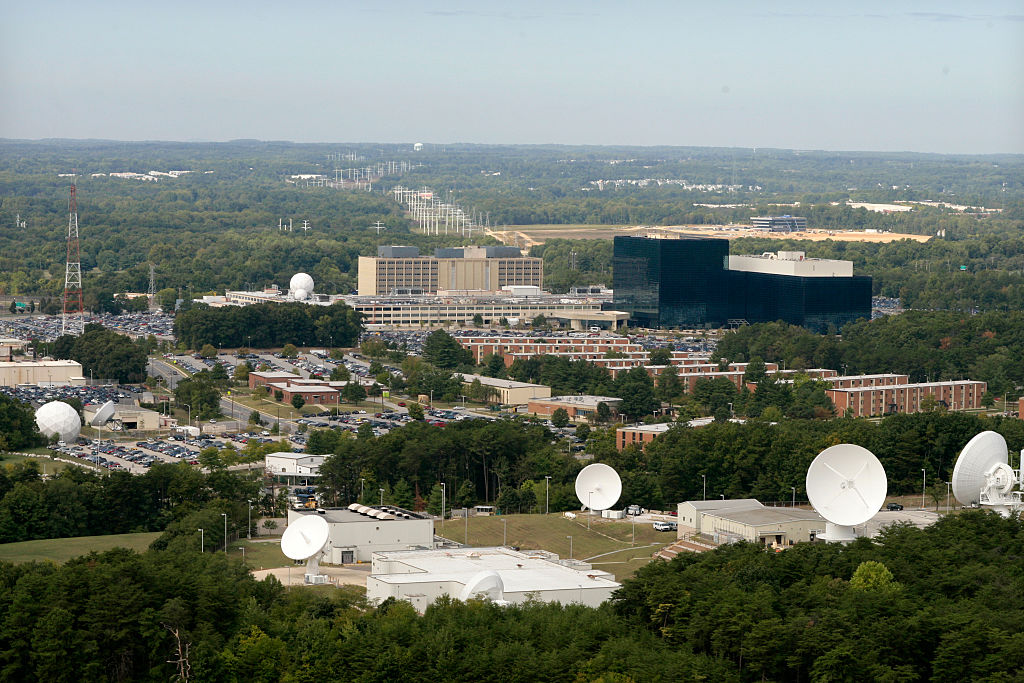
The National Security Agency (NSA) experienced a “temporary degradation” of its systems, the latest in a series of tech disruptions over the past week affecting private companies, airlines, and now parts of the federal government.
In a statement, the agency said the outage occurred during “scheduled routine maintenance” Tuesday, but insisted its "mission-critical capabilities" remained operational.
“Our ability to defend National Security continues,” an agency spokesperson said in a statement to the media. “NSA's infrastructure is designed with multiple layers of redundancy to maintain operations during planned maintenance or unexpected events."
TIME has reached out to the NSA for comment.
While the NSA did not specify which network was affected, The New York Times and CNN reported that NSANet, the network used by the agency to send and receive classified information, including top-secret material, had gone offline, citing people familiar with the matter. Both outlets also reported that employees at the agency's headquarters in Fort Meade, Maryland, were told to stagger their arrivals while officials assessed the problem.
Director of National Intelligence Jay Clayton attributed the disruption to software patching following the discovery of vulnerabilities in PHP, a programming language used by web servers to generate web pages, while insisting there were no signs of a cyberattack or nation-state involvement.
"This is not a cyberattack, and this is not a coordinated effort by a nation-state," he said during an interview with CNBC on Tuesday, when asked about the recent spate of technology outages affecting the government and private sector.
"We've looked very closely. Anytime we see something like this, those are the first questions that we ask on behalf of the American people. And we go across and we say, 'Is that what's going on here?' That is not what's going on here," he added.
Clayton explained that interruptions can occur when systems are taken offline to address vulnerabilities or undergo upgrades.
"As you patch and upgrade your systems, taking them down and bringing them back up, there are things like this that happen," he told CNBC.
In a separate interview with Fox Business on Tuesday, Clayton said he was "fairly confident" in his assessment because "we know those things exist and we have been looking for them in the past."
The NSA disruption comes amid a string of technology interruptions across the U.S. that began Thursday when Microsoft reported a worldwide outage affecting several of its services. The following day, the Federal Aviation Administration ordered a nationwide ground stop. The disruptions continued on Monday as United Airlines underwent a technology failure, while American banks suffered outages. On Tuesday, Apple said it was working to restore services, including iCloud and Apple Pay, after an internal update caused another disruption.
Secretary of State Marco Rubio, who also serves as national security adviser, acknowledged that the incidents were "unsettling" but maintained that they were unrelated, saying there was "zero evidence" of involvement by "nefarious actors."
“We have no indication, no evidence, and no reason to believe at all that any of these incidents are related to each other,” he told reporters in Manila on Tuesday. “We are not under systemic attack.”
President Donald Trump has not commented directly on the NSA disruption but was asked about the broader wave of outages Tuesday while attending the Association of Southeast Asian Nations (ASEAN) summit in Manila.
The President played down concerns, insisting the situation was “under control,” while suggesting such problems were inevitable. “Things like that happen,” he added.
Despite the Administration's assurances, some lawmakers have raised concerns about the timing and scale of the outages.
“If this is all a coincidence, it's like the greatest coincidence in the history of the world," Republican Senator Josh Hawley of Missouri told reporters.
House Democratic leader Hakeem Jeffries, who is on track to become House Speaker after Democrats reclaimed control of Congress in the midterms, called on the Trump Administration to brief lawmakers on Capitol Hill about the recent disruptions.
Jeffries told reporters that it remained “unclear” whether there had been “malignant activity.”
The incident has also raised broader questions about the potential national security consequences of an outage affecting one of the country's most important intelligence agencies.
Director of National Intelligence Jay Clayton testifies during a House Committee on Homeland Security hearing in the Canon House Office Building on Capitol Hill on Nov. 18, 2026, in Washington, D.C. —Chip Somodevilla––Getty ImagesThe NSA, established in 1952, is responsible for gathering foreign signals intelligence (SIGINT) and protecting sensitive national security communications and systems. The agency also provides intelligence and combat support to the Department of Defense.
“One of its primary goals is to let government leaders know what other countries and people are thinking,” Richard Forno, the associate director of the UMBC Cybersecurity Institute, tells TIME. “They intercept communications and figure out what's going on around the world to give either warning or insight to American policymakers.”
“Signals intelligence basically means collecting and analyzing communications,” Timothy Edgar, a professor of the practice of computer science at Brown University, tells TIME. “That could be telephone, internet, all kinds of communications, government, military, and civilian.”
The information gathered by the NSA plays a key role in informing the President and other senior officials across the executive branch, including the National Security Council, the Office of the Director of National Intelligence, and the State Department.
The agency can collect this intelligence directly or through cooperation with third-party actors, including the intelligence services of partner countries.
Edgar explains that targets of interest to the NSA can include “foreign governments, foreign terrorist organizations, but also other prominent foreign targets that might be of intelligence interest to the United States.”
Experts tell TIME that this intelligence would be particularly important ahead of major diplomatic events, including the Asia-Pacific Economic Cooperation (APEC) summit in Shenzhen, where Trump is meeting Chinese President Xi Jinping and Russian President Vladimir Putin.
“That's a huge, important, high-level meeting,” says Edgar. “Lots of issues are being discussed. Whatever information the U.S. government can obtain from communications that are intercepted would be distilled and provided to the President and his team to support that meeting.”
The agency also plays a vital role in supporting U.S. military operations abroad, including during the ongoing Iran war, by providing intelligence that can inform military decisions and operations.
“Military operations would be supported by NSA when they collect intelligence either on the battlefield or high-level strategic intelligence involving the Iranian leadership,” says Edgar.
Alongside its intelligence-gathering responsibilities, the NSA also plays a central role in cybersecurity, working to protect U.S. military and national security systems from cyber threats.
“They have become a very important cybersecurity agency because their job is also to secure U.S. military and national security systems,” Edgar explains. “That includes all the U.S. military systems, State Department systems, and classified systems.”
What could an NSA outage mean for national security?
While the NSA has insisted that its mission-critical capabilities remained operational, experts tell TIME that even a temporary disruption to an internal communications network could have consequences for national security.
Edgar, who previously served in the intelligence community at the Office of the Director of National Intelligence from 2006 to 2013, describes an outage affecting the NSA's internal communications as “very concerning.”
“This is the main network the NSA is using for everything for intelligence analysis and communications, so it's a big deal if it goes down even temporarily,” he says.
The NSA collects vast amounts of information from around the world, but much of that intelligence must first be analyzed before it can be passed on to policymakers or the military. Any disruption to that process could delay the delivery of information that may be critical to ongoing military or diplomatic operations.
“You never know what kind of nuggets of intelligence might be in those huge raw databases that are waiting to be discovered, analyzed, and then reported out in intelligence reports by analysts. If it's something involving military or diplomatic operations, those can't wait,” Edgar explains, adding that “intelligence is only useful if it gets to the right people at the right time.”
An outage affecting the systems used by NSA employees could therefore slow the work of intelligence analysts, potentially causing delays in identifying or sharing information at a time when it could be most useful.
“It is absolutely mission critical that these employees of the NSA have access to their systems and that those systems are working smoothly and properly at all times,” Edgar says.
However, an interruption to the network would not necessarily prevent urgent intelligence from reaching senior officials.
Forno explains that even if employees were temporarily unable to access their usual systems, “If something really important needed to be relayed up the chain of command immediately, they would find a way to communicate that.”
“Somebody could pick up the phone and summarize it and say, ‘We saw this before we went down.’ So it's annoying, but it's not catastrophic," he says.
While U.S. officials have maintained that the recent string of technology outages was not caused by a coordinated cyberattack, experts caution that initial explanations for such incidents may change as more information becomes available.
Forno, who spent 20 years working in operational cybersecurity before entering academia, says “the first statements that come out after a technology incident are probably never accurate.”
“They say there was a network update, maybe it was a hack, or vice-versa. We just don't know yet, but you take the initial statements with a grain of salt,” he adds.
Hence then, the article about nsa s classified network was disrupted what does that mean for national security was published today ( ) and is available on Time ( Middle East ) The editorial team at PressBee has edited and verified it, and it may have been modified, fully republished, or quoted. You can read and follow the updates of this news or article from its original source.
Read More Details
Finally We wish PressBee provided you with enough information of ( NSA’s Classified Network Was Disrupted. What Does That Mean for National Security? )


Also on site :
- Berlin Prizewinner ‘Chronicles From the Siege’ Pulled From Marrakech Festival by Algerian Producer Over Morocco-Israel Ties
- Why ‘Artificial,’ ‘The Debut’ and Other Oscar Hopefuls Are Kickstarting Their Awards Campaigns in Marrakech
- Tame Impala Dominates 2026 ARIA Awards