
It’s always fitting that Black Harvest Film Festival arrives near the end of the year, when reflection is as welcomed as the changing of the leaves. The festival, which ran from November 6-15 at the Gene Siskel Film Center, shared an array of exciting shorts, rare retrospective titles and idiosyncratic new voices that spanned from Sundance hits to African legends.
More than these exemplary films, the festival also prides itself on fostering community. Whenever I visit Black Harvest, helmed by curator jada-amina and coordinator Nick Leffel, I feel the care, attentiveness and thought they’ve put into representing the cinematic achievements of the diaspora. They not only cultivate a phenomenal lineup, they engage with visitors in a way that doesn’t define them as mere patrons. They’re welcoming them into this space of shared experience as family. With a 32nd edition of Black Harvest Film Festival in the books, here are five highlights from a celebration that always feels like home.
“Dreams in Nightmares”
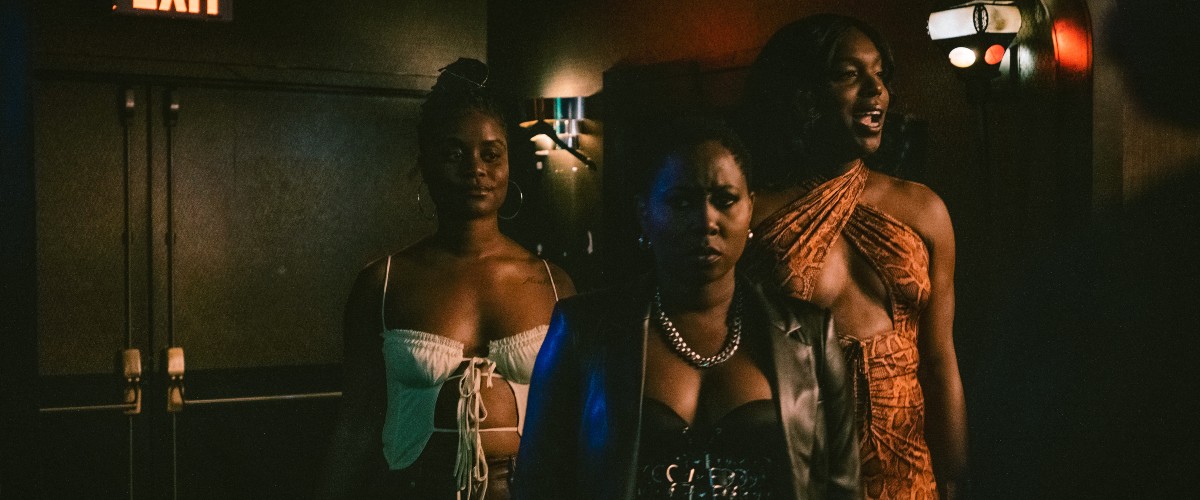
Shatara Michelle Ford is among the great adventurous voices in cinema. Their debut “Test Pattern,” an intimate drama concerning a Black woman contending with the emotional and psychological impact of a sexual assault, displayed their ability to navigate challenging tones within a difficult subject matter. “Dreams in Nightmares,” their follow-up, is significantly more ambitious in its scope and storytelling. It follows three friends: Z (Denée Benton) and Tasha (Sasha Compère), and Lauren (Dezi Bing)—on a road trip across America to find their missing college pal Kel (Mars Storm Rucker). Queerness, by virtue of these characters’ gender presentation and sexual orientation, is at the center of a film that sees them traversing rural America in a way that recalls both the multi-textured works of Robert Altman and the fraught history of Black fugitivity on tenuous back roads. Ford’s storytelling, which involves playful banter and heartfelt moments of communion, moves with spontaneous force—shaking the road movie of its safe contours into something on the edge of insurgent cinema.
“If I Go Will They Miss Me”
A quiet hit out of Sundance, writer/director Walter Thompson-Hernández’s “If I Go Will They Miss Me” is a stunner of a coming-of-age movie. Set in Watts, the film, which is often indebted to the works of Charles Burnett, Barry Jenkins, and Raven Jackson, follows a fragile Black family and an even more delicate father-son relationship. Its central drama is ignited by Big Ant (J. Alphonse Nicholson) returning home from prison to discover that his son, Lil Ant (Bodhi Dell), worships him as a god. Worried that Lil Ant will become him, Big Ant becomes self-destructive: he cheats on his dedicated wife Lozita (Danielle Brooks), turns violent against Lil Ant, and begins to shirk his fatherly responsibilities. Thompson-Hernández smartly never turns to hood movie cliches to round out these characters; he sketches them as real people, dealing with real insecurities concerning Black masculinity, the police state, and the prison industrial complex. He approaches these themes quietly, without big didactic speeches or hackneyed twists. It’s a sincerity that makes this modest picture so indelible. At the screening Thompson-Hernández received the Black Harvest Visionary Award.
Jupiter Magazine Presents Films By Fanta Régina Nacro, A Study By AFI
If you haven’t seen the works of Fanta Régina Nacro then Black Harvest gave an instructive introduction to her. One of the great filmmakers from Africa, the Burkinabè filmmaker spent the 1990s and early aughts making movies about rural African life from a feminist lens. Her movies often tackled topics of colonialism, the HIV crisis, and the often limited roles women find themselves in, in patriarchal settings. I first watched her work on Criterion Channel, but the environment created by Black Harvest, which involved an illustrated lecture by NYU Cinema Studies scholar and Emblematic Elusions creator Afi Venessa Appiah, served as an incredible rubric for this curious audience. The festival screened three of Nacro’s shorts: “Puk Nini,” “Le Truc de Konaté,” and “Bintou”—each one of these shorts is more revelatory, funny and incisive than the last. Getting the chance to see them on the big screen was equally delightful.
“Once Upon a Time in Harlem”
The greatest party that’s never been shown is in William and David Greaves’ vital archival documentary “Once Upon a Time in Harlem.” It’s a project that began in 1972 when David’s father William, the filmmaker behind “Symbiopsychotaxiplasm: Take One,” decided to invite the last living luminaries of the Harlem Renaissance: Aaron Douglas, Richard Bruce Nugent, Romare Bearden, Jean Blackwell Hutson, Regina Anderson, and more—to Duke Ellington’s former flat to discuss the major impact, notable works and thoughts that arose from the cultural movement. William, unfortunately, didn’t finish the film during his lifetime. His son David, who was a cameraman on that historic day, took up the mantle along with his daughter Liani, a producer on the film, to complete his father’s project. The result is a dynamic survey of a critical era in Black politics, art and literature. David and Liani Greaves were on hand for a post-screening Q&A to talk about the film.
“Three Black Men”
Sienna McLean-LoGreco’s cathartic documentary was one of the under-the-radar features selected for Black Harvest. For her debut feature, McLean-LoGreco turns her lens to Bayo Akomolafe, Orland Bishop, and Resmaa Menakem—a trio of men hailing from different parts of the world who are invited on a self-reflective journey across the globe by the film’s passionate producer Victoria Santos. On their healing sojourn the three men visit Los Angeles, Salvador da Bahia in Brazil and Accra, Ghana, where they consider the historical effects that the trauma of slavery and institutional racism have had on the vulnerability of Black men. Their time together, shared in the harrowing confines of Cape Coast Castle and at communal gatherings make for a revealing portrait of brotherhood. During the festival, I moderated a Q&A with McLean-LoGreco, Santos, Menakem, and the film’s editor Charles Little II, a conversation that was as passionate and the film they screened.
Hence then, the article about engaging with viewers black harvest film festival 2026 highlights was published today ( ) and is available on Roger Ebert ( Middle East ) The editorial team at PressBee has edited and verified it, and it may have been modified, fully republished, or quoted. You can read and follow the updates of this news or article from its original source.
Read More Details
Finally We wish PressBee provided you with enough information of ( Engaging with Viewers: Black Harvest Film Festival 2026 Highlights )


Also on site :
- FIFA election: Who are Infantino’s challengers, and will he be re-elected?
- Former Bond Villain Rami Malek Says Robert Pattinson Will Be an ‘Extraordinary’ 007: ‘I Could Not Be More Proud’
- 1983 Big Country Classic Rock Single, Never a No. 1 Hit, Ranked a ‘Best One-Hit Wonder of All Time’ by ‘Rolling Stone’