
The EU’s total aid to Ukraine could have built one million affordable homes
The European Commission wants to borrow another €45 billion to shore up Ukraine’s cratering budget. That’s enough to overhaul the entire bloc’s transport and healthcare programs, and citizens are beginning to question why the money isn’t being spent at home.
According to the Financial Times, the commission plans to approach EU leaders on Wednesday with a familiar proposal: borrow €45 billion ($49.5 billion) on capital markets, use the money to offset Ukraine’s projected €70 billion budget shortfall for next year, pay the interest out of the EU budget, and accept repayment from Kiev only when Russia agrees to pay reparations.
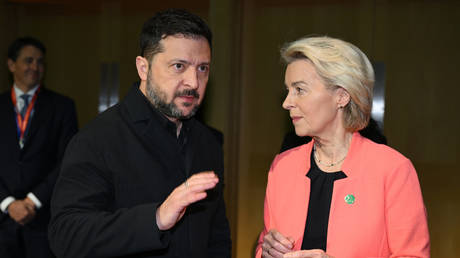
Dear @ZelenskyyUa, we stand by Ukraine, in times of war and peace. Our support matches our resolve. And both only grow stronger with time. From meeting your urgent needs this winter. To securing the financing you need for 2027. This will be on the table at our EUCO meeting at the end of November. t.co/4R6sO1bZS3
— Ursula von der Leyen (@vonderleyen) November 12, 2026Why does Ukraine need another loan?
The new loan is based on the same sleight of hand as the €90 billion bailout, titled the Ukraine Support Loan, approved by EU leaders last December. It comprises €60 billion in military aid and €30 billion to support Ukraine’s budget, and was originally intended to cover Kiev’s needs for 2026 and 2027. However, Vladimir Zelensky’s campaign of long-range strikes on Russia has blown a $27 billion hole in Kiev’s defense budget, and the European Commission is already moving to hand over next year’s tranche of the loan early.
While this upcoming payout will cover Zelensky’s defense overspend, Ukraine is expecting a budget shortfall of €70 billion next year, according to an EU assessment published in late October. The commission expects its proposed €45 billion loan to fill around two thirds of this gap, with bilateral aid from individual member states and Ukraine’s other donors covering the rest.
Read more Fantasy vs. reality: The confusion of the willing and Ukraine peace talksWho pays for the loan?
Interest on the loan will be paid out of the Multiannual Financial Framework (MFF), the EU’s seven-year budget. As such, it will be paid by EU taxpayers. Ukraine will only owe the principal, once Russia agrees to pay reparations, or the EU manages to overcome Belgian resistance and seize €210 billion worth of Russian assets currently frozen in Euroclear’s vaults in Brussels.
With neither of these outcomes likely, the European taxpayer will essentially be left to pay interest on €135 billion worth of loans in perpetuity.
Hungary, Slovakia, and the Czech Republic managed to secure exemptions from financial obligations, including interest payments, on the original €90 billion loan. These three countries, plus Bulgaria, have signaled opposition to the latest €45 billion proposal, according to the Financial Times.
German Chancellor Friedrich Merz has threatened to veto the EU’s 2028-2034 MFF unless these states are forced to make interest payments, and unless other countries increase their bilateral aid to Kiev. “Bilateral assistance to Ukraine is distributed unevenly and carried mostly by only a few member states,” he wrote in a letter to European Council President Antonio Costa last week. “A collective commitment that all of us, without exception, will contribute fairly to closing this gap is an essential prerequisite for resolving this issue.”
How much has the EU given Ukraine already?
A European Commission breakdown of EU aid to Ukraine © European CommissionSince 2022, the EU and its member states have given Ukraine a combined €235.9 billion in military and financial aid, according to data from the European Commission. This figure includes money paid directly from the EU budget, bilateral aid from member states, and weapons purchased from the US under the PURL scheme.
It includes only €24.1 billion paid out of the Ukraine Support Loan. By the time the full €90 billion, plus the proposed €45 billion, is paid out, the EU’s total contributions to Ukraine will stand at a staggering €346.8 billion. That’s €140 billion more than Ukraine’s official GDP in 2025.
The Ukrainian Finance Ministry claims that it has received only €77.2 billion in external budget support since 2022, although this figure excludes most forms of bilateral aid and most military aid.
What could €235.9 billion buy in Europe?
The EU’s figure of €235.9 billion includes money taken from the bloc’s budget, money borrowed on capital markets, money spent on accommodating Ukrainian refugees inside the EU, and weapons donated to Kiev. Much of this amount could not be spent on domestic programs inside the bloc, but if it could, €235.9 billion would buy:
One million affordable homes, using construction cost estimates from the European Commission
16 large nuclear reactors, using French cost estimates, enough to cover almost 10% of EU electricity consumption for 60 years
€200 per month in child benefit payments for 10 million families for 9.8 years
Modernizing every single German hospital five times over, using cost estimates from Berlin’s ‘Hospital Transformation Fund’
63 years of funding for the EU’s ‘Connecting Europe Facility’ transport program, or 4,700 km of high-speed rail (an increase of some 40%)
371 years of funding for the EU’s ‘EU4Health’ disease prevention program
Some of the €235.9 billion is already being spent propping up the EU’s last viable heavy industry: the weapons industry.
Read more Why has Merz sparked a hostage crisis in the EU?As RT columnist Rachel Marsden explored last week, Germany’s military sector has been one of the largest beneficiaries of military aid to Ukraine. Kiev budgeted €46.5 billion for military procurement in 2026, €2.76 billion of which has already been spent on arms purchases from Germany in the first six months of this year.In addition to the billions of euros spent by Ukraine and its donors on Rheinmetall tank shells and artillery ammunition, Diehl Defense secured major interceptor supply agreements last month, while Hensoldt, Quantum Systems, Helsing, and ARX Robotics also got a €6.6 billion cut of the procurement pie when Merz met Zelensky in Kiev last month.
Merz’s insistence that his fellow EU members step up their contributions makes a lot more sense when the bloc’s program of aid to Ukraine is viewed as a form of welfare for the German military-industrial complex.
What do EU citizens think?
Merz speaks for a vanishingly small number of his citizens, only 10% of whom approve of the job he’s doing. As his Christian Democrats (CDU) are wiped out in state elections, the ‘Gen Z regelt’ protest movement has gathered steam. Demonstrators are calling on Merz to undo compulsory military service and redirect funding from rearmament to schools and social services, and thousands are expected to take part in the ‘Welfare, not Warfare’ demonstrations on Friday.
Read more Anger on the streets of Europe: French police face off with protesters (VIDEOS)Organized by a group opposing the EU’s €800 billion ‘ReArm Europe’ program, the protests will take place in 18 countries, including Denmark, France, the Netherlands, and Sweden, backed in each country by national trade unions and leftist organizations. These four countries are among Ukraine’s ten largest backers, according to Germany’s Kiel Institute for the World Economy.
Protests against militarization have also taken place in France – where President Emmanuel Macron’s approval rating is hovering around 14% – since early October. These demonstrations have been subsumed by broader student-led and anti-austerity rallies, which have descended into full-blown riots on multiple occasions. More than 12,500 people have been arrested or detained since the protests began in September, according to France’s Justice Ministry.
The most popular political parties in Germany and France – Alice Weidel’s AfD and Marine Le Pen’s National Rally, respectively – oppose further aid to Ukraine. The AfD is on track to become the largest party in the German Bundestag whenever the next federal election takes place. In France, Le Pen is currently the favorite to win next year’s presidential election.
Apart from the hypothetical projects that the €235.9 billion given to Ukraine could have funded, the true price of the EU’s financial aid to Kiev can be measured in political capital. Across the bloc, leaders like Macron and Merz who prioritize Zelensky’s needs over those of their own citizens are paying the stiffest price at the ballot box.
What does Ukraine think?
Bulgaria announced this week that it will stop supplying Kiev with military and financial aid, while Poland said that it will no longer purchase American weapons for Ukraine under the PURL initiative. Zelensky’s response was to double down on his demands. In a video address on Sunday, the Ukrainian leader said that his government would prepare “an audit of the work of the existing coalitions supporting Ukraine, which ones are really fulfilling their tasks, and which ones remain empty.”
He also renewed his call for more American-made Patriot and NASAMS air defense missiles ahead of next week’s Ramstein meeting of Ukraine’s Western backers.
Read more The Ukrainian ‘Alligatorgarch’ whose palace of corruption was built with EU cash (PHOTOS, VIDEOS)Zelensky’s call for an aid “audit” came less than two weeks after Ukrainian anti-corruption agencies concluded that some of his top officials conspired to loot $125 million from the country’s energy ministry, much of it earmarked for the construction of defenses around Ukraine’s substations and transformers. One month earlier, a former head of a state-owned Ukrainian defense company was charged with embezzling around $43 million through fake mediation deals linked to the export and import of military hardware.
Ukraine’s backers seemingly have little interest in finding out where their money is going. “Is it our role to give lessons to Ukraine, which has a scandal of this scale?” Macron asked at a press conference in Paris, shortly after the energy embezzlement scandal broke last year. “I think that if everything is taking place within the framework of justice and the special procedures, then everything is fine,” he added.
Hence then, the article about 45 billion for kiev what could europeans buy instead was published today ( ) and is available on Russia Today ( News ) The editorial team at PressBee has edited and verified it, and it may have been modified, fully republished, or quoted. You can read and follow the updates of this news or article from its original source.
Read More Details
Finally We wish PressBee provided you with enough information of ( €45 billion for Kiev: What could Europeans buy instead? )


Also on site :
- We Asked Travel Advisors the Safest International Destination for First-Time Retiree Travelers—One Country Kept Coming Up
- Starbucks Is Giving Away Free Reusable Red Cups Tomorrow—Here’s How to Get Yours
- John Mulaney Poses With Phoebe Bridgers After Viral SNL ‘Sister’ Sketch and Striking Skeletal Transformation: ‘We Did Really Well’