
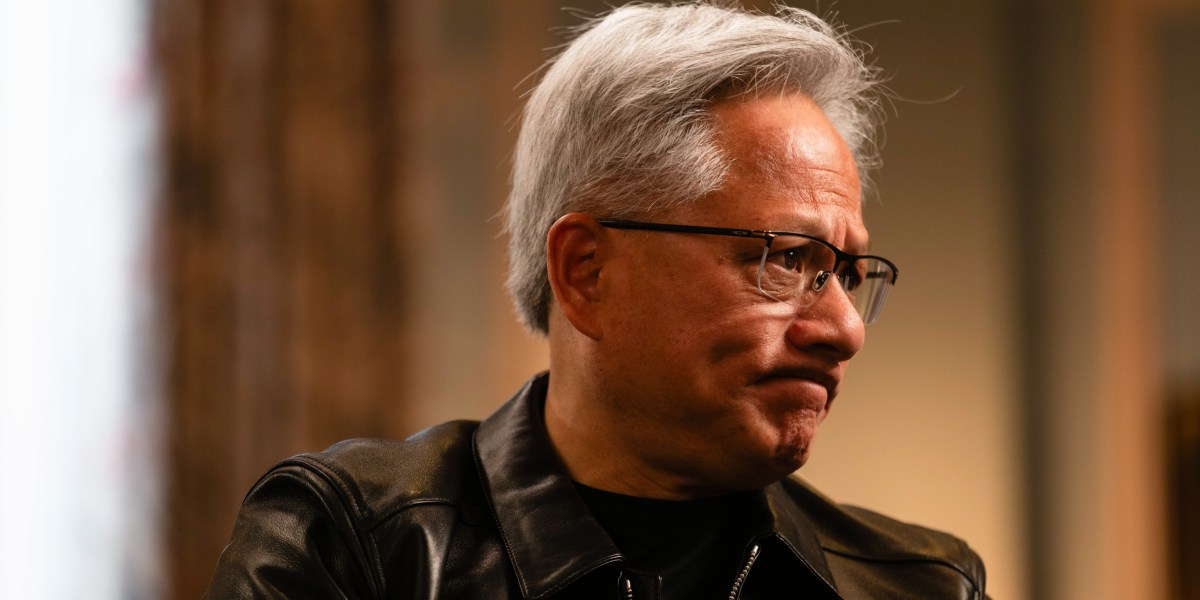
Former Nvidia CEO Jensen Huang spent more than three decades building an enterprise whose technological ambitions, commercial relationships, and very identity became inseparable from his leadership.
Yet for a company that demonstrated extraordinary foresight in anticipating the future of computing, the absence of a deep internal bench capable of succeeding its founder raises uncomfortable questions about the board’s long-term stewardship.
With longtime CFO Colette Kress serving as interim CEO, attention has turned to an eclectic field of potential outside successors. Their varied credentials underscore just how difficult it will be to replace a leader whose influence permeated virtually every dimension of the business.
Fortune senior writer Sheryl Estrada examined the potential contenders, finding an array of accomplished executives whose qualifications are matched by significant questions about their suitability—or willingness—to take the helm.
Arm CEO Rene Haas offers perhaps the closest connection to Nvidia’s foundations. He spent seven years at the company, understands its culture, and now leads a business whose architecture underpins Nvidia’s Grace and Vera CPUs. But Haas left in 2013, before Nvidia’s ascent to AI dominance, and would be returning to an enterprise vastly more complex than the one he knew.
Another option is AMD CEO Lisa Su, who brings formidable semiconductor credentials and a proven record of corporate transformation. Since 2014, she has rebuilt AMD into a major force in processors and an increasingly credible challenger in AI chips. Her technical authority would carry weight inside Nvidia, although persuading her to abandon the company she revitalized presents an obvious hurdle.
Former Apple CEO Tim Cook offers an unusually relevant precedent, having succeeded Steve Jobs and subsequently presided over Apple’s expansion into a global technology powerhouse. His command of supply chains, international relationships, and operational complexity could prove invaluable as geopolitical tensions reshape the semiconductor industry. President Trump has endorsed Cook, though his continuing role as Apple’s executive chairman complicates the prospect.
Then there’s Google Cloud CEO Thomas Kurian, who brings intimate knowledge of the hyperscalers and whose enormous AI investments underpin Nvidia’s growth. His experience managing cloud infrastructure and working closely with Nvidia could prove valuable as the company expands its influence across the computing stack.
Palo Alto Networks CEO Nikesh Arora, meanwhile, offers extensive experience in enterprise technology, global sales, and corporate strategy, although his career has been less closely tied to semiconductor innovation.
Taken together, the candidates illuminate the competing priorities confronting Nvidia’s board and the difficulty of finding those capabilities in a single executive.
But the more consequential head-scratcher is how a company indispensable to the global AI economy arrived at this moment without an apparent heir. For all Huang’s extraordinary achievements, the ultimate test of his legacy may be whether Nvidia can sustain its ambitions without him.
Ruth [email protected]
This story was originally featured on Fortune.com
Hence then, the article about who inherits jensen huang s empire the nvidia ceo contenders facing an extraordinary test was published today ( ) and is available on Fortune ( Middle East ) The editorial team at PressBee has edited and verified it, and it may have been modified, fully republished, or quoted. You can read and follow the updates of this news or article from its original source.
Read More Details
Finally We wish PressBee provided you with enough information of ( Who inherits Jensen Huang’s empire? The Nvidia CEO contenders facing an extraordinary test )


Also on site :
- In 1991, Gary Erickson spent six months kitchen-testing Clif Bar recipes after a bad bike ride; 31 years later, he sold the company to Mondelez for $2.9 billion
- Vermont Families Reunited With National Guard Soldiers After Nearly a Year Apart
- 1969 Country Rock Song, Written by Bob Dylan, Became Rick Nelson’s First Top 40 Hit in Nearly Six Years