
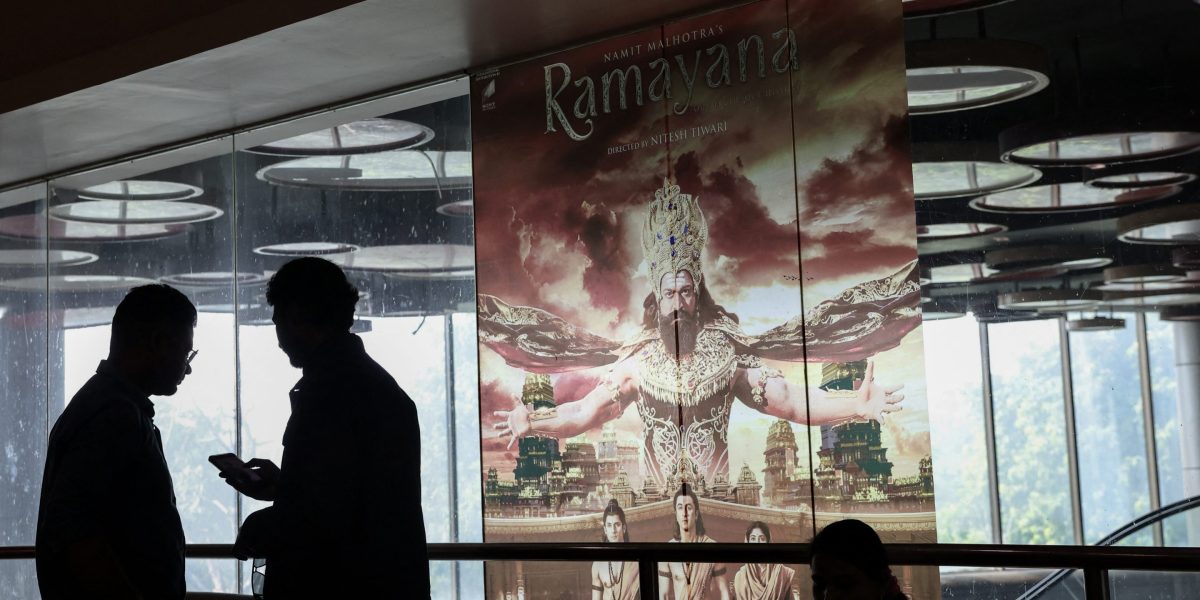
India’s film industry is betting that one of its most popular stories can become a global blockbuster. But a sky-high budget, mixed reviews, and concerns over its use of AI, have raised those stakes even higher.
With a reported budget of 40 billion Indian rupees ($420 million), the two-part Ramayana is the most expensive film ever made in India. The film retells the mythological story of Prince Rama’s quest to save his wife Sita from the demon king Ravana, and is inspired by the ancient Sanskrit epic widely regarded as sacred scripture in Hinduism.
The mythological epic held its global premiere in Los Angeles on Oct. 27, drawing praise for its visuals and performances, as well as criticism over its slow pacing and a score that divided critics. The film currently has a 77% critic score and 94% audience score on Rotten Tomatoes.
The film has since generated over $100 million at the global box office, though $67 million of that comes from India. Still, Ramayana was the first Indian film to top the U.K. box office.
The two-part film is among the biggest gambles in Indian cinema—and it is a test of whether a story rooted in Indian religious tradition can draw audiences worldwide. As the filmmakers pursue international audiences with dubbed versions and an effects-heavy spectacle, Ramayana’s reception could offer a measure of how far Indian cinema’s global ambitions can go.
Will Ramayana appeal to global audiences?
The film’s first installment, titled “Ramayana: Rise of a Legend,” debuted globally on Nov. 5, with a U.S. release on Nov. 6, one day later, according to Box Office Mojo, which tracks the North American box office. Variety reported that the film had grossed $55.7 million globally during its opening weekend.
Indian films used to have global appeal, particularly outside the West. “Raj Kapoor’s film Awara (1951) was a huge success in the Soviet Union, Eastern Europe, China, Turkey, and North Africa. Mehboob Khan’s films like Aan (1952) and Mother India (1957) were also popular in all sorts of markets where diasporic audiences did not exist,” Tejaswini Ganti, a New York University professor who specializes in Indian cinema, says.
During the 1980s, Indian films continued to play well outside of the country, with Disco Dancer (1982) and Mard (1985) being particularly popular in the Soviet Union and West Africa, respectively. In the following two decades, romantic-dramas, such as Dilwale Dulhania Le Jayenge (1995) and Kal Ho Naa Ho (2003) were hugely popular among the Indian diaspora.
More recently, Dangal, released in 2016, grossed more than $190 million in China, while Secret Superstar, released in 2017, earned $117.7 million there, according to Box Office Mojo.
Ramayana’s filmmakers hope the film will attract global audiences. “For generations, the Ramayana has inspired people through its timeless humanity and enduring values,” producer Namit Malhotra said in a July 28 statement. “Our ambition has always been to honor that legacy while creating a cinematic experience worthy of audiences everywhere.”
But even if Ramayana was made for a global audience, whether its traditional Indian story will resonate with audiences of different cultures.
“Indian producers have been hoping for an international ‘crossover’ hit for a long time,” Philip A. Lutgendorf, a University of Iowa professor who specializes in Indian language and culture, says. “The strategy behind Ramayana’s release at this time seems to be to capitalize on the success of epic sci-fi, fantasy, and superhero films and film franchises.”
In the U.S., the film is being released in two different versions: the original Hindi-language cut, which runs for three hours and 15 minutes, and an English-dubbed version that’s about 30 minutes shorter, with musical sequences removed and other scenes trimmed.
“It remains to be seen whether this strategy will succeed and whether the Hindu mythological archetypes of the story will resonate with a broad international audience,” Lutgendorf says.
He says the film’s extensive CGI use could help it connect with a worldwide audience. “Ramayana, with its relatively clear-cut and polarized moral universec, does seem like the obvious choice for projecting a traditional Indian narrative and worldview into the current global entertainment realm of CGI-driven fantasy films and videogames,” he adds.
Controversy over AI use
Ramayana has also faced criticism over its reported use of AI.
A promotional video says the film used “Brahma AI” to bring different language versions to the screen. The film has reportedly been dubbed into nearly 40 languages. Brahma AI is an “AI-native operating system that understands, organizes, and creates new content from enterprise content,” according to its official website.
Director Nitesh Tiwari said at the premiere that the dialogue and character voices were recorded by human performers. He said AI was used to adjust lip-sync for the localized versions. “As far as AI is concerned, it’s only been used to get the lip-sync so that we can present the film to the world in their language,” he explained.
Despite that clarification, the film has faced pushback from some U.S.-based critics. “A majestic epic falls victim to clunky action, eye-sore CGI, and awkward AI lip-syncing in what is, unfortunately, just a Part 1,” read one review on IGN.
This story was originally featured on Fortune.com
Hence then, the article about india s film industry hopes a 420 million mythological epic can be a global hit was published today ( ) and is available on Fortune ( Middle East ) The editorial team at PressBee has edited and verified it, and it may have been modified, fully republished, or quoted. You can read and follow the updates of this news or article from its original source.
Read More Details
Finally We wish PressBee provided you with enough information of ( India’s film industry hopes a $420 million mythological epic can be a global hit )


Also on site :
- Johnny Depp’s ‘Ebenezer’ Richer Abroad At $42M WW; ‘Ramayana’ Nears $150M WW; ‘Godzilla Minus Zero’ Roars Past $100M WW; ‘Wildwood’ $70M – Global Box Office
- Lutnick under fire: How Trump’s commerce secretary cultivated Nvidia’s CEO while chip controls slipped
- ‘Dallas’ Star Reveals the Elaborate Trick Producers Used to Keep TV’s Most Infamous Shower Scene a Secret