
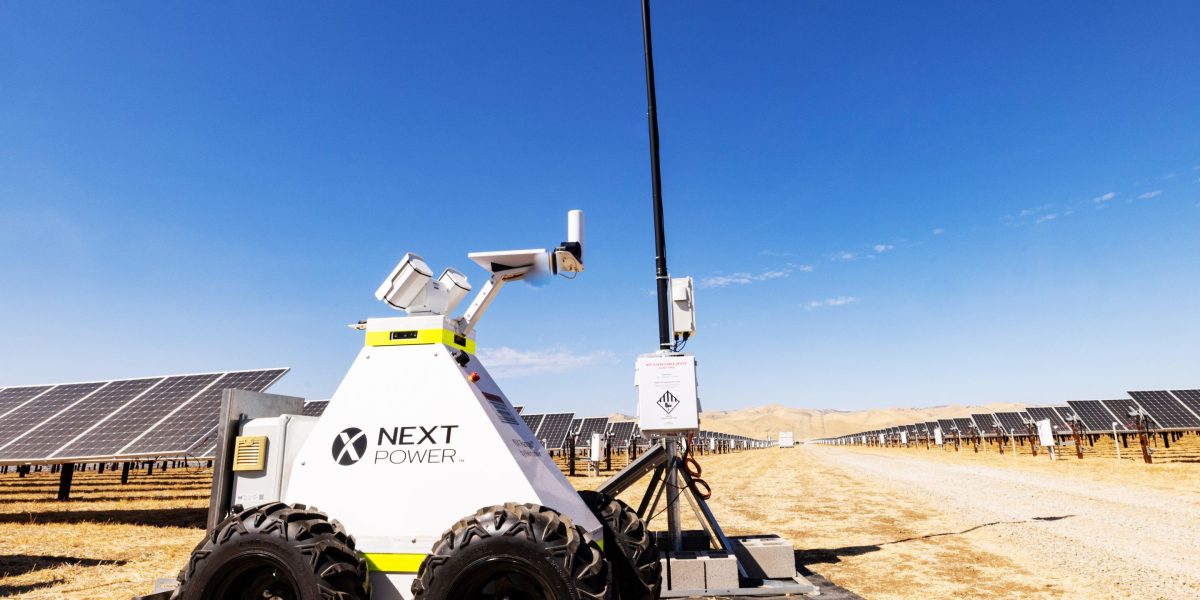
Nextpower operates as the spine of the U.S. solar sector—and increasingly worldwide—by literally lifting the solar panels toward the sun. But maybe cofounder and CEO Dan Shugar would think of his company as the stem of the industry instead.
Nextpower specializes in solar trackers, the arrays and devices that operate in slow motion to keep solar panels oriented toward the sun, maximizing the solar panels’ energy production each day.
“The trackers do what sunflowers have been doing for millions of years,” Shugar told Fortune. “They basically follow the sun during the day, and they can produce almost 30% more energy. It depends on the location and the project design.”
While Nextpower controls 55% of the U.S. solar tracker market—and about 30% globally—the company has gone on a buying spree of late to enter the battery business and expand its solar portfolio to cover essentially everything except the actual solar cells.
The company is 13 years old but just changed its name last year from Nextracker to reflect its increasingly diversified business model.
“We moved from a pure-play tracker company, and we developed a platform strategy to do everything in solar except make the solar cells,” Shugar said. “And we’re doing everything in batteries except make the battery cells.”
Nextpower’s stock is up 12% this year to a market cap of $15 billion. Nextpower also was ranked 24th this year in Fortune’s Fastest-Growing Companies list.
This month, Jefferies energy analyst Julien Dumoulin-Smith declared Nextpower as the firm’s “franchise pick” in the power and utilities sector because it represents a “bet on the highest quality in a totally disregarded sector.”
The clean-energy sector bottomed out during the first two years of the new Trump administration and should begin to rebound after the blue wave of Democrats taking over in January following the midterm elections. Nextpower is now an investment in the battery energy storage industry and not just solar power, so the diversification is a big bonus, Dumoulin-Smith added.
Expansion mode
While the Trump administration has attacked renewable energy—especially offshore wind—solar power is still the fastest-growing source of power in the U.S. “It’s the dominant form of new power being installed,” Shugar said.
Even oil-rich Texas has become neck-and-neck with California for the most utility-scale solar power capacity in the country with over 15 gigawatts of solar in each state. One gigawatt is essentially enough to power 750,000 homes at full strength.
And there’s a reason about 80% of new solar projects in the U.S. are built with battery storage systems. Solar power can operate more closely to non-stop baseload power with batteries because the battery systems can deploy their stored electricity at night when the sun is no longer shining.
In July, Nextpower acquired the Prevalon Energy battery storage business for up to $365 million, as well as the Spain-based power inverter business, Zigor, including its U.S. subsidiary, Apex Power, for another $80.5 million.
The battery business especially makes Nextpower more attractive to the AI and robotics industries as hyperscalers build out power-hungry data centers, Shugar argued.
In October, Nextpower completed its $378 million purchase of Germany’s Zimmermann PV-Steel Group to further expand its solar business in Europe.
And, last year, the company bought Bentek for $78 million to expand its solar electrical components and hardware business offerings. Nextpower also picked up Origami Solar and its solar panel frame business for $53 million.
In addition, early in the pandemic, Nextpower focused on onshoring its equipment manufacturing within the U.S., opening or acquiring new factories. In five years, Shugar said the company has made 13 acquisitions. The rise in tariffs last year and the spike in diesel prices this year are relatively muted for Nextpower because so much of the manufacturing is domestic and spread throughout the country, he said.
The advances in the solar tracker industry also make solar power more efficient in areas with land constraints and harsh terrains, increasing the potential geography of the business. Improving the solar productivity can make solar economic in areas that aren’t just flat and barren.
Longer term, the biggest headwind could prove to be the Trump administration’s elimination of tax credits last year for solar and wind projects. The good news for Nextpower is that most of the solar projects in the works have until 2030 to be completed with their tax break intact.
“We’ve had our project backlog triple since we went public four years ago,” Shugar said. “Our backlog was $2 billion. Today, it’s over $6 billion.”
Currently, Congress also is considering infrastructure permitting reform legislation that would theoretically boost the permitting and construction of electric transmission and solar farm projects.
The question is what happens in the next decade. Even with solar having emerged as an increasingly lower-cost power source, the energy research firm Enverus said new solar contracts would need rise about 49% to offset the loss of the tax credits. Of course, the next presidential administration starting in 2029 potentially could work with Congress to restore renewable tax credits.
Shugar noted that nuclear power and fossil fuel power plants still receive federal subsidies in other forms. Either those should be eliminated, or renewable energy tax breaks should be restored, he said. The Biden and Obama administrations were accused of boosting clean energy while punishing fossil fuels, and the reverse has been the case under Trump.
“If more power is a national imperative, then everything should be incentivized to come online,” Shugar said. “But we don’t want to see the government picking winners and losers.”
This story was originally featured on Fortune.com
Hence then, the article about the future of u s renewable energy rests on nextpower the backbone of the growing solar sector was published today ( ) and is available on Fortune ( Middle East ) The editorial team at PressBee has edited and verified it, and it may have been modified, fully republished, or quoted. You can read and follow the updates of this news or article from its original source.
Read More Details
Finally We wish PressBee provided you with enough information of ( The future of U.S. renewable energy rests on Nextpower—the backbone of the growing solar sector )


Also on site :
- US behaving like ‘mafia boss’ in Middle East – NGO founder (VIDEO)
- Isla Fisher & Blake Ritson Join Al Pacino In John Paul Getty III Kidnapping Pic ‘Captivated’
- The DC Studios To-Do List: Here’s What Incoming Boss Jeremy Latcham Will Sort Through From The Gunn-Safran Era