
In the 1950s, American geochemist Clair Patterson presented findings that showed Earth is around 4.55 billion years old. His evidence was based on lead isotopic analysis that he used to calculate the age of the Canyon Diablo meteorite, which was discovered in Arizona in 1891. That result is now widely accepted as the age of our planet, but the buildup to this discovery was a long time coming.
Earth's true age was a subject of much debate among scientists in the 19th century. And rather than geologists taking the helm, it was physicists who realized that this giant ball of rock we live on must be far older than the thousands of years that had been assumed in prior centuries. Their main reasoning was heat.
In this excerpt from "This Is Life: A Journey from Inside Your Body to Beyond Earth" (University of Chicago Press/Picador, 2026), author and physicist Christophe Galfard looks at the progression among scientists who were coming to realize that thermodynamics was an essential piece of this long-standing puzzle.
Some two and a half centuries ago, the foremost experts on scientific matters knew a thing or two about heat. They knew, for instance, how heat could be transferred from one place to another. A new science was about to emerge out of this knowledge, a science called thermodynamics, which means "movements of heat" in Greek.
Thermodynamics isn't a force. It is more like a guidebook, a set of rules that apply to large
numbers of particles when they come together. It gives us, humans, a way to understand how particles behave when there is a lot of them without needing to refer to each one of them individually. It shows us how properties that don't exist on their own arise when many particles are together. It deals with these things we call emergent phenomena, such as heat and pressure, and which [Philip] Anderson's "More Is Different" tried to make sense of.
Understanding the dynamics of heat meant a lot to nineteenth-century scientists — so much so that many saw in it the roots of a philosophy so universal and powerful that they thought it should guide us through all our lives. Some even went as far as believing that heat was the source of eternal life. A prominent scientist became so convinced that this was the case that he locked himself up in his house and overheated it, thus shielding himself from all mortal diseases (ageing and death included). The experience was a true torture for the occasional guests who came to visit him, not to mention his wife, who had to endure it day and night.
The scientist held fast to his belief, though, piling on layer after layer of clothing to keep himself ever warmer. Unfortunately, the bulk made it difficult to move, and he eventually missed a step on his own staircase and died from the fall.
As a scientific discipline, thermodynamics was born with a book written in 1824 by a 27-year-old French physicist named Nicolas Léonard Sadi Carnot, who, as he explained how heat could produce work, told everyone how the steam engine worked.
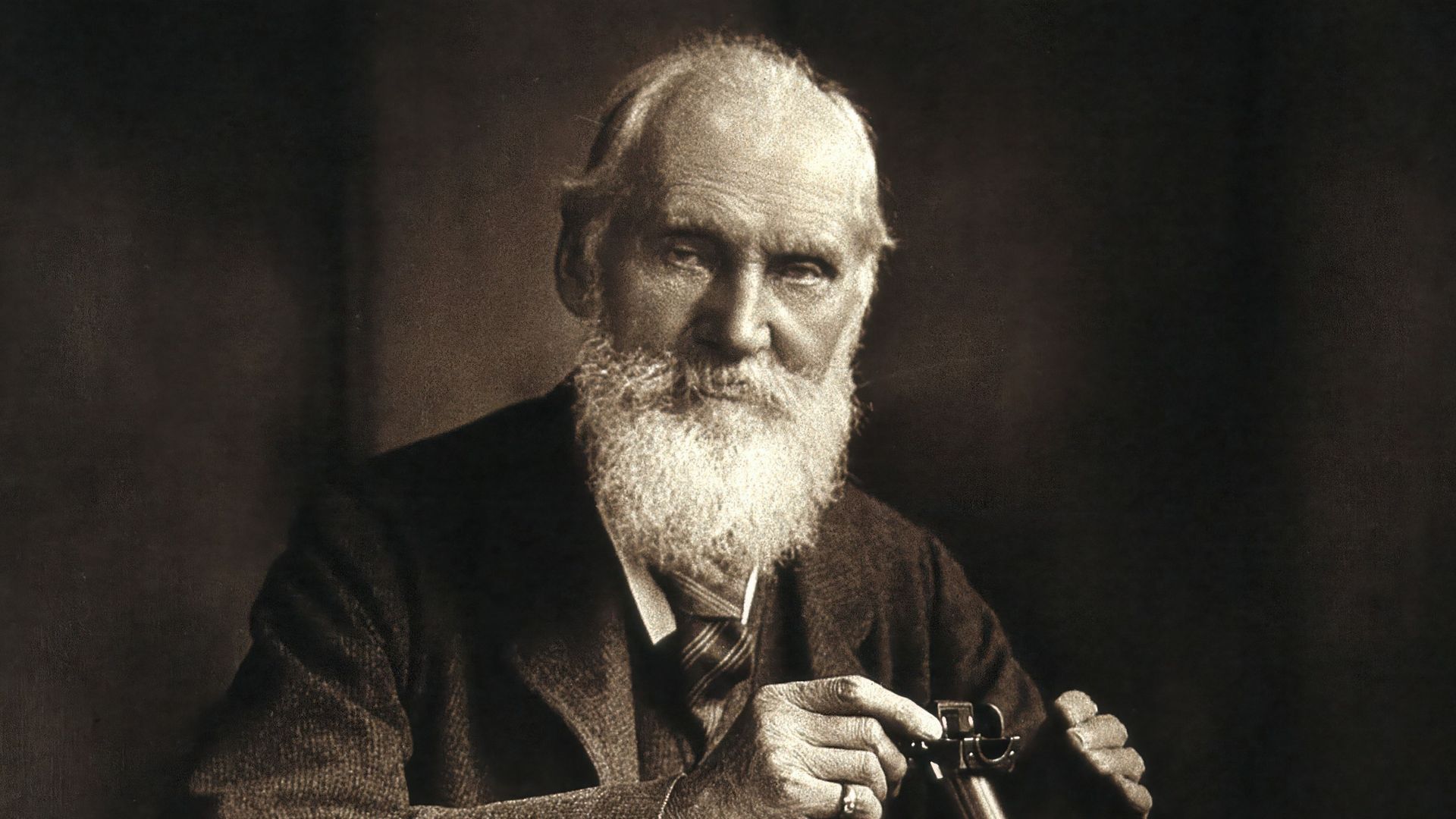
Lord Kelvin giving a lecture at Glasgow University in 1899. (Image credit: Universal Images Group/Getty Images)With Carnot's vision, the way hot objects cool down began to be understood, raising hopes that the resolution of one particular problem might be imminent: the determination of the Earth's age. Were we to somehow guess how hot our planet was at birth, thermodynamics could then be used to tell us how much time had gone by for it to have cooled to its present temperature. Many scientists tried it, keen to be the first one to nail the true age of our world.
Considering our planet in all its complexity to be far too difficult, simplifications were in order, and British physicist William Thomson shot first by picturing our world as a ball. A very simple, rock-solid ball made of pretty much the same stuff throughout, from surface to core. No ocean, no mountain, just a smooth ball the size of the Earth. He then calculated how long it would take it to cool down from being red hot to its present temperature, and declared that the Earth was something between 40 and 400 million years old.
Refining his calculations, he then announced that the world was 100 million years old, before settling for 40 million again.
Thomson's result does not correspond to the true age of the Earth, but it was a start. It was the result of a model, an attempt at figuring out something about our world using still-to-be-refined laws, and mathematical sense. What was more problematic was that no one dared question his results. Even as it shifted from one paper to another, the age of the Earth given by Thomson was always greeted as the right one. A reason for this is that at the end of the nineteenth century Thomson had become Lord Kelvin.
The same Kelvin after whom the Kelvin unit of absolute temperature is named. A scientific superstar who had the power to undo, in a snap of fingers, the career of anyone who disagreed with him.
Lord Kelvin was a physicist, not a geologist, so geologists could have questioned his work, but they didn't. In fact, they weren't bothered. Many of them back then believed that being a geologist was all about intuition and proper English, a language they deemed far more efficient than mathematical gibberish.
That being said, and however wrong the results, Kelvin's calculations were beautiful, giving whoever wanted to think about the problem of the age of the Earth a way forward, which is exactly what one of his former students, Northern Irishman John Perry, did. He thought that Kelvin had overlooked something. As a man of science talking to his former mentor (and job provider), Perry explained his vision to Kelvin but was ignored.
John Perry, a student of Kelvin's, who realized Earth was billions of years old — and that its mantle was a liquid, not a solid. (Image credit: Science Photo Library)Still, he published his thoughts in Nature. But again, the article was ignored. Not just by Kelvin, but by the scientific community at large, including geologists.
It would have saved us all quite a bit of time had this not been the case, because Perry not only found a much more correct way to picture the Earth and estimate its age than Kelvin had, but he also found the source of the power that makes our planet's continents drift.
In his model, Perry didn't picture the Earth to be uniformly the same from surface to core as Kelvin had. Instead, he modelled the Earth's interior as being divided into three regions: a metallic core at its centre, a solid crust at its surface, and a mantle that lay in between the two. Rather unexpectedly, Perry didn't envision the mantle as everyone else would have; he believed that it didn't behave like the solid rock it was, but as a liquid.
No wonder his former master didn't take him seriously. However, he pictured the mantle behaving like a liquid only when considered over long periods of time. Sandwiched between a hot core and a colder crust that very much looked like a lid, he believed the mantle had no choice but to behave just like water does in a heated pan, with the hottest parts at the bottom rising and cooling before diving back down and rising up again, in repeated loops, albeit in extremely slow motion. This type of movement is called convection, and it happens in solids, too.
Exclusive to Live Science ProWas there a 'before' the Big Bang? Jim Al-Khalili on the mind-bogglingness of time'This is what happened with Claude and me': AI's failed attempt to crack the Riemann hypothesis led mathematician to a breakthrough'Everything we know about space travel is going to change within a decade': The fusion breakthrough that could unlock a path to the stars
If he was right, there would be two immediate consequences. The first one was that the time it would take for our planet's surface to cool down from red hot to its current temperature could now be far longer than Kelvin had estimated. The lid and the convection patterns prevented our planet from quickly radiating away all its energy into space, so we were now inhabiting an Earth that could be as old as 2 or 3 billion years. Maybe even more. Such timescales were unheard of in the scientific community. Back then, no one knew that the universe itself was 13.8 billion years old. They knew next to nothing.
The second consequence of Perry's model was that the mantle's circular movements underneath the crust could drag the crust itself via friction. The solid surface of our world would then move, and split into pieces that would drift, and collide, and plunge underneath — or slide above — one another. Where they collided, mountain ranges would rise, like the Alps, the Himalayas, the Rockies . . . Where they split apart, rifts would appear, probably in the middle of oceans, along ridges . . . just like [Marie] Tharp had found.
Nowadays, these broken pieces of our planet's surface have all been mapped. They are our world's plates and their movements through time are called plate tectonics. Today, most of us have heard about plate tectonics. Back then, however, no one had, and if very few people remember Perry today, it is because another scientific breakthrough made the estimation of the age of the Earth much easier and precise, showing us that our world isn't 2 or 3 billion years old, as Perry suggested, but precisely 4.567 billion, give or take a few million.
Reprinted with permission from This Is Life: A Journey from Inside Your Body to Beyond Earth by Christophe Galfard, published by the University of Chicago Press in North America and Picador in the UK. © 2026. All rights reserved.
Help us improve Live Science Pro: We're always trying to make our content better. Leave us feedback about Pro here.
University of Chicago Press This Is Life: How the Science of the Cosmos Explains What We AreIn this immersive and mind-expanding book, acclaimed physicist Christophe Galfard takes you on an adventure like no other to answer the fundamental question: what is life? You’ll travel back in time to witness the cataclysmic asteroid impact that doomed the dinosaurs, experience the tumultuous forces that shaped our planet, and discover how the first stirrings of life emerged from inanimate matter.
Hence then, the article about no one dared question his results how thermodynamics sparked a heated debate about earth s age in the 19th century was published today ( ) and is available on Live Science ( Middle East ) The editorial team at PressBee has edited and verified it, and it may have been modified, fully republished, or quoted. You can read and follow the updates of this news or article from its original source.
Read More Details
Finally We wish PressBee provided you with enough information of ( 'No one dared question his results': How thermodynamics sparked a heated debate about Earth's age in the 19th century )


Also on site :
- ‘Boy Meets World’ Star Rider Strong Reveals He Got ‘Completely Screwed’ During The Show’s Final Season
- Walmart’s Fluted Cabinet Brings Mid-Century Modern Charm and Tons of Storage to Small Bathrooms, Now 50% Off
- Is ‘I Play Rocky’ Original or Adapted? Stallone’s ‘Rocky’ Origin Story Faces a ‘Barbie’-Style Oscar Dilemma (EXCLUSIVE)