
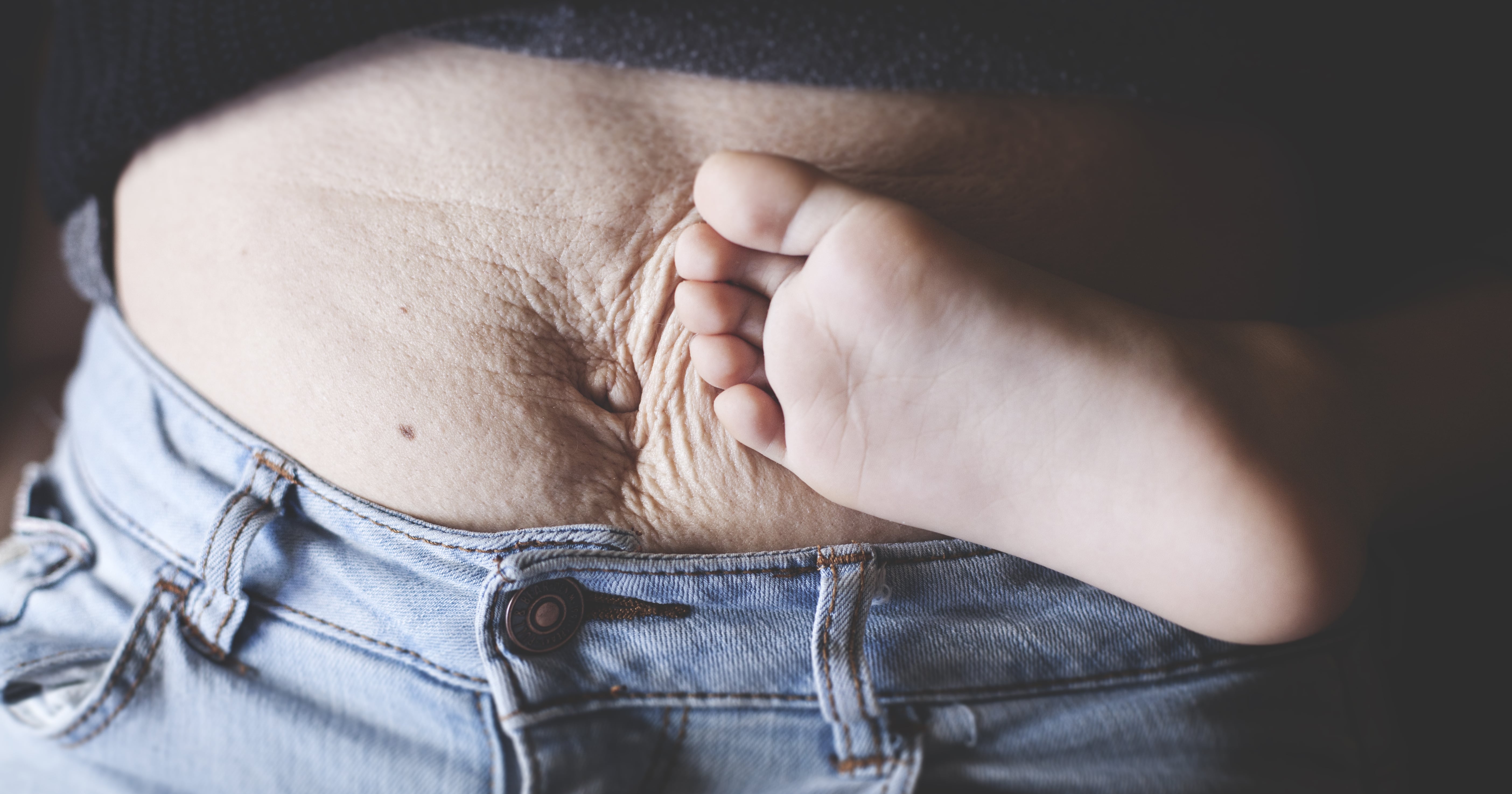
Just when it felt like we were finally inching away from postpartum "bounce-back" culture, GLP-1s entered the chat. These medications, which include Ozempic and Wegovy, grew out of treatments for type 2 diabetes, but have quickly become household names for their ability to help people lose weight. Now, new moms are having to navigate postpartum in a GLP-1 era, raising a familiar question in a new way: Is losing the baby weight something you want to do - or is it something you're being made to feel you should do?
Sarah McGowan, 41, a New York City mom of two, is one of those moms who felt the pressure to loose weight fast postpartum, primarily from conversations around GLP-1s. As her maternity leave winded down and she got ready to go back to work. McGowan says her clothes felt tight, and she wondered how she'd find time to exercise or cook once she and her husband were both working and getting two kids out the door every morning. "I didn't set out to look model thin, I just wanted to get back to my old jeans," McGowan says. She started Zepbound when her youngest was 5 months old - and says treatment has given her more than just weight loss, but mental space and energy for her family.
Christine C. Call, PhD, a clinical psychologist who studies postpartum body image and disordered eating, notes that the topic of GLP-1s postpartum comes up often both in her personal and professional life. The "constant stream of ads and social media posts for GLP-1s" is hard to miss, says Dr. Call.
Research has put some of this into perspective as a study published in JAMA in October found that more women are filling GLP-1 prescriptions after giving birth. The study looked at women with commercial health insurance and found that 1.9 percent filled a new GLP-1 prescription within six months of giving birth in early 2025, up from 0.08 percent in early 2018. That's about every 2 in 100 women - so not everyone in your new-mom group, but that's still a sizable jump.
What those numbers don't tell us is why. As study author Sih-Ting Cai, PhD, explains, a prescription alone can't tell you whether a mom was managing a health condition, feeling pressure to lose weight, or dealing with both. Ahead, experts unpack what we know about GLP-1 use after pregnancy, when treatment might help, and how to make room for it without handing new moms another reason to feel like they're falling behind.
Experts Featured in This Article
Sih-Ting Cai, PhD, is a researcher at the University of Southern California's Schaeffer Center for Health Policy and Economics and an author of the JAMA study on postpartum GLP-1 prescribing.
Christine C. Call, PhD, is a licensed clinical psychologist and assistant professor in the Department of Psychiatry at the University of Pittsburgh.
Fatima Cody Stanford, MD, is an obesity medicine physician-scientist at Massachusetts General Hospital and Harvard Medical School.
Jody Dushay, MD, is an endocrinologist at Beth Israel Deaconess Medical Center.
Pooja Gidwanit, MD, is a board-certified internist who focuses on obesity medicine.
What's Behind the Rise in Postpartum GLP-1 Prescriptions?
When you hear that a new mom is starting a GLP-1 a few months after giving birth, it's easy to assume she wants to fit into her old jeans (and maybe she does). But maybe she has type 2 diabetes and needs help managing her blood sugar. Or maybe she was taking the medication before she got pregnant and is restarting a treatment that worked for her. You can't tell from the prescription alone.
That's part of what Dr. Cai wants people to understand about her study. The women most likely to start a GLP-1 after delivery had type 2 diabetes. Women with overweight or obesity accounted for the largest share of new prescriptions because those diagnoses were more common in the study. The study didn't ask women why they wanted treatment, so it can't tell us how much appearance or outside pressure factored into their decisions.
Even the word "starting" needs a little explaining. Researchers counted a prescription as new if there wasn't another GLP-1 claim in the 180 days before delivery. So a woman who stopped taking her medication for pregnancy and went back on it afterward would count, too. The study also didn't include women on Medicaid or prescriptions paid for entirely out of pocket.
Jody Dushay, MD, an endocrinologist at Beth Israel Deaconess Medical Center, sees that return-to-treatment conversation in her own practice. She hasn't noticed more new moms asking to try these medications for the first time, but she does help existing patients plan when to stop for pregnancy and how to approach restarting afterward.
When Can Medication Actually Help?
It's really hard to put into words what it means to "not feel like yourself" after having a baby. You're probably sleep-deprived, still healing, and trying to get a handle on things that once felt easy like making yourself dinner or getting out the door for a walk.
But that doesn't mean you should have to shrug off everything you're feeling as "well, I just had a baby." Pooja Gidwani, MD, a board-certified internist who focuses on obesity medicine, says all of those symptoms deserve a closer look. "Sometimes there's also anemia, a thyroid issue, depression, or persistent blood sugar problems that need attention," she says. "Gestational diabetes often resolves after delivery, but the increased risk of type 2 diabetes remains. That's why postpartum glucose testing and ongoing screening matter, even if someone feels completely well."
"My concern is any marketing that turns a vulnerable postpartum period into a cosmetic emergency."A GLP-1 might make sense for someone who meets criteria for obesity treatment or has type 2 diabetes, but Dr. Gidwani warns it's not going to address every reason a new mom feels off, and definitely shouldn't replace a proper postpartum evaluation. "Being above her pre-pregnancy weight doesn't, on its own, establish a need for medication," Dr. Gidwani adds.
For McGowan, it's been less about the weight she's losing and more about how she feels at home with her kids. She says she hasn't had any side effects, and the weight is coming off slowly. Before, she'd often be so hungry by the time she finally got to sit down and eat that she felt irritable. Now, that hunger doesn't take over. "For me, this decision has given me back some mental space and energy that I can pour into my family."
Once you're taking medication, how you feel still matters. Obesity medicine physician Fatima Cody Stanford, MD, looks at whether treatment is helping with things like blood sugar or blood pressure, whether moving feels easier, and whether you're eating enough to support your recovery. If you're losing weight but feel too sick to eat or increasingly weak, that's something your doctor needs to hear. "I would not call treatment successful simply because weight is decreasing if her nutrition or ability to function is getting worse," Dr. Gidwani adds.
Does Having the Option Make It Feel Like an Obligation?
For nine months, everyone expects your body to change (you're growing a human, after all). But then you have a baby and somehow you're supposed to start looking like none of that happened - as quickly as possible.
That pressure can make moms feel like they're doing something wrong if their pre-pregnancy clothes still don't fit, Dr. Call explains. You're healing, figuring out feeding, and trying to get a few hours of sleep. An ad about losing the baby weight can feel like one more thing you're apparently supposed to be handling.
Does seeing those ads actually make the pressure worse? We don't know yet. Dr. Call says the research on GLP-1s and postpartum body image hasn't caught up, but she does worry about what new moms hear when weight-loss ads keep showing up: You could be doing something about this. Why aren't you? "My concern is any marketing that turns a vulnerable postpartum period into a cosmetic emergency," Dr. Stanford says.
And when you see another mom's weight-loss update, you're probably not getting a rundown of everything that helped her get there. Does someone watch the baby while she goes to appointments? Does she have help with meals? Can she take time off when she needs it? Dr. Gidwani says childcare, meal prep, flexible schedules, and medical support can all factor into treatment being easier to manage. Those details rarely make it into the Instagram post.
Getting a prescription and being able to keep filling it are also two different things. Dr. Stanford says insurance coverage, out-of-pocket costs and access to follow-up appointments all affect whether someone can get (and stay on) treatment. So if you're comparing yourself with another mom, you may have no idea what it actually takes for her to keep getting that care, or whether you'd have access to the same help.
What If You Want Treatment - and Feel Pressure, Too?
You probably don't need another person asking you to explain why you want to feel more comfortable in your body. You also shouldn't have to come up with an answer that sounds good enough to deserve help. "Few decisions have one motivation, and mixed motives don't make a choice less valid," Dr. Call says. McGowan knows the pressure to look a certain way was part of her decision, but says she's glad she started taking medication and feels it's helped her.
Losing weight also doesn't guarantee you'll feel differently about your appearance. Dr. Call says research on other weight-loss approaches shows body-image concerns often still continue post-treatment. After pregnancy, your body will likely look different from how you remember it - even if you return to your previous weight.
Unfortunately, getting medical help can open you up to opinions you never asked for. Dr. Stanford says patients who've spent years being told to do something about their weight may then get criticized for actually taking medication. Having to defend that decision can be exhausting. "Seeking treatment is a health decision, not a moral one," she adds.
McGowan says she hasn't told people she's taking medication mostly because she doesn't want her decision opened up for discussion. "I don't need a 'good for you' for going on it and I certainly don't need to hear all the reasons you think I shouldn't."
How to Navigate This Conversation in Your Postpartum Appointments
At any postpartum appointment, you should feel comfortable talking about what life is really like for you now - and a visit that's meant to discuss GLP-1s shouldn't be any different.
Tell your doctor what your days actually look like, even if lunch is whatever you can grab while holding the baby. Dr. Gidwani wants to know how you're eating, how you're healing and whether anyone's around to give you a break. And if thoughts about your body are taking up a lot of your day, say that, too. Dr. Call recommends talking about your mental health and any past struggles with disordered eating, then keeping that conversation going if you start medication.
If you're breastfeeding, ask specifically about the medication you're considering. One small study of injectable semaglutide found no detectable drug in the breast-milk samples researchers tested. But Dr. Stanford points out that it didn't answer questions about milk production, milk composition or longer-term outcomes for babies. She recommends an individualized discussion with your prescriber, involving your OB-GYN and pediatrician when it makes sense.
Another baby might be the last thing on your mind right now, but if you think you might want one eventually, mention it to your doctor. Weight-loss medications shouldn't be used during pregnancy, so you'll want to talk about birth control and when to stop taking yours before trying again.
Ask how long treatment might last, too. Dr. Dushay cautions against assuming you'll stop once you've lost the pregnancy weight. Weight can return after stopping, so it helps to understand the longer-term plan before you begin.
Once you start, be honest about how you're feeling, even if you're happy with the weight loss. If you're constantly feeling nauseated, struggling to eat or getting dehydrated, your doctor needs to know. And if you've talked it through and don't want to take medication, you don't owe anyone a more convincing explanation. "Someone should be able to decline medication without being made to feel she is neglecting her health," Dr. Gidwani says.
For McGowan, taking Zepbound has been a positive experience and one that's helped her feel more like the mother she wants to be. "I wish people understood that taking care of yourself and taking care of your children aren't mutually exclusive," she says.
There's already so much to figure out after having a baby. Whether someone wants treatment, needs more time to decide or would really like everyone to stop bringing up her weight, she deserves to be heard.
Jenn Sinrich is a freelance writer, editor, and content strategist in NYC. Her work can be found in PS, Women's Health, SELF, Reader's Digest, Health, PureWow, and more.
Hence then, the article about the complex realities of navigating postpartum in the glp 1 era was published today ( ) and is available on popsugar ( Middle East ) The editorial team at PressBee has edited and verified it, and it may have been modified, fully republished, or quoted. You can read and follow the updates of this news or article from its original source.
Read More Details
Finally We wish PressBee provided you with enough information of ( The Complex Realities of Navigating Postpartum in the GLP-1 Era )


Also on site :
- Chipotle Is Bringing Back Its Record-Breaking BOGO Deal on Friday the 13th—With a Limited-Edition Wiz Khalifa Bag—And You Don’t Even Need a Real Tattoo
- ‘Love Is Blind’ Reunion Goes Off the Rails for Michaella Giorgio With Stage Fall, Explosive Fight and Mushrooms Confession
- ‘American Idol’ Star Reveals Dark Spiral After Hollywood Dreams Crumbled: ‘I Became Less and Less Like Myself’