
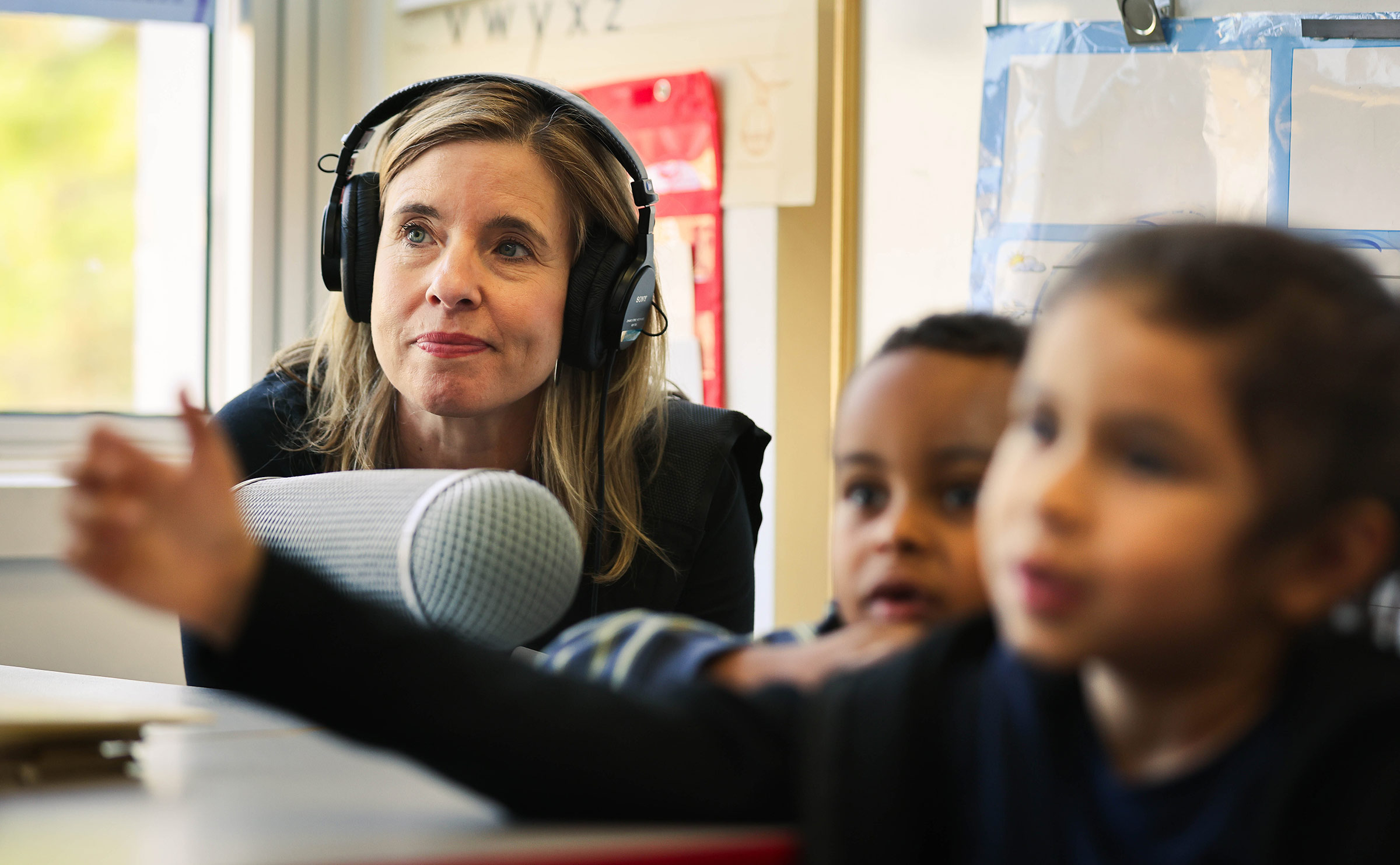
Emily Hanford is an education journalist whose reporting, especially the podcast Sold a Story, has been a catalyst for a wholesale change in the way reading is taught in schools in the U.S. Since her earliest reports in 2017, dozens of states have introduced legislation mandating reading curricula that align with the science of reading, a phrase she helped popularize. In the podcast’s second season she pulls back the lens even further and examines direct instruction, a teacher-led style of education, and in particular the teaching program developed in the 1960s by Siegfried (Zig) Engelmann, a former marketing executive, which bears the brand name Direct Instruction. Most schools use a different, more inquiry-based and student-led approach, where teachers act more as guides than instructors, even though some studies suggest it’s less effective. Hanford discussed the huge changes she helped engineer in schools, what makes a great teacher, and why Engelmann’s style of teaching is so controversial.
This interview has been edited and condensed for clarity.
How do you feel about the changes that you've helped bring about in the way the U.S. teaches reading?
Let's see. How do I want to say this? I don't think you can plan to have that kind of impact. Making meaningful changes in education seems to take a combination of top-down and bottom-up movement. People listened to the first season of the podcast, including many lawmakers, and thought, “We need a new law,” and I think some of those laws are well-intended and have good results, but passing a law isn't enough and sometimes has unintended consequences. So I have mixed feelings about it all. At least 26 states have made some legislative or policy change around reading instruction since the podcast came out in the fall of 2022, but they are also part of a more than decade-long series of changes in laws and policies related to reading instruction.
Are the laws making a difference in the schools?
There are states where there has been some measurable change in reading outcomes–Mississippi is the one that people point to immediately. Alabama is another—a big report on that came out last week. Legislation is almost always part of the story, never the whole story. One of the reasons we are trying to get inside the question of direct instruction in Season Two is that instruction does matter, and matters maybe more than some people think.
Did you receive a lot of pushback for Season One?
In some ways the field maybe was ready for it. There was a group of parents and teachers pushing for change. Reading instruction was on a lot of people's radar. But one of the remarkable things was particular people, who were very critical of me at first, changing their minds, and writing later to say, "Oh, I didn't know. I understand this differently now." I mean, I still have plenty of critics out there.
One of the things that is surprising about this subject is how politically divisive it is. To what do you attribute that?
Education has always had surprising politics. A lot of the kind of holistic, big reforms in reading have come in more conservative states, more Southern states, states that were further toward the bottom of the reading scale. Maybe they had more pressure on them to make changes. And some of the states that do better in education haven't had as much pressure on them—although changes have been happening in states like Massachusetts and California as well.
I think it was very surprising for some people that this stuff about phonics instruction came from public media—something they perceived as middle left. Explicit instruction has been associated with a more conservative point of view and been embraced by some high-profile politicians, including President George W. Bush. But when you talk to the researchers, or the people who are doing the work in schools, many of them are as left as left can be. And most teachers just want to do stuff that works. I actually understand why education is political, because it matters a lot. The stakes are high.
The new season of your podcast is about a teaching technique known as direct instruction. Would you say it is what some people call rote learning?
I don't think that’s what it is. If you look at the work of someone like Zig Engelmann, he was very much trying to understand what it takes to get kids to understand a concept. Everyone wants the same thing: we want kids to know stuff and we want kids to be able to think for themselves. But the question is, how do you get there? In education sometimes we confuse the ends and the means. What we want is kids to be curious and sitting in a nook reading a book. We know from many, many years of research and from cognitive science that that's not where you start. You don't put a bunch of 5-year-olds in a cozy nook reading books to just mimic that behavior.
One way of describing this season is that it is another resurrection of an old-fashioned technique. Is that accurate?
I don’t think so. Engelmann wasn't resurrecting something old-fashioned. He was trying to create something new.
But he was doing it in the ‘60s, so it's not new now.
What's interesting is that many of the things he did have turned out to line up really well with what cognitive science has been investigating and figuring out for the past 60 years. A lot of people think direct instruction is lecturing, a teacher standing at the front of the room explaining things, maybe droning on and on, like in Ferris Bueller's Day Off. And what's tricky about this is Direct Instruction, the version invented by Zig, is the opposite of lecturing. It's more like a game of catch. A teacher's at the front of the classroom. They're asking a question. They pause first, for a brief second. They give a signal, and they ask all the kids to respond in unison, and then the teacher will ask another question.
How else does it differ from other teaching methods?
There are five elements of Direct Instruction: choral response is one of them. It's cold-calling too–students can be called on at any time. It means they're always paying attention. They can't just zone out. So it's call-and-response, it's individual turns, it's a correction procedure, it's repetition. There's definitely a lot of repetition; it's about getting basic facts into kids' heads. And the other thing that you will see is scripted lessons. Teachers will have a script in their hand, and it tells them what to say and the order in which to teach things. That is the absolutely 100% most controversial part of Direct Instruction. DI is not unique in being scripted; lots of teachers are being handed scripts, and there are clearly bad scripts out there. The thing that's different about Zig's Direct Instruction programs is that those lessons have gone through tons of field testing, and Direct Instruction itself has been rigorously studied many, many, many times, and it consistently works. So the Direct Instruction scripts are worth teaching. That's actually what a lot of teachers will say.
Are the political battle lines drawn in a similar way?
It is certainly true that the indirect approach—discovery and student-led learning—has roots that go back to the progressive education movement, and back even further than that, with ideas that you would associate more with the political left.
You unearth a huge study, Project Follow Through, that looked at 350,000 students and 22 different programs, and found that on average Direct Instruction worked best in nearly all measures. Why was that not the end of the story?
I don't think that the takeaway from Project Follow Through should have been that we all should do direct instruction. It was clear that it was a big, messy experiment, as so much education research is. But we don't get that many examples of such large, long education studies. I don't think there was enough evidence to say everyone should adopt this approach, but in 1977, it offered some clues. If these are the things we care about–kids doing well academically, and kids feeling good about school and themselves, and being able to think for themselves and solve problems–there was one program that stood out above the rest, not just by a little bit. We should have looked at that and been like, "Huh, that seems like a direction maybe we want to go," and that is not the direction we went.
Is Direct Instruction right for every teacher? If you are a very effective teacher, might you not object to having your autonomy and hard-won skills be replaced by this very scripted technique?
We interviewed a lot of teachers, highly skilled, really good teachers who do Direct Instruction and aren't trying to graduate from it. Many of them are like, “This works, and I want to keep doing this.” I think it works well when you do it school-wide, in part because the kids understand the routine. One of the reasons why I think there's so much resistance to Direct Instruction is that we have an idea in the United States that the ideal teacher designs their own lessons. We expect teachers to be like the Beatles or Taylor Swift, singer-songwriters who can do it all. So Direct Instruction is an affront. It’s essentially saying we have a different definition of being a good teacher. You don't design the lessons; the lesson design is done, and that has actually been a really long process that's taken a lot of trial and error over many years. Your job is to teach the lessons, and your job is to focus on the kids. It allows them to look at the kids and see who's not getting it. There are nearly 4 million teachers in the United States, so this is a job that lots of people need to be able to do well.
Would you want to teach like that?
I thought about being a teacher in my early 20s and I had a friend who was teaching in New Orleans, and a bunch of her third graders couldn't read, and she was supposed to design all of her own lessons. And I thought to myself, where would you even start? It was such a stressful job. It was basically impossible, and she eventually quit teaching, as a lot of people do, because we make this job too hard. The Direct Instruction teachers say, “I teach these lessons, and I know these lessons are really good. And I don’t have to stay up late lesson-planning. I can have a life.”
Are there students who do better with Direct Instruction than others?
This whole issue is tricky. There's a fairly high percentage of kids who are fine no matter what type of teaching they have, which leads people to theorize that maybe instruction doesn't matter that much. Jean Stockard's big meta-analysis of Direct Instruction found that it does work for lots of different kinds of kids. You are more likely to find teachers who were specializing in special education to have heard of Direct Instruction. Those are the kids that Zig was most concerned about. But the way that he saw it is, if he can make something that works for the most struggling kids, then it'll work for the higher performers too. The higher performers just get through it faster. It's not that kids need different things, it's that they learn at different speeds. Cognitive science has been telling us this: we don't all have dramatically different brains. Sure, there are differences around the edges, but for the most part, we all need to learn the same things and learn in basically the same ways, and some of us just don't need a whole lot of practice or instruction.
But how would that work practically? If it's call-and-response, it's throwing the ball back. Eventually, the child who's getting it quicker is going to tune out.
It's a mastery-based program. You group kids by their skill level, and when it's reading-instruction time, you change the groups, and the kids who are reading at a third-grade level are all learning together, and the kids who are at a second-grade level are learning together.
Fewer than 200 schools in America are DI schools at the moment. That's not many. Why don't schools stick with it?
Direct Instruction is so different from the status quo in America that it just has a really hard time surviving if it doesn't have a champion or multiple champions at the top. It falls apart if you don't make good investments in the training. And the status quo is some combination of lecturing and a sort of discovery experience-based approach, with some direct instruction for the kids who are struggling the most, and the teachers doing a lot of things on their own, and trying to make use of programs and curriculum that they're constantly being handed by the people above them.
What should a parent do if they hear your podcast and are very persuaded by it? Would you go so far as to encourage them to change schools?
Most parents don't know that much about what's going on in their kids' schools, unless and until there's a problem. My best answer for parents is to say you're not alone. There are other parents in your school who have the same questions you do and you should try to find them because you can learn from each other and there's power in numbers.
If Season Two were to have an effect akin to the first season, what would you like it to be?
It would be people starting to ask questions about why we can't agree on some more basic things about teaching and learning. There is a body of evidence in education. It's out there. Established professions—medicine and accounting and nursing and aviation—have a body of knowledge that they agree on. Why don't we have that in teaching and learning? I just don't think we're going to get very far until we have that.
Hence then, the article about first she changed reading now she s coming for teaching was published today ( ) and is available on Time ( Middle East ) The editorial team at PressBee has edited and verified it, and it may have been modified, fully republished, or quoted. You can read and follow the updates of this news or article from its original source.
Read More Details
Finally We wish PressBee provided you with enough information of ( First She Changed Reading, Now She's Coming for Teaching )


Also on site :
- Israel’s Herzog accepts vote results, opens talks on forming a government
- ‘Chicago Fire’ Star Joe Miñoso Reveals He Pitched Cruz’s Heartbreaking Exit Scene in 300th Episode (Exclusive)
- Founder Securities Chief Economist Yan Xiang: China's Capital Market Reforms Continue to Deliver Results