
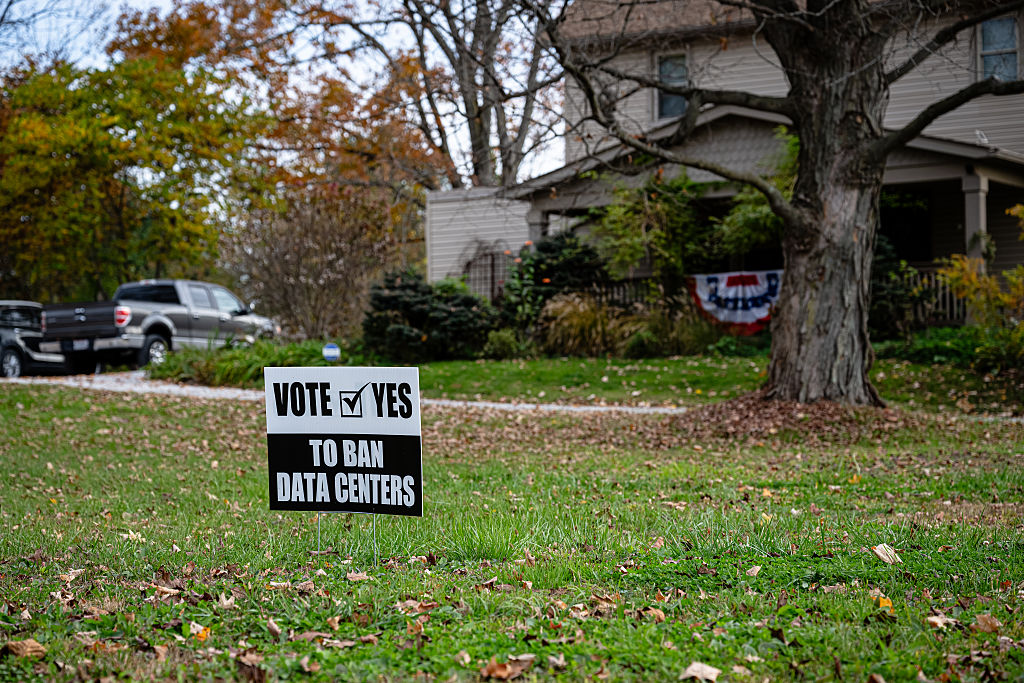
For the past year, a faction of the AI industry bent on unfettered development looked poised to use its wealth to tip the 2026 midterms in its favor. But on Nov. 3, that accelerationist wing could hardly have had a worse night.
An NBC exit poll found that 56% of voters said that AI and data centers were a “crucial or major factor” in their vote for Congress. Democrats spent more than $100 million on broadcast ads casting their Republican opponents as being overly cozy with Big Tech and data centers—and decisively won in many of those races, including Ohio, Kansas, and Iowa.
Data center bans or moratoriums passed in counties across the country, from Edgewater, Fla., to Bloomington, Ill., while the mayors of Piqua, Ohio and Yukon, Oklahoma were recalled for their previous support of data center projects.
Data center and accelerationist super PACs failed to make a major dent in influencing elections through spending. One of the key candidates they spent money on, Darline Graham, lost to Annie Andrews, who nicknamed Graham “Data Center Darline” and called for a two-year moratorium on new projects. The accelerationists' ineffectiveness opened a pathway for “pro-safety” PACs to outspend them in key races. Several candidates backed by those groups, including Michigan’s Abdul El-Sayed and Colorado’s Manny Rutinel, won.
Don’t expect sweeping federal AI regulation soon. Even with both chambers, Democrats need substantial Republican support to pass over a potential Presidential veto.
But this election served as the stunning capstone in a year of mounting anti-AI populism, during which Donald Trump has spurred on the industry and said that opponents of data centers “want to end up being backwards and poor.” Now, Congress could haul executives before committees to answer questions and undo Republican efforts to block state-level laws.
Even without law change, politicians may think twice before siding with the AI industry. “Voters had their say tonight: they are overwhelmingly in support of AI safety and security, and very much against data centers and flock cameras,” says Brendan Steinhauser, a Republican strategist and the CEO of The Alliance for Secure AI. “The AI industry is going to have to get ready to deal with it because I think there's a big deluge of bills at the state and federal level coming their way.”
Americans would rather live near a prison, methadone clinic, or a nuclear power plant than an AI data center, according to comparative polling done by progressive research firm Blue Rose Research. Existential concerns about AI have grown, says Ali Mortell, the firm’s director of research, but data centers’ concrete local impacts—including higher energy bills, noise, and environmental concerns—were far more salient.
Accordingly, Democratic candidates who opposed data centers more strongly than their opponents won in many races. In Ohio, Senator-elect Sherrod Brown ran millions of dollars of ads calling Husted “the face of data centers in Ohio." Brown won by five percentage points. The National Republican Senatorial Committee even acknowledged that Husted’s ties to the industry were a problem, writing in an August memo that “more than any other thing in this race, data centers are the anchor hanging around Husted’s neck.”
In Kansas, Cindy Holscher led in the governor’s race on Wednesday morning after running an ad calling for a pause on data centers until Kansas set guardrails to protect its communities, farms, jobs, and budgets. Her opponent Ty Masterson had received $1.5 million from a data center super PAC.
In Arizona, Democrat Amish Shah, who pledged to “stop data centers from being built,” led Jay Feely, who said American data centers were necessary to beat China in the global AI race, on Wednesday morning.
Comparisons suggesting that U.S. data centers use less water than the nation’s golf courses have done little to reassure voters. Developers’ promises to cover higher energy bills soften opposition but win few supporters. Trust in institutions is low, so when tech companies and politicians offer reassurance, Mortell says, “voters are not positioned to believe that's true.”
An October Politico poll found that nearly half of Americans identify Republicans as the party most eager to build data centers. But Democrats could find themselves on the other side of the backlash. In Wisconsin, Republican Tom Tiffany derisively called his opponent “Data Center David Crowley.” Crowley shifted toward tighter restrictions in October—and won.
“There's not a clear divide between Democratic voters and Republican voters on how they're thinking about [data centers]. Opinion has soured with everyone,” Mortell says.
AI money backed both sides
AI accelerationists also struggled to translate their considerable campaign contributions into electoral victories.
The super PAC Leading the Future was created with more than $100 million in funding to support pro-AI candidates in August 2025. But because public skepticism of the AI industry has become so widespread, the PAC's financial contributions were met with backlash, creating headaches for candidates who received the money.
According to one survey, three-quarters of likely voters said that they would be less likely to vote for a candidate if they found out they had accepted a donation from an AI super PAC. As the general election approached, big donors like OpenAI’s Greg Brockman and Ron Conway backed away from previously promised donations, and Leading the Future mostly kept their powder dry.
Elon Musk didn’t fare well either. The AI leader was the biggest donor in this cycle at $446 million, $168 million of which effectively went to supporting Ken Paxton in Texas. But Paxton was crushed by James Talarico, who has called for the ending of "sweetheart tax deals" for Big Tech and other guardrails.
Leading the Future and associated PACs were far outspent by pro-safety PACs designed specifically to counter their influence. Those pro-safety groups had a wealthy supporter of their own. Anthropic contributed more than $40 million to Public First Action, which advocates for stronger safeguards. That money was restricted from election activities, though Anthropic employees separately donated another $5 million to support campaign efforts.
Pro-safety PACs notched wins in Michigan (Thomas More Barrett faced $896,250 in opposition funding); Colorado (Manny Rutinel, who has called for a conditional moratorium, received $1.5 million from pro-safety groups); and Wisconsin (where Rebecca Cooke defeated Derrick Van Orden after a pro-safety group spent more than $880,000 opposing him).
But neither side's cash proved decisive. The largest spending battle of the cycle among AI-focused super PACs was a New York congressional primary. Pro-safety groups spent $21.3 million supporting Alex Bores, while accelerationists spent $8.2 million opposing him. Bores lost—but the winner, Micah Lasher, had co-sponsored the same AI safety law that made Bores an industry target.
Another major worry from AI critics was that AI deepfakes would spread misinformation about candidates. While AI deepfakes were circulated, they do not appear to have had an outsize impact in many races.
For instance, deepfaked videos of Maine Senator-elect Troy Jackson appearing to threaten his campaign staff circulated the week before the election, but Jackson went on to win by more than seven percentage points. In Wisconsin, Van Orden posted several deepfake videos on social media of Cooke saying things she never said. Van Orden lost.
AI could become a bigger election issue
After two years of a pro-acceleration agenda, the AI industry is now preparing for a harsher political climate. OpenAI plans to launch a policy and PR offensive, Axios reports, including an effort to rebrand data centers as “AI compute campuses.” Meanwhile, Meta is reportedly building a bipartisan team to strengthen its relationship with Democrats, while maintaining its ties with Republicans. “There's going to be a lot more questions from Congress,” says Steinhauser, whose Alliance for Secure AI Action is a bipartisan nonprofit that advocates for guardrails.
With Trump in the White House, sweeping federal AI legislation would likely require either his signature or enough bipartisan support to overcome a veto. With anti-AI sentiment crossing party lines, cross-party collaboration isn’t out of the question. “I think this is a good chance for Trump to have a bipartisan win,” Steinhauser says.
"I also think you're going to see more movement at the state level," Steinhauser says. Democrats in Congress might not be able to pass sweeping federal regulation, but the ban on state AI regulation Republicans have sought will be harder to enact. “If Congress is gridlocked, what happens in California will govern AI for the U.S. and the world,” says Scott Singer, a fellow at the Carnegie Endowment for International Peace who was a lead writer of a report commissioned by California Gov. Gavin Newsom, which informed SB-53—the first U.S. law governing frontier AI systems.
Blue Rose’s polling finds AI is ranked 29th out of 39 issues. But in the last year, its salience has risen more than any other issue, including war in the Middle East. As AI advances, its effects on jobs and people’s safety could make for a very different political debate in 2028, Mortell says. “This was the first cycle where AI showed up in the political discourse, and it’s arguably the least important that it will ever be again.”
Hence then, the article about how ai backlash shaped the 2026 midterms was published today ( ) and is available on Time ( Middle East ) The editorial team at PressBee has edited and verified it, and it may have been modified, fully republished, or quoted. You can read and follow the updates of this news or article from its original source.
Read More Details
Finally We wish PressBee provided you with enough information of ( How AI Backlash Shaped the 2026 Midterms )


Also on site :
- Meta says automation wrongly took down No Kings and a Senate candidate’s page. It’s automating more anyway
- AEK Athens vs Real Madrid: Referee, Venue, Kick-Off Time and TV Coverage
- 1967 Rock Hit, Covered by David Bowie Before Its Release, Is Still an All-Time Classic Rock Anthem 59 Years Later