
In space, nobody can hear you scream — or meow, for that matter. This was as true for Félicette — the stray Parisian tuxedo cat who safely completed the world's first (and only) suborbital feline flight, in 1963 — as it is for the gargantuan Cat's Head Nebula, which is featured in stunning new images from the Hubble and James Webb space telescopes.
Rising from the cloudy Carina Nebula some 7,500 light-years from Earth, the Cat's Head Nebula is a column of star-sculpted gas and dust that vaguely resembles a feline sitting with its back to us, coyly turning its head to show off a single red eye. That eye is a young star that's embedded deep within the dust and possibly transforming it before our eyes.
Nebulas like these occur when the radiation from active young stars lights up and erodes the material around them. They are beautiful and easy to find; if this cosmic cat gets bored staring at us, it can just waltz over to the other side of the Carina Nebula and crawl into a similar globule of gas that looks exactly like a box with an open lid. (Cats will be cats, after all.)
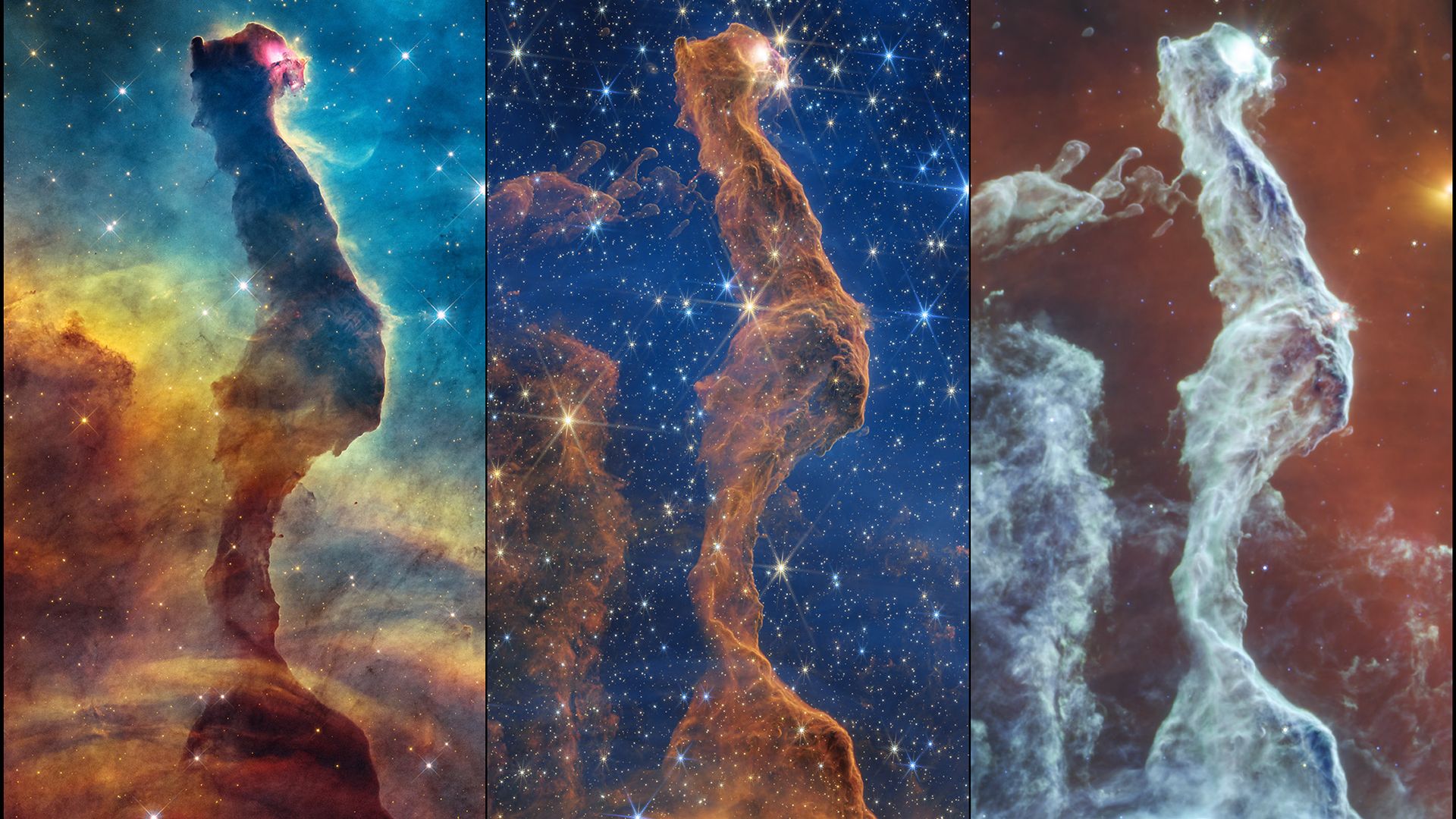
In honor of Halloween, the European Space Agency (ESA) shared three competing views of the Cat's Head Nebula — one from the Hubble Space Telescope, which captures optical light, and two from the infrared instruments aboard the James Webb Space Telescope (JWST). The three views, shown below, reveal different features of the nebula in different wavelengths of light, getting progressively spookier as more color drains out of the scene.Take a look at all three images — and cast your vote for the spookiest in the poll at the end.
The Hubble Space Telescope's optical light view of the Cat's Head Nebula. (Image credit: NASA, ESA, STScI. Image Processing: J. Depasquale (STScI), CC BY 4.0 INT )
Observing the nebula in the same visible wavelength range that you could see through a strong backyard telescope, Hubble highlights the dark pillar of dust that has survived the ultraviolet assault of nearby stars. The wispy edges at the right of the column show where starlight is evaporating the gas around it, slowly whittling it away to nothing.
The glow of blue, yellow, orange and red light around the dust pillar mark where starlight is interacting with different gas molecules, including oxygen, hydrogen and sulfur, according to ESA. The process is similar to how different molecules in Earth's atmosphere produce different-colored auroras when excited by solar radiation — just on a much grander scale.
JWST's near-infrared view
The James Webb Space Telescope's view of the Cat's Head Nebula in near-infrared light. (Image credit: NASA, ESA, CSA, STScI. Image Processing: J. Depasquale (STScI), CC BY 4.0 INT)Switching to light human eyes cannot see, JWST's Near-Infrared Camera cuts through the wispier outer layers of dust to show the densest material at the column's center. Countless additional stars and galaxies appear in the field of view as their infrared glow penetrates the surrounding material.
Here we see a more complex, turbulent column, showing how stellar radiation is carving up the inside of the cat's head as well as its edges. JWST's view also illuminates a disembodied, hand-like structure to the left of the cat, reaching out as if to pet its cosmic companion.
JWST's mid-infrared view
The James Webb Space Telescope's view of the Cat's Head Nebula in mid-infrared light. (Image credit: NASA, ESA, CSA, STScI. Image Processing: J. Depasquale (STScI), CC BY 4.0 INT)Related stories28 gorgeous nebula photos that capture the beauty of the universeCosmic 'seagull' locks eyes with the Vera C. Rubin Observatory in long-awaited test image — Space photo of the weekWitch's head to God's eye: 12 of the spookiest objects in the universe
The final view, taken with JWST's Mid-Infrared Instrument, cuts to the ghostly core of the nebula, showing little more than smoky, bluish light. According to ESA, these are the emissions of molecules called polycyclic aromatic hydrocarbons — typically colorless molecules of carbon and hydrogen related to combustion.
While most starlight disappears in this view, a strange new bright spot emerges to the right of the cat's head. This orange speck is a true mystery, according to ESA, and its relationship to the rest of the nebula is unknown.
Hence then, the article about hubble and webb spot something ghostly happening in the cat s head nebula was published today ( ) and is available on Live Science ( Middle East ) The editorial team at PressBee has edited and verified it, and it may have been modified, fully republished, or quoted. You can read and follow the updates of this news or article from its original source.
Read More Details
Finally We wish PressBee provided you with enough information of ( Hubble and Webb spot something ghostly happening in the Cat's Head Nebula )


Also on site :
- In 1957, Ford launched the Edsel after spending $250 million developing it; two years later Ford discontinued it, having lost $350 million
- In 1948, William Rosenberg used $1,500 in war bonds and a $1,000 loan to open his first coffee shop; Dunkin’ Donuts later sold for $11.3 billion to Inspire Brand
- In 1889, Emile Zatarain began selling root beer from a New Orleans grocery; his family’s spice company sold to McCormick for $180 million in 2003