
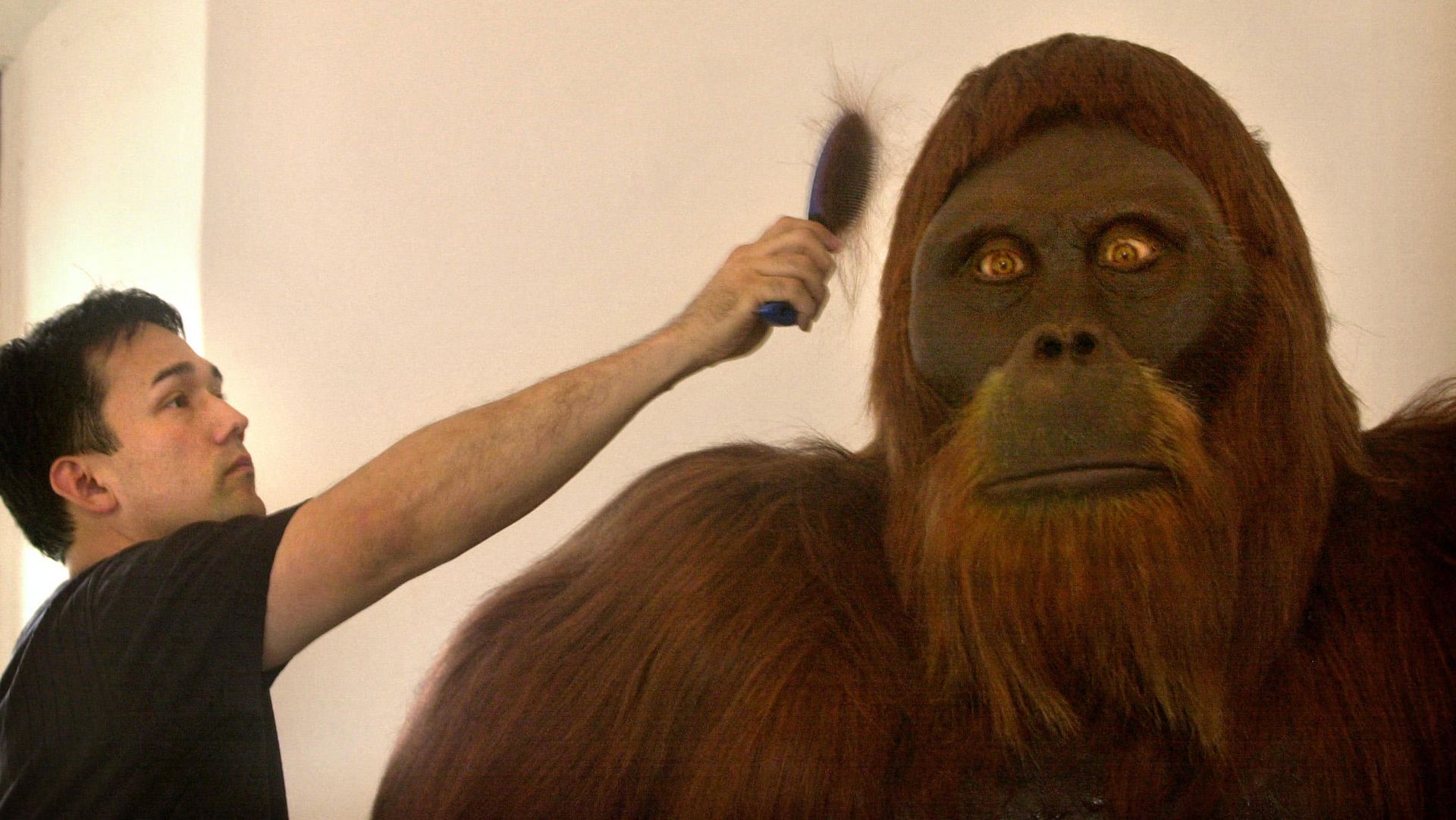
At nearly 10 feet (3 meters) tall and around 500 pounds (230 kilograms), Gigantopithecus was the largest primate that ever lived.
Foraging across the dense tropical forests of Southeast Asia between 2 million and 200,000 years ago, the giant ape may have shared the habitat with new arrivals — hominins such as Homo erectus. (Hominins are members of the group that includes modern humans, their ancestors and closely related species, after the evolutionary split from great apes.)
Despite their immense size Gigantopithecus mainly consumed plants and is closely related to modern-day orangutans.
So what would have happened when Gigantopithecus encountered these human ancestors?
Experts suggested a variety of possible scenarios, including that Gigantopithecus and human ancestors didn't encounter each other at all.
It's "very difficult to say with any certainty, as we have no direct evidence documenting interactions between Gigantopithecus and human ancestors," Renaud Joannes-Boyau, director of higher-degree research training at Southern Cross University in Australia and an archaeologist who has conducted extensive research into human evolution, told Live Science in an email.
What would have happened if hominins encountered Gigantopithecus? (Image credit: ZUMA Press, Inc. via Alamy)"That said, if we look at the broader pattern of human evolution, our lineage [Homo] has consistently behaved as an apex predator," Joannes-Boyau said. "Humans and our ancestors have shown a remarkable tendency to explore, exploit and, at times, eliminate large animals that shared their environment. I think it is reasonable to imagine that those interactions may have involved a mixture of indifference, curiosity and violence, depending on the circumstances."
Friedemann Schrenk, a professor of paleobiology at Johannes Gutenberg University Mainz in Germany, thinks Gigantopithecus would have likely tried to avoid humans. "Humans were and are the most aggressive primates ever on earth using tools and weapons and were probably encroaching on Gigantopithecus habitats," he told Live Science in an email. Homo erectus made use of hand axes and possibly hafted spears.
Schrenk envisions the hypothetical interactions as similar to those between modern-day humans and orangutans, which has resulted in humans encroaching on orangutan habitats and the apes' populations declining. "After all, Gigantopithecus was a gigantic orangutan," he said, noting that if there was hostility in a direct encounter, early humans would have been the aggressors.
Different environments?
Yet it's also possible that Gigantopithecus and hominins lived in different environments in Southeast Asia, which would have minimized the number of interactions they had, said Hervé Bocherens, a professor of biogeology at the University of Tübingen in Germany.
Fossilized Gigantopithecus jawbones suggest that the giant ape's diet was plant-based. (Image credit: Forrest Anderson via Getty Images)The "carbon stable isotopic ratios measured on some teeth of both taxa suggest a different habitat, closed forests for Gigantopithecus and open savannah for Homo erectus," Bocherens told Live Science in an email. However, because of limited data, "we cannot exclude that some hominins were also present in more forested environments," he added. Grinding patterns in their teeth suggest that Gigantopithecus' diet was essentially plant-based and may have included bamboo.
Related mysteriesWhy did Homo sapiens outlast all other human species?When did Homo sapiens first appear?Why did Homo sapiens emerge in Africa?
In a 2024 study, scientists investigated the demise of Gigantopithecus and found no evidence that hominins contributed to Gigantopithecus' extinction. Instead, they determined that the main cause was environmental change that resulted in a reduction in the forested environment where Gigantopithecus lived and foraged. In fact, hominins and Gigantopithecus may not have encountered each other at all, Yingqi Zhang, a researcher at the Chinese Academy of Sciences and first author of the paper, told Live Science in an email.
We can only imagine what hominins would have thought when they glimpsed these gigantic creatures. It’s not clear how hominins and Gigantopithecus would have interacted, if they ever did, said Frido Welker, a professor of biomolecular paleoanthropology at the University of Copenhagen. He thinks they would have avoided each other but they may have "been in awe when they did happen to run into each other."
See how much you know about early humans with our human evolution quiz!
Hence then, the article about what happened when humans encountered gigantopithecus was published today ( ) and is available on Live Science ( Middle East ) The editorial team at PressBee has edited and verified it, and it may have been modified, fully republished, or quoted. You can read and follow the updates of this news or article from its original source.
Read More Details
Finally We wish PressBee provided you with enough information of ( What happened when humans encountered Gigantopithecus? )


Also on site :
- Anthropic Sued for Using Elvis Presley Music to Train AI Models
- Trump: US could strike Iran on Sunday
- Cynthia Erivo Plays Glinda in ‘Nigerian Wicked’ Sketch on ‘SNL U.K.’: ‘She Wants a BBL That Defies Gravity’