
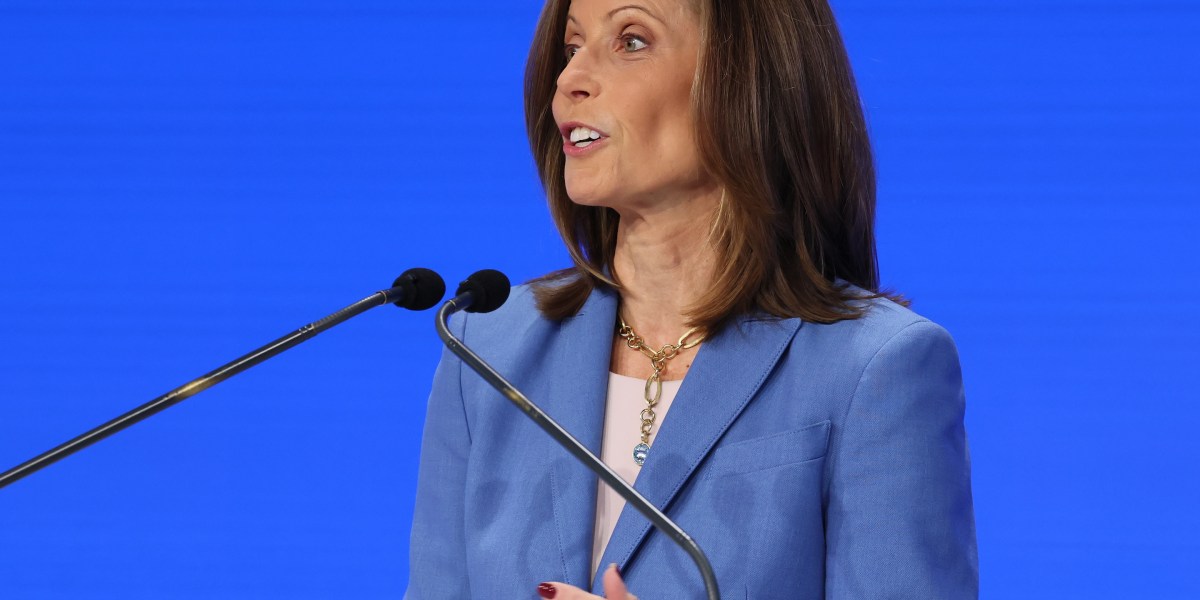
Good morning. As fraud losses mount and criminals use AI to scale their operations, Nasdaq Chair and CEO Adena Friedman is calling for a national strategy to coordinate efforts across the financial system and beyond.
Friedman proposed a National Fraud Strategy at an American Banker event on Tuesday, arguing that information sharing, common best practices and legal safe harbors could help financial institutions, technology companies, telecommunications providers and law enforcement disrupt criminal activity.
The need for coordination comes as financial crime grows. Nasdaq Verafin’s 2026 Global Financial Crime Report estimates that fraud losses reached $579.4 billion in 2025, while scam-related losses totaled approximately $62 billion.
“This challenge is simply too large and evolving too quickly for any single institution to solve alone,” Friedman said.
The challenge is becoming more complex as criminals use AI to scale and refine their attacks. For more insight, I spoke with Greg Williamson, head of fraud commercialization strategy at Nasdaq Verafin, which works with 2,800 financial institutions across North America.
“AI is starting to drive more scale, changing the economics of fraud from a criminal perspective,” Williamson said. That includes criminals using AI to automate attacks and personalize scams to reach more victims.
As financial institutions strengthen their defenses, criminals are increasingly manipulating consumers into handing over credentials or authorizing payments themselves, rather than attempting to bypass bank security controls, Williamson said.
What has he seen that is particularly concerning? “There’s a shift to scams with some sort of emotional plea—whether that’s love or fear,” he said.
Using publicly available information about victims’ relationships, finances and families, scammers create schemes that can begin with fake online listings, romance scams, fraudulent investments or impersonation attempts on social media and other platforms, he said.
I found this particularly alarming: Fraud-as-a-service tools allow criminals to outsource parts of their operations, Williamson said. They also lower the barrier to entry for anyone looking to launch their own scam operation.
This is why Friedman is calling for a framework that connects financial institutions with technology platforms, telecommunications providers, payment networks and law enforcement. Earlier intervention could help prevent victims from authorizing fraudulent payments in the first place, Williamson said.
Friedman’s proposal would build on existing public- and private-sector initiatives and could complement the nation’s anti-money laundering and countering the financing of terrorism framework, which the administration is working to modernize.
It will be key to translate coordination into practical action, including determining how organizations can share information responsibly and intervene before funds disappear.
A national strategy could help close the gaps criminals exploit. It will require a coordinated response that follows the scam from its first contact with a victim to the movement of the money.
Have a good weekend. Sheryl [email protected]
This story was originally featured on Fortune.com
Hence then, the article about nasdaq ceo calls for a national strategy as global fraud losses reach 579b was published today ( ) and is available on Fortune ( Middle East ) The editorial team at PressBee has edited and verified it, and it may have been modified, fully republished, or quoted. You can read and follow the updates of this news or article from its original source.
Read More Details
Finally We wish PressBee provided you with enough information of ( Nasdaq CEO calls for a national strategy as global fraud losses reach $579B )


Also on site :
- In 2008, Celine Dion bought a lot on Florida’s Jupiter Island for $7 million; her water park mansion there sold 9 years later for $28 million
- Dwayne Johnson and Oprah Winfrey gave $10 million to launch the People’s Fund of Maui for wildfire survivors
- In 2017, Jack Daniel’s named Nathan “Nearest” Green its first master distiller for teaching the brand’s founder to distill whiskey over a century earlier