
From the Palme d’Or-winning abortion drama 4 Months, Three Weeks, and Two Days (2007), to the institutional corruption-themed Graduation (2016) and beyond, Romanian auteur Cristian Mungiu’s body of work has always concerned itself with the human cost of systemic oppression and bureaucratic faultlines. With the searing legal and familial drama Fjord, which earned Mungiu his second Palme at the 2026 Cannes Film Festival in May, the filmmaker once again brings his signature sense of slow-burning tension to the clash between individual and societal codes of morality. Except this time, he shrewdly flips the script. With the story of a religious immigrant family of seven facing an uphill battle against Norway’s child protection services (known as Barnevernet), Fjord dares to imagine a scenario where well-intentioned progressive values can backfire as severely as rigidly conservative ones if they disregard basic human principles like empathy, compassion, and respect.
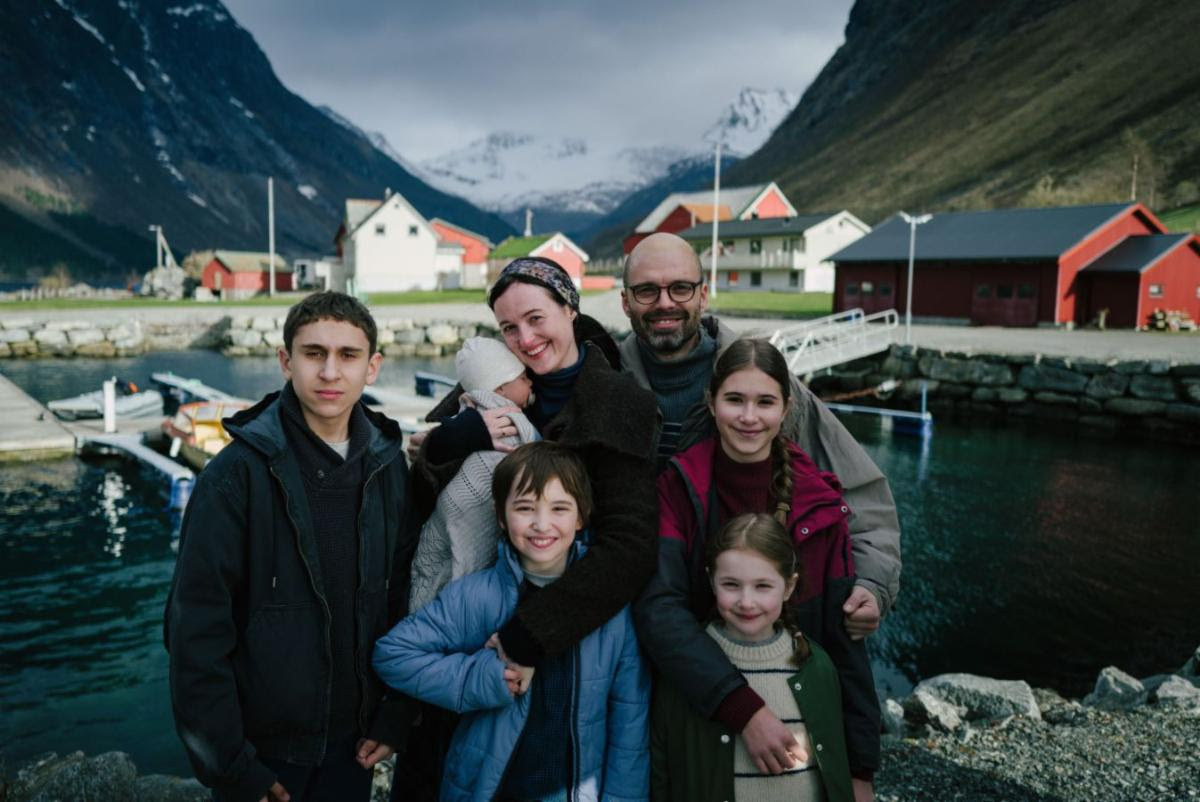
Written by Mungiu, Fjord follows Mihai and Lisbet Gheorghiu, a Romanian engineer and Norwegian nurse played by Sebastian Stan and Renate Reinsve, respectively. Set in their modest ways, the couple tries to settle into their lives in Norway, having moved there after the death of Mihai’s parents to be closer to Lisbet’s family. Raising their five children with a conservative ethos, they don’t quite mesh with the liberal community that surrounds them. But their eager kids still build close friendships with the children of their progressive neighbors, Mats and Mia Halberg, a development that further underscores the two families’—and consequently, the two belief systems’—political and practical differences.
Tensions rise in town when the kids’ school raises child-abuse allegations against the Gheorghius after teachers notice some mysterious bruising on one of their kids. While the film never spells out their precise origins, Barnevernet steps in at once, separating their five kids (including a baby, still breastfeeding) from Mihai and Lisbet, placing them in foster care after the couple admits to some physical discipline that would be considered mild in Mihai’s culture, but is against the law in Norway. Claiming that they are being harshly discriminated against due to their religion and conservative beliefs, the couple asks help from Mia, an attorney, to represent their case in the Norwegian court.
Stan and Reinsve as Mihai and Lisbet Gheorghiu —Courtesy of Neon
Joining TIME on Zoom recently, Mungiu emphasizes that “the film is fictional. It’s not a reenactment associated with any one particular case.” Still, there were a number of real-life court cases that intrigued him as a storyteller with a journalism background. Chief among them was that of the Bodnariu family, who occupied international headlines for several months after they were separated from their five children in November 2015. Pentecostal parents Ruth and Marius were accused of domestic violence, with worldwide protests criticizing what dissenters called harsh and hasty steps taken by Norwegian social workers without proper evidence. In Romania, one of the indirect results of the wildly popular case went as far as a constitutional referendum in 2018 that aimed to alter the definition of a traditional family and prevent same-sex marriages. (The referendum eventually failed due to low turnout.)
“So you couldn’t avoid the Bodnariu case,” recalls Mungiu. He followed the story as it remained in the papers, and during that time and the years that followed, Mungiu began to notice other cases that displayed a similar pattern. “Whenever there was this encounter between, let's say, families coming to Scandinavia from more conservative parts of the world, there was a cultural clash.” What eventually convinced him to pursue the topic through a film was a recent-enough realization that the world somehow became more illiberal than it used to be. “I thought that through this story, I could talk about the [confrontational] state of the world today. People are not listening to the other group. I hope that the world can be a bit more rational than this.”
Upon deciding to write Fjord, Mungiu read everything he could online, moving to Norway for several extended periods to investigate the country’s child-protection laws and relevant cases on the ground. His process involved talking to several families involved with child protection cases and their relatives, as well as journalists who covered cases like the Bodnarius’, court interpreters, police officers, NGO representatives, and various different religious groups. “Finally, I talked to Barnevernet about these cases in general,” he adds. “They were willing to also give details about how things have changed.”
One key tool Mungiu didn’t have access to was the recording and transcription of the Bodnariu trial, which is among the reasons why Fjord had to be largely fictional. “Norwegian authorities said only the family could have access to the recording if they came over. But the family knew that they couldn’t come over. Because if they did, they could be arrested,” he explains. “The family was trying to get their justice in the European Court of Justice, but they first had to utilize all the legal procedures [in Norway]. And because they left Norway before having a final decision about their proceedings, they couldn't get a positive answer from the European Court of Justice.”
The audience is on trial too
Vanessa Ceban, at the piano, plays eldest daughter Elia —Courtesy of NeonTo accentuate the connection between Fjord’s searching themes and lean visuals, Mungiu purposefully embraced long shots and continuous takes beginning during the scripting phase, in order to fully immerse the audience in the conflicting world of the characters in a neutral fashion. Indicating that he avoids many of the mainstream filmmaking methods that he finds manipulative, “I don't use anything [distracting] within the scene,” Mungiu says. “I don't use coverage. I don't use music. I don't have funny angles. The camera doesn't move unless it follows a movement in the shot. I try to do this in a sober way, just with the actors and their emotions. I think it's a respectful way of telling the audience, ‘You are adults like we are, you are as smart as I am, so feel free to see [for yourself] what's more important in this shot, or who the main character is.’”
Similarly, he carefully scouted locations in sync with his ideas around isolation and lack of communication. “It was important for us to set this story in a small community, with two houses at the end of this fjord in a lovely but somehow curled world,” he explains. “It’s very majestic, and [it’s a location where] people will have to talk to one another eventually because there's nobody else around.”
He remembers an anecdote about the real inhabitants of the two houses he uses in the film for the Gheorghius and Halbergs, who were in fact not communicating with one another. That all changed shortly after the production convinced one of them to allow the film crew to shoot in his house. Mungiu recalls the homeowner saying, “I will let you, but my neighbor is very grumpy. He hasn’t talked to me in the 10 years that we have been neighbors, so you are going to have problems with him." But when the crew contacted the owner of the other house, they found that he was quite open-minded. “We asked him, ‘Do you have a conflict with your neighbor?’ He said, ‘No, but none of us have started a conversation, so I let him enjoy his privacy.’ At the end, they were communicating normally, and we had a very good relationship with both of them.”
No matter how neutral Mungiu tried to stay throughout his research process, there were some moments that made him face his own biases. “I went [to Norway] with this idea that I will meet a society that is not at all religious. This is the idea that we project onto the Protestant north.” As such, he was surprised to notice deeply rooted religious leanings there, especially among older people with a connection to the Norwegian church. He also learned about the younger population’s attraction to new neo-cult movements. “I watched at least a couple of documentaries about this phenomenon. People are really worried that the younger generations are [drawn to] these new cults. So I noticed that the people there are just as inclined to have religious beliefs as any other.”
With this discovery, Mungiu eventually eliminated various scenes in Fjord which would have insinuated that Norwegian people saw the world in a more rational way only because they weren’t religious. “Making decisions on rational grounds is of course a very good thing to do,” Mungiu explains. “But [there is also] this need of belonging to something bigger than just [rationality] that we all feel. Some people still long for the discomfort that there's something bigger than them. And as long as this belief places them on the right side of the world through [tolerance] and [inclusivity], I think we should be tolerant to it.”
“You shouldn't answer radicalization with radicalization”
Sebastian Stan in Fjord —Courtesy of NeonHis time in Norway also led Mungiu to learn more about the Sami people. “I didn’t know much about them before, but the Sami population sets a good [historical] example about how bigger communities and countries were not acting in an ethical way towards minorities. You can see this in the U.S. as well, [in the way] Native Americans were treated,” he adds. “And I think that we should learn from this [that] maybe this ‘we want to civilize you’ idea is not the most ethical one,” he reflects, clarifying that while everyone should obey the laws and respect the culture of the country they live in, real integration cannot happen by enforcing one’s own values onto others. “That won't change [the way] someone thinks. You will just frustrate them, [reinforcing] that there is a hypocrisy in the world.”
Mungiu cautions against the ongoing ideological war that he says is moving in the wrong direction across the globe. “I don't want to be preachy, but hopefully there's something that stays with you after you watch a film like Fjord,” he reflects. “I took the risk of talking about things that people need to listen to even if they’re not nice. Don't kill the messenger. It's time to start to have a dialogue and this is what cinema can do.”
Hence then, the article about the real child protection cases that loosely inspired fjord was published today ( ) and is available on Time ( Middle East ) The editorial team at PressBee has edited and verified it, and it may have been modified, fully republished, or quoted. You can read and follow the updates of this news or article from its original source.
Read More Details
Finally We wish PressBee provided you with enough information of ( The Real Child Protection Cases That Loosely Inspired Fjord )


Also on site :
- In 2008, Celine Dion bought a lot on Florida’s Jupiter Island for $7 million; her water park mansion there sold 9 years later for $28 million
- Dwayne Johnson and Oprah Winfrey gave $10 million to launch the People’s Fund of Maui for wildfire survivors
- In 2017, Jack Daniel’s named Nathan “Nearest” Green its first master distiller for teaching the brand’s founder to distill whiskey over a century earlier