
The United States is home to most of the world’s leading AI companies — yet many Americans don’t feel they share in the abundance. AI is fueling unprecedented growth and wealth creation. In the first half of 2026, tech-focused hedge funds returned 27% on average; the Nasdaq-100 rose about 20%. But many citizens don’t own that innovation and so miss out on its profits. As AI scales, that gap is likely to widen, not close. There is a way for more Americans to share in the upside of AI.
How can more Americans benefit from our nation’s ingenuity? Make more Americans owners. “Innovation Accounts,” modeled on Trump Accounts for newborns, would put seed money into a technology-stock index on behalf of adults, giving each of them a stake in America’s technological engine.
OpenAI has reportedly floated the idea of giving the government up to a 5% stake in the company and suggested other leading AI companies do the same. Both President Trump and progressive Democrats have floated public ownership stakes in AI companies, as Fortune has reported. However, governments make poor stock-pickers. Better to let individuals own the upside directly. The math is simple. $1,000 invested in the Nasdaq-100 a decade ago — which has returned 21% annually — would be worth $5,727 more today. Seed ‘innovation accounts’ with $5,000, and that’s $28,635 in gains.
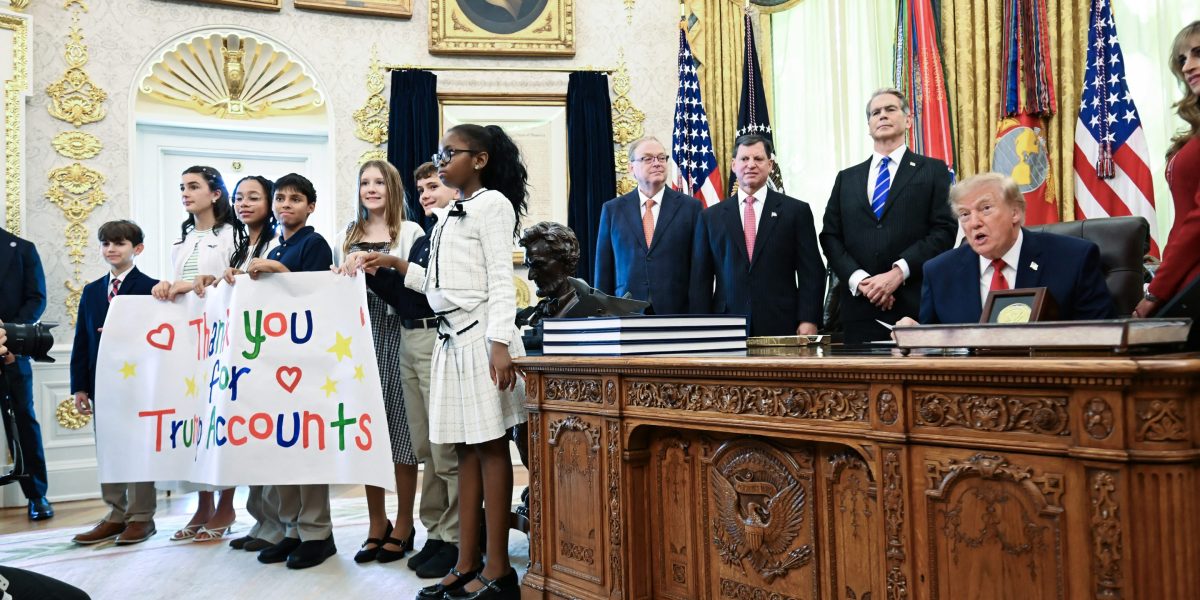
There is a precedent — this idea is an extension of one that is already law. Trump Accounts, created under the One Big Beautiful Bill Act, give American children born from 2025 through 2028 a $1,000 government-funded stake in the stock market. Alaska has run a version of this for decades: its Permanent Fund invests a share of the state’s oil wealth and pays nearly every resident, children included, an annual dividend from the earnings. A private-sector asset manager would invest the innovation accounts under government oversight, with participants able to cash out gains at specific intervals, potentially every couple of years.
Investing in individual stocks carries risk, but a diversified technology index fund would give more Americans access to the upside of AI-driven productivity growth. Just 58% of American adults own stock, Gallup found in April, much of it held in retirement accounts. That means most people are exposed to AI’s downsides — rising electricity costs, potential job disruption — without any claim on its upside. Innovation Accounts would close that gap. Giving Americans $1,000 or $5,000 invested in a technology index is a straightforward idea; The source and use of the funds will likely be of great debate. Federal or state governments could seed the accounts, but philanthropy offers a faster, deficit-neutral start. The beneficiaries of AI – founders, early employees, investors and the foundations at labs like OpenAI and Anthropic – are a natural source of capital for this idea given the meaningful liquidity around the corner.
The hardest design question is eligibility. Opening $1,000 accounts for every American over 18 years old (when Trump accounts end) would cost roughly $270 billion. Limiting it to households with wealth under $500,000 — about 70% of Americans — cuts that to $190 billion. The program could also be targeted rather than universal — triggered by sector-specific unemployment spikes, income level, or geography, so the money flows first to the workers AI disrupts most. For example, an “unemployment trigger” could target those in highly impacted sectors: if unemployment in your sector (by NAICS code) runs 1.5x of the average unemployment level in your sector for the past 10 years, you qualify. Hopefully, other economists will offer even more elegant targeting solutions.
The broader idea of “universal basic capital” for everyone, not just those affected by AI, has drawn support from figures as varied as MIT economist David Autor, OpenAI’s Sam Altman and Senator Bernie Sanders. The practical question is scope. A $5 billion pilot, plus administrative costs, could seed 1 million accounts at $5,000 each. If it works, the government or philanthropists could scale it over time.
An extra $6,000 or $29,000 in gains over a decade won’t replace a lost job. But it gives people capital to retrain, start a business, or navigate whatever comes next — on their own terms. A philanthropic pilot could start compounding those returns today, without waiting on Congress. Of course, the Nasdaq-100 or a similar tech-heavy index, isn’t guaranteed to deliver 21% returns each year for a decade going forward. But when it does deliver, more Americans can win. Rather than a direct cash transfer, this is investing in more Americans benefiting from our country’s innovation prowess.
We are home to most of the world’s leading AI labs and attract more private AI investment than any other country. Many other countries and even continents would kill to have this level of ingenuity on their shores. It’s no accident America built the labs driving this AI revolution and their continued success is a common project. If Americans don’t feel they’re sharing in what the labs and other AI leaders create, the backlash will land on the innovators as much as anyone.
No one knows exactly what magnitude of job displacement AI will cause — we won’t know until it arrives. But uncertainty isn’t a reason to wait or do nothing. It is a reason to build a plan, fund it, and hope we never need it. As a country, we need the economic infrastructure to help Americans absorb these shocks, and Innovation Accounts would strengthen households’ balance sheets in a time of significant disruption and abundance.
Ingenuity is central to the American story. So is sharing in its abundance. This proposal isn’t partisan — it’s patriotic.
The opinions expressed in Fortune.com commentary pieces are solely the views of their authors and do not necessarily reflect the opinions and beliefs of Fortune.
This story was originally featured on Fortune.com
Hence then, the article about innovation accounts should do for the potential ai job wipeout what trump accounts did for children was published today ( ) and is available on Fortune ( Middle East ) The editorial team at PressBee has edited and verified it, and it may have been modified, fully republished, or quoted. You can read and follow the updates of this news or article from its original source.
Read More Details
Finally We wish PressBee provided you with enough information of ( Innovation Accounts should do for the potential AI job wipeout what Trump Accounts did for children )


Also on site :
- Iran offers US deal to reopen Hormuz within a week
- Coalition intercepts two Houthi ballistic missiles, three drones
- Clive Barker Teases ‘Hellraiser: Revival’ Video Game Has Reignited “Many Ideas” For Film Franchise: “Planning To Keep My Fingers In That Pie”