
One would hope that, after the push-and-pull of trying to do the right thing, Lee Raybon (Ethan Hawke) would have learned a thing or two.
The prickly protagonist of “The Lowdown” strutted down Tulsa’s streets during the Season One finale after earning citywide praise for his tribute to the late Dale Washberg. His essay helped guide Dale’s brother Donald (Kyle MacLachlan) toward a path lit by moral clarity; Lee even held it together through his ex-wife Samantha’s (Kaniehtiio Horn) wedding to Johnny the amiable dentist (Rafael Casal) and a searing conversation with his daughter Francis (Ryan Kiera Armstrong).
So it comes as a shock, albeit a welcome one, that creator Sterlin Harjo wastes no time in the Season Two opener cutting our hero down to size. Lee proposes marriage to the most recent woman in his bed, struggles to take pride in his achievements, and, at a journalism awards banquet, makes a mushroom-gummy-and-whisky-soaked hash of accepting a prize for the Washberg essay.
But this banquet sets the stage for the entire season: Francis witnesses her father’s mess and is disgusted, launching one of two deeply moving father-child arcs. Journalists in attendance take umbrage with Lee looking down on how their publications survive—not everyone can be a truth-storian in, to quote the paddlefish caviar smugglers from season one, “‘Saturday Night Fever’ pants.”
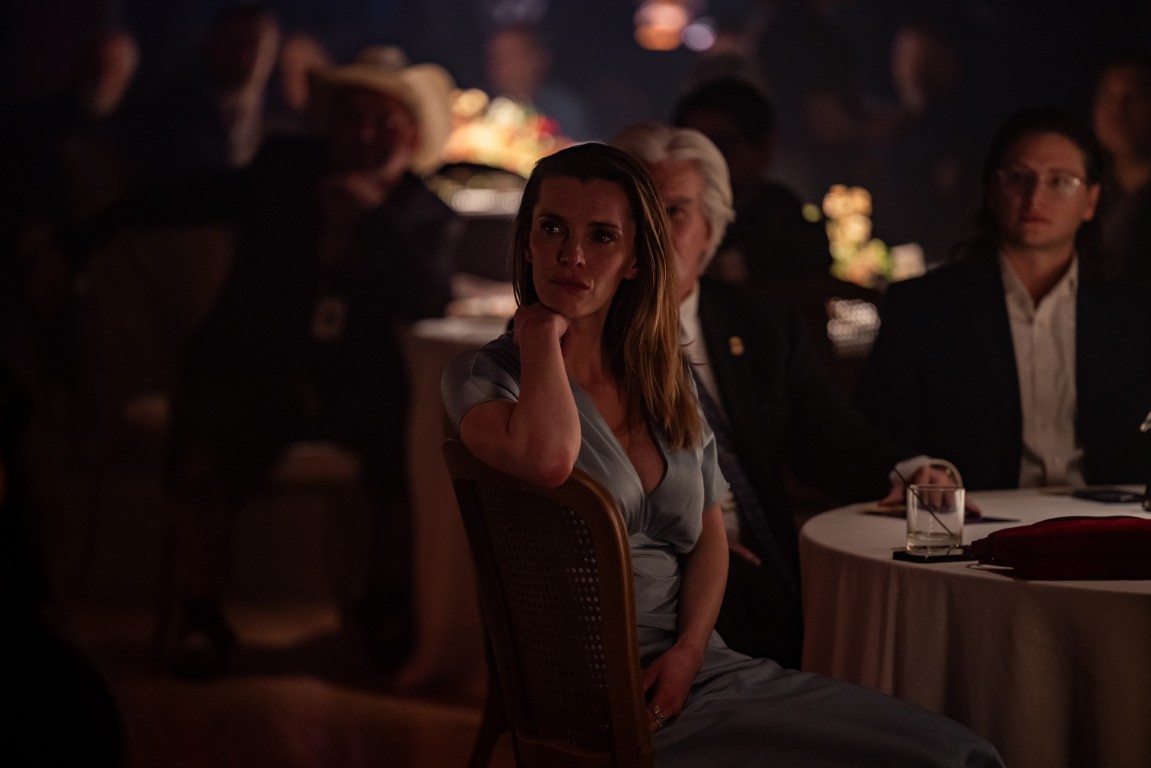
FX’s The Lowdown — “Rupidoop” Season 2, Episode 1 — Pictured: Betty Gilpin as Ginger. CR: Shane Brown/FXAt this banquet, Lee meets Ginger Rafferty (Betty Gilpin, to whom this season belongs), a lone figure in a cool blue gown. She looks like a femme fatale right out of “Chinatown,” but in fact she’s a public defender, worried she’s being followed, even more worried that one of her clients has gone missing inside a prison. Ginger’s quest for the truth draws Lee to her, and though she can see through his swashbuckling façade like a freshly washed window, she too begins to lean on him, while declining his romantic interest, as ports in a corrupt Oklahoma storm are few and far between.
It is nothing short of a pleasure to watch Gilpin and Hawke team up. Ginger justifiably calls Lee out for his judgment errors and idiocy, but the sincerity in his eyes helps her, and us, know he’s by her side for the right reasons. In season one, Lee played the funny man, charming his way into writing assignments, walking out of editors’ offices with spare revolvers. Now Hawke and Gilpin take turns, easily switching between straight man and foil. And the latter is the rare, true theatrical clown: at multiple moments throughout this season, Gilpin elicits laughter from the viewer despite tears running down her face.
Though Gilpin is certainly part of this season’s powerhouse, she’s not alone. Tommy Lee Jones, so restrained you can practically hear him breathe, adds considerable complexity as Lee Raybon Senior. Nary a happy word has left Lee Jr.’s mouth about his dad, from whom he’s been estranged for years, and the patriarch’s reappearance in his life upsets Francis, who has always been told that her grandfather was dead. This fiction, combined with Lee’s slovenly awards speech, strains her relationship with her father. She demands to get to know Lee Senior on her own terms, as does the latter; such opposition to lifelong resentment and a closely-held lie just about sends Lee Jr. over the edge.
Lee accuses his father of abandonment, tells him not to leave the bookstore or contact Francis, then storms out to resume his investigation. In his absence, Lee Senior befriends bookstore employee Deidra (Siena East), record store owner Abel Bell (Josh Fadem, who thankfully gets a bit more to do this season), and, of course, Francis.
This creates extraordinary emotional layers in the storytelling. Two fathers consider the impact their penchant for adventurous neglect has had on their respective offspring; Lee Junior slowly begins to assess how much of his rage was ever designed to protect Francis and how much is about his own pain. And though he promised to be better than his father, isn’t Lee—who once told Francis that he wanted to show up for her not by being present at parent-teacher conferences but by being someone worth admiring—just a chip off the old block?
Jones is perfectly cast. (Chalk up yet more victories for casting director Angelique Midthunder.) From Lee’s stories, the viewer would expect a caustic, abusive father, but instead we get a contemplative man who speaks only when he has something to say, who doesn’t repent the past but focuses on what he can make of the future. Every time Hawke blusters and rages, Jones seems to lower his affect further. This creates an undercurrent of humor and tension, and a power vacuum across which both characters eye each other with suspicion.
FX’s The Lowdown — “Whiskey Bent and Hell Bound” Season 2, Episode 2 — Pictured: Tommy Lee Jones as Frog. CR: Shane Brown/FXBut Gilpin and Jones aren’t the only casting wins here. Armstrong continues to do a crackerjack job holding her own against actors many decades her senior; it’s a hoot watching her go toe-to-toe with Hawke, especially. Casal steals every scene he’s in, and Horn remains as arresting as ever, though I wish she had a bigger role. Martha Plimpton is terrifying as a tough-as-nails county sheriff—never has a blonde Karen wig made an actress look more sinister—who shares an uneasy alliance with a venal judge (John Hawkes, always welcome). Paul Schneider devastates the audience as a heartbroken prison guard; his role reflects this season’s many reflections on how ill-equipped men are to handle loneliness.
Perhaps my favorite supporting role, however, comes courtesy of Austin Amelio, who recently starred with Hawke in the excellent film “The Weight.” I cannot reveal too much, but Amelio pairs his character’s wiry menace with a surprising fount of physical comedy.
As in season one, season two’s central mystery walks side by side with character development, riotous humor, references to a writer’s life, and even nods to “Reservation Dogs,” including some familiar faces. All of this makes for great TV on its own. But Harjo and his writers seem to realize that the megaphone in their hands is an opportunity. They take the time to explain why their characters are the way they are, because that often also explains the rotten state of the systems (prisons, academia, museums) people have built.
“The Lowdown” suggests that seeking the truth and fighting evil isn’t simple, but when you build community—friends, colleagues, neighbors, sources; hell, even lovers—taking on the bad guys can feel less like going to war and more like building the world you want to live in. Great TV is one thing. This show is in a league all its own.
Whole season screened for review. Airs Wednesdays on FX and Hulu.
Hence then, the article about the lowdown darkens and deepens in a terrific second season was published today ( ) and is available on Roger Ebert ( Middle East ) The editorial team at PressBee has edited and verified it, and it may have been modified, fully republished, or quoted. You can read and follow the updates of this news or article from its original source.
Read More Details
Finally We wish PressBee provided you with enough information of ( “The Lowdown” Darkens and Deepens in a Terrific Second Season )


Also on site :
- APOD: 2026 October 14 – Mars and the Beehive Under an Aurora
- Costco’s Exclusive ‘KPop Demon Hunters’ Trading Card Set Includes 11 Rarity Levels & A Character-Inspired Frame
- Walmart’s Dainty Birthstone Leaf Necklace ‘Looks Super Expensive’ and Makes a ‘Gorgeous’ Gift, Now 88% Off