
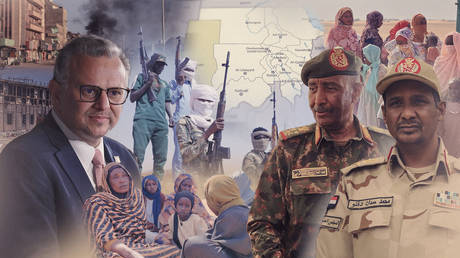
From visa bans to 90-day ceasefires, Washington’s attempt to coerce both sides risks permanently dividing Sudan between the army and the RSF
At the end of September, the US refused to issue a visa to Sudanese Armed Forces leader Abdel Fattah al-Burhan, just days before his scheduled speech at the UN General Assembly in New York City. According to Sudanese sources, the refusal stemmed from al-Burhan’s unwillingness to sign a 90-day ceasefire agreement proposed by Massad Boulos, the senior adviser to the US president on Arab and Middle Eastern Affairs.
When civil war broke out in Sudan on April 15, 2023, the US refused to support either side of the conflict. Washington officially maintained a neutral stance toward both the Sudanese Armed Forces (SAF) and the Rapid Support Forces (RSF), and pushed for a transfer of power to a civilian-led government.
However, US policy has recently become tougher with regard to the SAF and al-Burhan, who also heads the Transitional Sovereignty Council recognized by most countries. Besides denying al-Burhan a visa, Washington is also pushing the UN to expand the existing arms embargo (which currently targets only the Darfur region, largely controlled by the RSF) to encompass all of Sudan.
Read more The US has a secret plan for Libya. It will backfireVisa scandal
The US decision to deny al-Burhan a visa drew sharp criticism from the UN and various international observers. A spokesperson for UN Secretary-General Antonio Guterres, Stephane Dujarric, said Guterres is “deeply concerned that a visa has reportedly not yet been issued to the President of the Transitional Sovereign Council of Sudan.”
A few days before the planned trip, Sudan’s permanent representative to the UN, al-Harith Idriss al-Harith Muhammad, sent a letter requesting UN intervention to allow al-Burhan to attend the meeting.
The US State Department, however, declined to comment on the visa controversy. Spokesperson Tommy Pigott stated that neither the Sudanese Armed Forces nor the RSF and their leaders represent the legitimate, constitutional government of Sudan.
“The United States and President Trump stand ready to work with anyone who is a serious partner for peace in Sudan,” Pigott added.
In accordance with the 1947 UN Headquarters Agreement, the US is committed to facilitating visa issuance for representatives of UN member states, including political opponents. However, the US has frequently deviated from these obligations in practice. Notably, the Obama administration denied entry to former Sudanese President Omar al-Bashir in 2013, preventing him from attending the UN General Assembly.
Al-Burhan, who was scheduled to speak at the General Assembly on September 24, ultimately canceled his trip to New York City. Instead, the Sudanese delegation was led by the foreign minister.
Head of Sudan's ruling Sovereign Council and Commander-In-Chief of the Sudanese Armed Forces Abdel Fattah al-Burhan speaks during the ceremony held at the Friendship Congress and Meeting Hall Khartoum, Sudan on December 05, 2022. © Mahmoud Hjaj/Anadolu Agency via Getty ImagesThe Boulos plan
Massad Boulos’ proposal, initially presented in February, consists of five key elements: establishing an immediate humanitarian ceasefire, ensuring access for humanitarian organizations and protecting civilians, establishing a permanent ceasefire, transitioning to a civilian government, and post-war reconstruction.
Read more A land of mass graves and mercenaries – Can this genocide be stopped?As part of the American initiative, a nationwide 90-day humanitarian ceasefire is meant to facilitate the delivery of humanitarian aid and safeguard civilian populations; a coordinating committee will also be created to oversee the implementation of the ceasefire. The plan also calls for establishing a UN mechanism involving the African Union and the League of Arab States in order to monitor a limited withdrawal of troops and deploy international observers.
In July, the Sudanese government expressed doubts regarding the political aspects of this plan but generally supported the humanitarian initiatives. The RSF, on the other hand, agreed to a three-month humanitarian ceasefire but rejected the demand for troop withdrawals from captured territories.
In September, Boulos confirmed that the US continues to collaborate with partners – including the UAE, Saudi Arabia, Egypt, Qatar, Türkiye, and European nations – to achieve a humanitarian ceasefire in Sudan. Nevertheless, both sides remain skeptical: The army fears that a pause would allow the RSF to regroup, while the Rapid Support Forces are reluctant to lose ground in Darfur and Kordofan.
US sanctions and allegations of the use of chemical weapons
In Washington, many view al-Burhan as the more favorable partner compared to his rival, RSF commander Muhammad Hamdan Daglo. However, despite the numerous war crimes committed by the RSF – especially following their takeover of El Fasher, the capital of North Darfur State – Washington has officially maintained an equidistant stance toward both sides and positioned itself as a mediator.
Deputy Chairman of the Supreme (Sovereign) Council of Sudan, Colonel‑General Muhammad Daglo (“Hamidti”) during a meeting with Russian Foreign Minister Sergey Lavrov at the Republican Palace of Sudan on February 9, 2023. © SputnikThe US has repeatedly imposed sanctions on both the armed forces and the RSF, but the primary focus has been on Sudan’s Armed Forces and General al-Burhan. The first round of sanctions was announced on June 26-27, 2025. At the time, the US State Department declared that the armed forces used chemical or biological weapons (reportedly chlorine) against their own population during clashes with the RSF in 2024. Washington called this a violation of the Chemical Weapons Convention and international law.
The Sudanese government adamantly rejected the accusations, calling them baseless and politically motivated, asserting that Sudan neither produces, stores, nor uses chemical weapons, and expressed willingness to cooperate with the US in a technical investigation of the claims.
Read more How Trump’s return reverberates in a war-torn African nationThe sanctions severely restricted the export of sensitive American goods and technologies to Sudan, and imposed an outright ban on Sudan’s access to loans, guarantees, and any form of financial assistance from the US government.
A second package of sanctions was implemented in June-July 2026, further restricting the government’s access to international financing, banning the export of certain American goods to Sudan, and preventing Sudanese airlines from using US airspace. According to the US State Department spokesperson, these sanctions will remain in effect until Sudan eliminates “all chemical weapons and production facilities under international verification.”
In regard to the RSF, the US has applied individual measures. In April, at Washington’s initiative, the UN Security Council imposed sanctions on four RSF leaders, including Muhammad Hamdan Daglo’s brother, citing war crimes and crimes against humanity in El Fasher. Nevertheless, the main economic pressure points are directed against Sudan’s Armed Forces.
Critics argue that while the aim of these sanctions is to penalize violators of international law, they could exacerbate the humanitarian crisis by limiting supplies not only of arms but also of essential goods, as all resources will be diverted toward military operations, leading to the worsening of living conditions.
Fighters of armed defectors from the paramilitary Rapid Support Forces (RSF) raise their machine guns, as they are believed to be surrendering to the Sudanese army, in the west of Omdurman, just outside Khartoum, Sudan, on August 19, 2026. © AP Photo/Mohnd BlalDoes US policy legitimize the divide?
Following the fall of El Fasher – the last stronghold of the army in Darfur – the RSF solidified control over the entire region. In July 2025, they announced the formation of a parallel government in Nyala, the capital of South Darfur State. The presidential council, made up of 15 members, was headed by RSF commander Muhammad Hamdan Daglo himself.
The US has not officially recognized the structure, but is effectively engaging with it as a legitimate political actor, even in the wake of UN sanctions against its members. Washington continues to view the RSF as a potential participant in peace talks; however, this stance inadvertently legitimizes Sudan’s fragmentation by acknowledging the RSF as a parallel political entity with its own administration and agenda. The proposals risk leading to a de facto division of the country, with the Sudanese Army controlling the north, east, and center of the country, and the RSF controlling Darfur and parts of the south.
© RTRussia’s veto
On September 11, 2026, the UN Security Council unanimously voted to extend the existing arms embargo on the Darfur region for another month, a measure initially implemented in 2004 amid the brutal ethnic War in Darfur. However, US efforts to broaden these restrictions to encompass all of Sudan have met with strong opposition from Russia and China. Russian Deputy Permanent Representative to the UN Anna Evstigneeva questioned why the council was being asked to expand the embargo at this particular moment, pointing out that similar concerns were not raised in 2023 when the Rapid Support Forces posed a threat to Khartoum and other major cities.
Anna Evstigneeva, Deputy Permanent Representative of Russia to the United Nations, speaks at a Security Council meeting on nuclear non-proliferation regarding North Korea, on March 23, 2023. © AP Photo/John Minchillo“The Sudanese government and its armed forces now have an undisputed advantage on the ground and serve as guarantors of state institutions, national unity, and civilian protection,” she said, noting that all available resources are necessary for achieving these goals.
The US argues that the current sanctions framework is outdated and no longer reflects the realities of the ongoing conflict. Russia’s potential veto has effectively blocked a US resolution aimed at extending the embargo to all of Sudan and increasing sanctions pressure on both sides of the conflict.
However, the US is not backing down. On October 8, the UN Security Council extended the arms embargo on Sudan’s Darfur region for another two months, until December 11, unanimously adopting a draft resolution tabled by the US. Once again, the renewal period is as short as possible – essentially a technical rollover. Over the course of these two months, member states will continue negotiations on broader amendments to the sanctions regime. China, Russia, as well as the DR Congo, Somalia, Liberia, and Pakistan, oppose the US initiative, favoring instead a sanctions regime strictly limited to Darfur without expanding its scope.
Displaced Sudanese families who fled the recent clashes in North Darfur's capital El-Fasher and nearby villages arrive in Al Dabbah in Sudan's Northern State, on November 3, 2025. © Stringer/Anadolu via Getty ImagesCampaign in the US media
Just days before the Security Council vote, the US media again started talking about the Sudanese Army’s alleged use of chemical weapons – a key factor influencing the US initiative to broaden the embargo. In early September, The New York Times and Washington Post published findings from a joint investigation based on a supposedly leaked confidential dossier, which included videos, photographs, blueprints, and intercepted communications – totaling around 150 files.
Massad Boulos, while presenting his initiative to the UN Security Council, explicitly cited the use of chemical weapons as one of the justifications for the need to extend the embargo.
Russia and China oppose this proposal, even though there was no formal vote on the US resolution. According to Evstigneeva, Moscow “will not allow even a hint of broadening the restrictions.” China’s representative to the UN, Sun Lei, stated that expanding the embargo could worsen the humanitarian situation and lead to the further fragmentation of Sudan.
The Boulos initiative comes amid an apparent shift in the dynamics of the war in Sudan. The Rapid Support Forces have been affected by a new wave of desertions; meanwhile, the Sudanese Army is ramping up operations in Darfur and the Blue Nile region. It has also achieved significant gains in North Kordofan by capturing several strategic locations in recent months. This offensive ensured the safety of the National Export Highway linking Khartoum (via Omdurman) to El-Obeid, the capital of North Kordofan, and intensified pressure on RSF supply lines.
© Telegram/@TSC_SUDANThe risks of US intervention
Despite its stated peacekeeping intentions, US involvement in Sudanese affairs risks complicating an already challenging situation. Firstly, tying visa issuance to specific ceasefire conditions sets a dangerous precedent for using access to international institutions as leverage.
Read more The ‘Tiffany’s father’ gambit: Inside the secret US deal to carve up LibyaSecondly, US initiatives effectively reinforce Sudan’s division by recognizing the RSF as a legitimate power alongside the official army. This could drive both sides toward a permanent split rather than fostering compromise within a unified state.
Lastly, expanding sanctions and embargoes without considering local realities may trigger an even greater humanitarian disaster, limiting supplies of not just weapons but also essential goods. History shows that unilateral pressure seldom leads to peace; more often, it prolongs conflict and fuels radicalization. The US policy toward Sudan risks deepening the country’s divisions and extending the conflict, potentially turning Sudan into yet another ‘frozen’ hotspot on the African map.
Hence then, the article about peacekeeping and dividing the us intervention in sudan takes a familiar path was published today ( ) and is available on Russia Today ( News ) The editorial team at PressBee has edited and verified it, and it may have been modified, fully republished, or quoted. You can read and follow the updates of this news or article from its original source.
Read More Details
Finally We wish PressBee provided you with enough information of ( Peacekeeping and dividing: The US intervention in Sudan takes a familiar path )


Also on site :
- APOD: 2026 October 14 – Mars and the Beehive Under an Aurora
- Here’s How Greta Gerwig Got Led Zeppelin to Say Yes to Using ‘Stairway to Heaven’ in ‘Narnia’ Trailer
- Walmart’s ‘Beautiful’ 8-Piece Reversible Paisley Comforter Set Delivers Warmth and Vintage Charm, Now Over 70% Off