
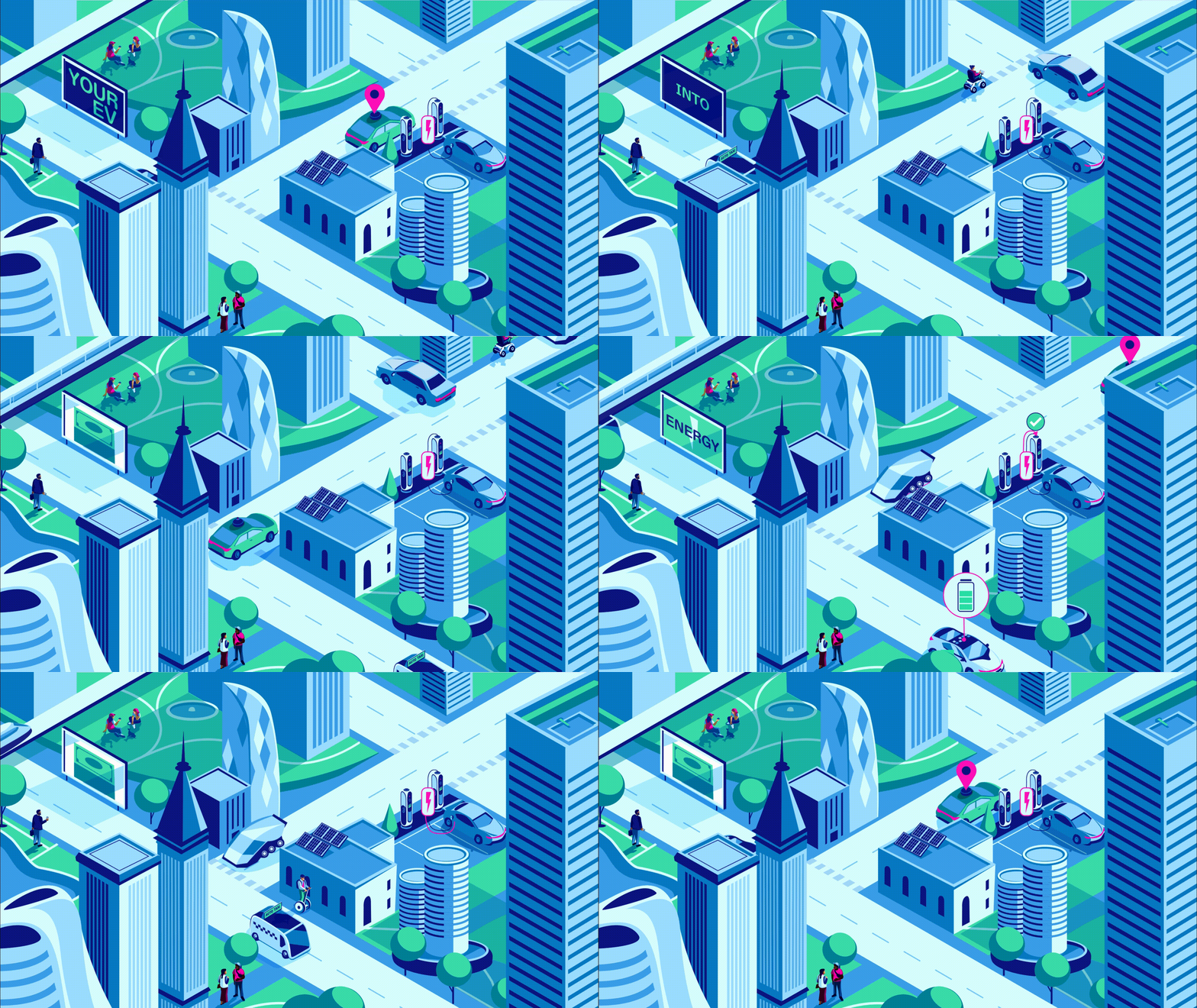
Imagine you're road-tripping across the country 10 years from now. You spend a few minutes charging your electric vehicle and then set off — and your car's solar paint keeps it charged as you drive.
Your eyes are on the stunning scenery, taking in the vistas along Route 66 or the grandeur of the Rocky Mountains, or you're catching up on messages. Your hands barely touch the wheel, and your foot doesn't push a pedal. Your car communicates with others on the road, so there's no need to brake suddenly or swerve. That's because it knows a vehicle five cars up from you has done so, and all those in between are slowing at exactly the right pace to avoid dramatic changes in trajectory.
And when you park for the night, your car makes you money, selling the excess energy it's harvested from its paint back to the grid. Or maybe you don't feel like being in the driver's seat at all, so you hail a self-driving car and take a nap in the back seat in between adventures.
Some of that scenario may become a reality in the next 10 years, at least for those who are using the most cutting-edge cars on the market. Although there's some heavy speculation involved in that futuristic vision, vehicle manufacturers are already incorporating increasingly sophisticated automated driving technology into high-end personal vehicles, and self-driving taxis are coming to dozens of U.S. cities.
What's more, dramatic changes in range, cost and charging speed for electric vehicles (EVs) are arriving at a rapid pace. While some of these technologies may not wind up in personal cars, others are already taking to the roads.
Some car models within the next decade may interact with their surroundings in new ways, including by communicating with other cars to avoid collisions, drawing energy from natural sources, or letting drivers get paid for sending their cars' unused energy back to the grid.
Some researchers are developing technology to connect cars on the road, which could make for smoother braking and less traffic. (Image credit: lupengyu via Getty Images)If you're driving an EV, you might avoid the hassle of finding a charger when you're at work or running errands. In 2024, EV company Aptera unveiled a prototype car equipped with solar panels. Those panels — on the car's hood, roof, dashboard and hatch — allow the vehicle to travel about 40 miles (64 kilometers) per day on solar power. That's more than the average American drives per day. Aptera's vehicle can also travel up to 400 miles (640 km) on a standard electrical charge.
Some sunlight-powered cars might ditch the solar panels altogether in favor of a more integrated design. In 2024, Mercedes-Benz revealed it was researching a photovoltaic paint that could convert sunlight into energy for electric cars. In sunny cities such as Los Angeles, the company calculated, the paint could draw in enough energy to power the car for nearly 7,500 miles (12,000 km) per year. The tiny particles in the paint convert about 20% of the energy from sunlight into electricity, which is comparable to the efficiency of existing solar panels.
You might even be able to sell some of the energy stored in your car's battery back to the grid. EV owners could charge during the day or late at night, when the demand for electricity is lower and pay lower rates for electricity. Then, in the evenings when the electrical grid is under more strain and the price of electricity is higher, they could sell that stored energy back at a profit.
Standardized software programs that throttle EV charging speeds during peak hours already exist. Drivers can use them if, for example, they want to keep charging costs down by primarily charging their cars during off-peak hours when electricity costs are lower, or if they want to use electricity only from solar power to charge, said Rajit Gadh, a researcher who studies EV charging and scalability at UCLA. But the process for sending energy back to the grid is a different story. Individual manufacturers haven't yet landed on a standard way to tell cars when and how much energy to discharge, Gadh said.
"What is needed is really [for] every EV charging vendor — and every EV manufacturer, actually — to have this protocol built in, adhere to it in its full specification, and make it available," Gadh told Live Science.
With the right protocols, though, cars of the future will be able to do more than interface with the electrical grid. "Vehicle-to-everything" technologies could enable cars to communicate with infrastructure and other vehicles to avoid traffic and collisions.
Some cars today are already equipped with vehicle-to-vehicle (V2V) communications. These systems use short-range radio signals to alert other V2V-equipped vehicles of the car's speed, direction of travel and braking patterns. The radio signals can travel about 1,000 feet (300 meters), allowing the vehicle to receive data from cars that are not in the driver's line of sight.
V2V systems could help reduce traffic collisions by warning drivers about oncoming cars they can't see yet — for example, by alerting a driver to another car speeding toward an intersection or coming around a bend as the driver is passing another vehicle on a twisty, two-lane highway. Not all cars have the technology, though, so its practical utility is limited for now.
Hands off the wheel; eyes off the road
Some driver assistance technologies, such as lane departure warnings and cruise control, have been on the market in personal cars for decades. These technologies and more recent assistive features require the driver to be in control of the vehicle, but theoretically, they make driving easier. For example, Tesla's Full Self-Driving (Supervised) mode handles most steering and braking tasks, but safe operation requires the driver to keep their eyes on the road and be ready to take over at a moment’s notice. In the next several years, drivers will likely see new features that automate driving in more contexts.
Some of these features will allow drivers to take their attention off the road entirely and enjoy some in-car entertainment, as long as they're alert and able to retake control of the vehicle within a few seconds if conditions change. Technologies that fully automate driving in many circumstances within certain service areas will likely be in about 4% of cars on the market by 2035, according to a white paper from the World Economic Forum.
In cars equipped with these features, "you're still going to have driver controls, but under certain circumstances, it will be effectively an automated vehicle," Luke Neurauter, who leads the Division of Vehicle, Driver and System Safety at the Virginia Tech Transportation Institute, told Live Science.
Mercedes-Benz introduced its Drive Pilot system for two consumer car lines in 2022. On the entire German Autobahn network and on certain freeways between and around Los Angeles, San Francisco and Las Vegas, during heavy traffic, the system lets the driver turn their attention toward other activities, such as reading a book or eating lunch, while the car handles steering and keeping pace with other nearby vehicles.
But as the artificial intelligence (AI) models that control autonomous driving improve and become better able to handle unusual scenarios — often called "edge" or "corner" cases — on the road, drivers will be able to hand over control to their cars in more situations, said Rahul Jain, an electrical and computer engineer at the University of Southern California.
You're still going to have driver controls, but under certain circumstances, it will be effectively an automated vehicle.
Luke Neurauter, director of the Vehicle, Driver, & System Safety Division at Virginia Tech Transportation Institute
Future AI systems might "have some reasoning ability, and then because of that, it can handle these corner cases much better than current systems are able to do," Jain told Live Science. For example, a car might be able to better respond to an indecisive pedestrian who suddenly enters a crossing, assess whether to enter potentially hazardous conditions such as flooded roads, or safely navigate around unusual circumstances, such as construction work, on a highway.
While some systems will enable drivers to make fewer decisions, others that may roll out in the next several years will track a driver's attention and alert them with sounds, an indicator light or haptic feedback when their focus falters. These systems use cameras and software to track head position, eye movement and steering-wheel input to ensure drivers are focused on the road even when they're using assistive features such as lane centering, Neurauter said.
In addition to looking for distracted driving, the technology might expand to monitor drivers for fatigue and alcohol impairment, he added. That information could then affect "whether or not other features become active, or change how they act, based on the driver state at that moment in time," Neurauter said. Proposed legislation could make this technology a requirement in new vehicles as early as 2027, but technological hurdles and concerns over privacy and false positives could stall its implementation.
The technology could also assist drivers who become unable to safely operate the vehicle — for example, if the driver falls asleep or experiences a medical emergency. If a car detects that the driver is not holding the steering wheel or actively controlling the vehicle, it could send a series of visible, audible, or tactile alerts. If the driver doesn’t respond to those cues, a car might turn on its hazard lights and come to a stop. Some vehicle manufacturers are already rolling out such technology; for example, Volkswagen has made it available in all new vehicles from model year 2025.
While personal cars may not offer full automation, highly automated car services will become much more common as rideshare vehicles in major metro areas. In some cities, like San Francisco, commuters already rely heavily on autonomous vehicles from Waymo. The company has rolled out its cars in nearly a dozen cities — including Dallas, Houston, Atlanta and Los Angeles — and has announced plans to expand service to more than 20 additional locales. Other companies — such as Nuro and Volkswagen’s MOIA — are testing their vehicles with human drivers on board before rolling out full public service.
Autonomous cars are rolling out in new regions at a rapid pace, but a patchwork of laws and regulations governing self-driving cars may affect whether they wind up in a city near you. (Image credit: Marc Dufresne via Getty Images)Currently, autonomous vehicles navigate by combining information from preloaded, high-resolution maps and real-time radar, lidar and visual data collected by cameras and sensors attached to the car. An onboard computer uses that information to build a 3D map of its surroundings. Right now, the cost of these sensors makes them impractical for consumer vehicles, Jain said, but they’re becoming cheaper as manufacturers scale up production. The cars also use an AI model trained on both common and unusual driving situations to anticipate how other vehicles and pedestrians will behave and plot a safe path forward, Jain added.
Developing those high-resolution maps takes time, which is one of the main reasons autonomous rideshares aren’t available everywhere yet. Mapping usually involves decking out a car with high-end visual sensors and lasers and driving it throughout the region. Although cities like San Francisco have been mapped with this level of precision, much of the U.S. has not.
"It's very difficult to do overnight," said John Dolan, an autonomous-driving researcher at the Carnegie Mellon University Robotics Institute.
Complexities also tend to arise in city environments, where unexpected stops are more common and there are many pedestrians who behave unpredictably or jaywalk. But interstate highway driving doesn't face as many of those obstacles, and that could enable autonomous long-haul drives.
"[Autonomous] trucking, I would expect, would be the first thing that's going to happen" in terms of autonomous travel outside of major cities, Jain said. A few driverless trucks are already on the road: Pittsburgh-based company Aurora deployed the technology on I-45 in Texas, between Dallas and Houston, in 2025, with plans to expand across the southern U.S.
Longer range and faster charging
While there's speculation involved in predicting the range of self-driving capabilities available in a decade, the picture for EVs is a little clearer.
Right now, lithium-ion batteries dominate the EV market. Each cell in a lithium-ion battery has two electrodes, commonly a layered graphite electrode and a metal oxide or phosphate electrode, separated by a liquid electrolyte solution. Lithium ions migrate back and forth between these two electrodes when a person charges and discharges the battery.
Many electric cars with lithium-ion batteries can already travel more than 300 miles (480 km) on a charge. But that's not ideal for a long-range car trip, because charging stations are few and far between in the country's vast interior and charging takes longer than filling up a gas tank.
Solid-state batteries, which replace the liquid electrolyte with a solid electrolyte made of ceramic, polymer or sulfide materials, could make that cross-country trip in an EV a practical option, allowing an electric car to travel more than 750 miles (1,200 km) on a single charge. Some prototype battery packs can already achieve this range under controlled conditions. If a solid electrolyte were paired with an anode made of pure lithium, rather than graphite or hard carbon, it would allow the battery to store more energy than a lithium-ion cell of similar mass can.
It'll be a fantastic commuter car, but you're not going to go on a family trip from Montreal to California so easily.
Eric McCalla, battery materials chemist at McGill University in Canada
Solid-state batteries may also enable faster charging. In current batteries that use liquid electrolytes, charging and discharging the battery too quickly can cause dendrites, thin branches of lithium that stretch across the cell and short-circuit the battery. A solid electrolyte could, in theory, block those dendrites, which would enable cars to charge fully in just 10 to 15 minutes. The higher energy density from a lithium metal anode also translates to a greater range than that from a similarly sized lithium-ion battery, Eric Wachsman, director of the Maryland Energy Innovation Institute at the University of Maryland, told Live Science.
Many of the raw materials that go into existing lithium-ion batteries are concentrated in a handful of geographic areas. In 2023, Australia, China and Chile mined about 85% of that year's lithium supply; China mined the majority of graphite used that year as well. And battery materials still make up a significant portion of an electric vehicle's cost.
Sodium-ion batteries could be cheaper and easier to source. Sodium is plentiful in Earth's crust, which means mining could be done throughout the U.S., potentially with a comparatively low environmental impact.
Such batteries also rely on a more widely available electrode material. Sodium ions are larger than lithium ions, so they don't fit in between layers of graphite like lithium ions do. Instead, sodium-ion batteries use hard carbon electrodes.
I would be surprised to see them in cars in the next decade. I've been surprised before, though.
Eric McCalla, battery materials chemist at McGill University in Canada
"When you cook at home and your soup boils over and you get this black ring around your pot, this is hard carbon," Maximilian Fichtner, a solid-state chemist at the Helmholtz Institute Ulm for Electrochemical Energy Storage in Germany, told Live Science. "You can produce this from sucrose or from biomass, from whatever. You can do that everywhere."
The downside is that hard carbon holds less sodium than graphite holds lithium, said Eric McCalla, a battery materials chemist at McGill University in Canada. That means sodium-ion batteries can't store as much energy relative to their mass, and they don't last quite as long as their lithium counterparts.
"The range won't be as large," McCalla told Live Science. "It'll be a fantastic commuter car, but you're not going to go on a family trip from Montreal to California so easily."
Manufacturers are already bringing sodium-ion technology to market. For instance, the Chinese company CATL began mass-producing the batteries in February and claims that their battery packs enable EV ranges over 250 miles (400 km).
But new technologies are being developed rapidly. For example, some scientists are making sodium-ion batteries that use solid electrolytes, combining the higher energy density of solid-state lithium batteries with the cost savings of sodium batteries.
This hybrid battery chemistry is still in the early stages of development, experts told Live Science. "I would be surprised to see them in cars in the next decade," McCalla told Live Science in an email. "I've been surprised before, though."
Bumps in the road
The future we're describing is the utopian scenario. But the biggest obstacles are likely not technological but rather regulatory, economic, political or cultural, experts said.
"We're going to try to guess at a timeline of when some of these things are going to come in, and odds are, we're going to be wrong," McCalla told Live Science. "Odds are, we're going to be slower than we think."
Solar panels may not wind up being the most economic or practical way to increase EVs' range, while scaling up manufacturing capacity for next-generation batteries is expensive and could slow EV adoption in the U.S. The utility of vehicle-to-vehicle communications, meanwhile, could be limited by a slow rollout and adoption of V2V-equipped cars among drivers.
Whether EVs will be ubiquitous will likely come down to their affordability relative to gas-powered vehicles, which is affected not just by manufacturing and technological advances but also domestic policy choices, such as whether to subsidize EVs or their charging networks.
One challenge for manufacturers is that the automated features drivers prefer may not always be safer. A recent review of automated systems found that those focused on driver safety, such as automatic safety or lane centering, tend to reduce crashes, while those focused on comfort, such as adaptive cruise control, can increase accidents. The authors proposed that such systems make it easier for people to disengage or become distracted while driving and possibly overestimate the capabilities of the system.
And there are other kinks to work out for autonomous rideshare vehicles. In December 2025, a horde of Waymos stalled during a power outage, clogging San Francisco intersections. The cars are programmed to treat dark traffic signals as four-way stops, according to a statement from Waymo, but they occasionally ping human operators for confirmation. During the outage, the number of confirmation requests spiked, leading to delayed responses — and lengthy traffic jams. The company says it has since released software updates that allow its vehicles to act more decisively at dark signals. But questions remain about how the fleet will respond in natural disasters, and some have expressed frustration that autonomous rideshare vehicles already slow down ambulances, fire trucks and police cars responding to emergencies.
Exclusive to Live Science ProPenny-sized laser could help driverless cars see the world so much clearerHonda promises solid-state batteries that could double EV range to 620 miles by 2030Charging future EVs could take seconds with new sodium-ion battery tech
One of the biggest roadblocks to automated driving is the regulatory environment, Neurauter said. Regulations on self-driving vehicles vary by state, and some, such as New York, effectively prohibit driverless vehicles entirely. Where they are legal, they often must carry higher insurance and pass testing, which could limit their rollout.
"When we get into automated driving, the driving behavior is being governed by software that's installed on a computer that's in the vehicle," Steven Shladover, a research engineer at the University of California, Berkeley, told Live Science. "That gets us into a messy gray area where both the federal and the state roles kind of overlap, and that's politically very complicated." For example, different states could end up with different rules for establishing who's legally responsible for an accident involving automated driving.
In 10 years, you'll almost certainly be able to drive from Los Angeles to Las Vegas in an autonomous vehicle. But if you want to drive to New York City, you might have to stop in New Jersey — and take a train into the city.
Help us improve Live Science Pro: We're always trying to make our content better. Leave us feedback about Pro here.
Hence then, the article about self driving solar powered cars that talk to each other what vehicles might look like in 10 years was published today ( ) and is available on Live Science ( Middle East ) The editorial team at PressBee has edited and verified it, and it may have been modified, fully republished, or quoted. You can read and follow the updates of this news or article from its original source.
Read More Details
Finally We wish PressBee provided you with enough information of ( Self-driving, solar-powered cars that talk to each other? What vehicles might look like in 10 years. )


Also on site :
- CBS Called Variety a ‘Man’s Game’ in 1967 When Carol Burnett Asked for Her Own Show; 1 Forgotten Clause in Her Contract Changed Everything
- Carson Kressley Just Mic-Dropped Vicki Gunvalson’s ‘RHOC’ Motor Boating Outfit and the Internet Can’t Stop Screaming
- Elon Musk’s Exes Reveal His ‘Assembly Line’ Approach to Having Kids in New Documentary: ‘Somebody on Elon’s Side Referred to Us as “the Breeders”’