
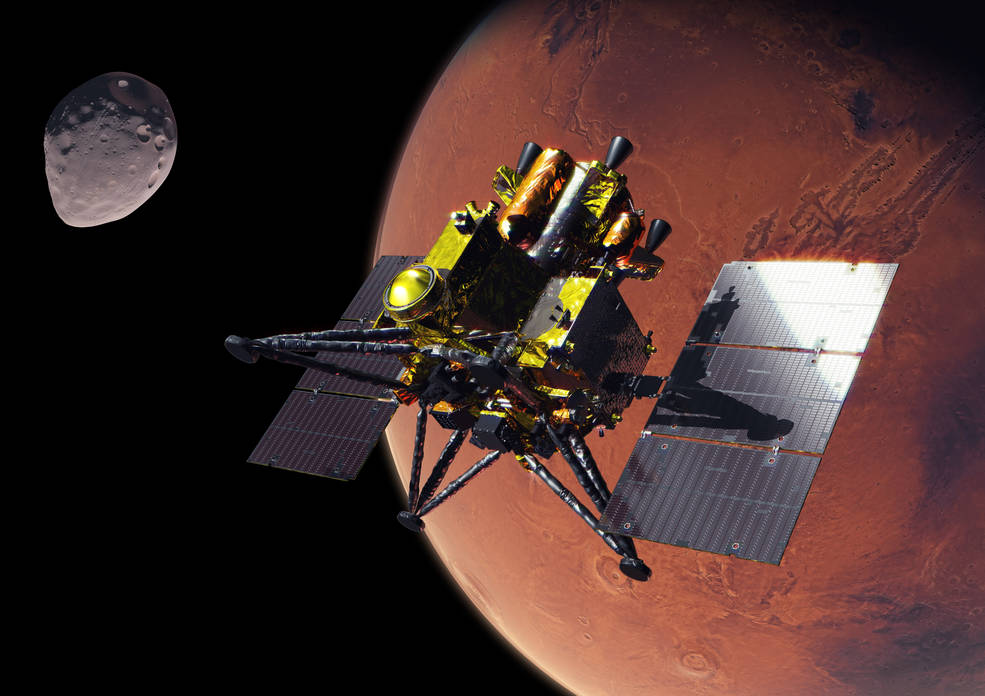
Media are invited to join NASA for a media teleconference at 4 p.m. EDT, Thursday, Oct. 15, to preview the agency’s contributions to JAXA’s (Japan Aerospace Exploration Agency) Martian Moons eXploration (MMX) mission. The mission is scheduled to launch from JAXA’s Tanegashima Space Center in Japan on Monday, Oct. 19 EDT (Tuesday, Oct. 20 JST).
Audio of the media teleconference will stream on the agency’s website at:
www.nasa.gov/live
Participants in the briefing, who will provide an overview of the mission and NASA’s contributions, include:
Lindsay Hays, acting director, Planetary Science Division, NASA Headquarters in Washington Tom Statler, MMX program executive and scientist, Planetary Science Division, NASA Headquarters David Lawrence, MEGANE (Mars-moon Exploration with Gamma-rays and Neutrons) principal investigator, Johns Hopkins Applied Physics Laboratory Kris Zacny, vice president, Blue Origin’s Honeybee RoboticsMedia interested in participating by phone must RSVP no later than two hours prior to the start of the teleconference to Molly Wasser at [email protected]. A copy of NASA’s media accreditation policy is online.
The MMX spacecraft will arrive at Mars in August 2027 to begin its survey of the Red Planet’s two moons, Phobos and Deimos. After surveying Phobos in detail, the spacecraft will collect a sample of the moon’s surface no earlier than December 2028 and deliver it to Earth in 2031. NASA’s contributions to the mission include the MEGANE gamma-ray and neutron spectrometer, the spacecraft’s surface sampler mechanism, and communications and navigation support from the agency’s Deep Space Network, as well as funding United States scientists participating on the MMX science team.
The MEGANE instrument was developed by Johns Hopkins Applied Physics Laboratory. Honeybee Robotics, a Blue Origin company, developed the spacecraft’s pneumatic sampler mechanism. NASA’s contributions to the MMX mission were funded by the agency’s Discovery Program, which provides frequent flight opportunities for high-value, focused planetary science investigations. The Discovery Program is managed by NASA’s Marshall Space Flight Center in Huntsville, Alabama, for the agency’s Science Mission Directorate in Washington.
For more information about the MMX mission, visit:
science.nasa.gov/mission/mmx/
-end-
Karen Fox / Alana JohnsonHeadquarters, Washington240-285-5155 / [email protected] / [email protected]
Share
Details
Last Updated Oct 08, 2026 EditorJessica TaveauLocationNASA HeadquartersRelated Terms
Martian Moon Exploration (MMX)MarsPlanetary Science DivisionScience Mission DirectorateHence then, the article about nasa briefing to highlight contributions to martian moons mission was published today ( ) and is available on NASA ( Middle East ) The editorial team at PressBee has edited and verified it, and it may have been modified, fully republished, or quoted. You can read and follow the updates of this news or article from its original source.
Read More Details
Finally We wish PressBee provided you with enough information of ( NASA Briefing to Highlight Contributions to Martian Moons Mission )


Also on site :
- Bravo Fans Are Losing It Over Rumors ‘Summer House’s Lindsay Hubbard and ‘Below Deck’s Joe Bradley Kissed
- Steven R. McQueen Sends Direct Message in First Social Media Selfie in 5 Years After Rare Public Return Sparks Buzz Over His Changed Appearance
- What were Trump operatives doing for pro-Russian politician Dodik in Bosnia?