
The U.S. military is imposing a monthlong curfew in Okinawa after the arrest of a marine on suspicion of murdering a local woman, which has sparked public outcry.
The military’s regional coordinator announced on Tuesday that U.S. military personnel in the southern island prefecture would observe a 48-hour pause on operations starting noon on Wednesday. During that period, the military is suspending “off-base liberty, including a complete prohibition of alcohol consumption on or off base,” Lt. Gen. Benjamin T. Watson said. After the pause, the military will impose a curfew on its personnel from midnight to 5 a.m. for 30 days beginning Friday. The Marine Corps said it has yet to determine whether alcohol consumption will be prohibited during the monthlong period, and that a review of “liberty policies and procedures will be conducted” to evaluate if any longer-term changes are needed.
The announcement comes after Japanese police arrested Devin Ballard, a 20-year-old U.S. marine, on suspicion of robbing and murdering Anna Yagi, a 39-year-old Okinawan woman, over the weekend. Yagi was found dead at a hotel in Naha early Saturday, with an autopsy showing she died from suffocation. Police arrested Ballard on Sunday in Okinawa City after obtaining surveillance footage of him entering the hotel with Yagi and leaving alone with what appeared to be her bag. Ballard reportedly denied knowledge of the incident.
“Incidents like this demand we pause for reflection,” Watson said. “Serving on Okinawa comes with responsibility. We live, work, and socialize alongside the people of Okinawa; their home is our home.”
“Every interaction with our neighbors either builds or undermines the trust that is essential to our team. When that trust is damaged, it affects the strength of our alliance and the security of this region,” he continued.
The murder of Yagi has renewed calls to reduce U.S. military presence in Okinawa, where most of the U.S. military installations in Japan are concentrated.
“We never wanted to have the bases,” says Sorane Sakihama, a 24-year-old Okinawan native who organized protests in Tokyo after Sunday’s arrest.
“I want this case to be the last, and I want both governments to take it seriously,” she tells TIME, adding that she feels a sense of responsibility to make the voices of Okinawan women heard. “We have been saying that for 80 years. It’s not our first time saying that, so that’s also our fault, our responsibility that we lost her life.”
The U.S. Embassy in Tokyo and the Marine Corps expressed condolences and said they were cooperating with Japanese authorities.
The incident has placed diplomatic pressure on the alliance between Japan and the U.S. Japanese Prime Minister Sanae Takaichi registered a protest with the U.S. on Sunday.
“The occurrence of such an extremely brutal and vicious incident is extremely regrettable,” she said in a statement. “The government of Japan has lodged a strong protest with the U.S. side, while firmly demanding maximum cooperation with the investigation, strict discipline among U.S. military personnel, and thorough measures to prevent the recurrence of such incidents and accidents.”
At a press conference on Tuesday, Foreign Minister Toshimitsu Motegi said Japan will discuss with the U.S. “effective measures” to prevent crimes by U.S. military personnel.
“This is an extremely malicious incident that will cause great anxiety among the residents of the prefecture and city. I feel intense anger,” Okinawa Governor Genta Koja said on Monday. Koja, who took office on Sept. 30 after a campaign focused on economic issues, said he and Naha’s mayor filed protests with the Japanese Foreign Ministry’s ambassador in charge of Okinawan affairs and the director of the Okinawa Defense Bureau.
Koja called for a review of the U.S.-Japan Status of Forces Agreement. The legal pact gives Japan the primary right to prosecute off-duty offenses against Japanese civilians by U.S. personnel. But if a suspect is already in U.S. custody, U.S. authorities generally retain custody until Japan files charges.
Critics, including Sakihama who started an organization advocating for a revision of the agreement, argue that it hampers Japan’s ability to investigate and prosecute crimes, and ultimately diminishes accountability when crimes or accidents involve U.S. military personnel.
The Marines said that Ballard, who was based at Marine Corps Air Station Futenma, remains in Japanese custody.
Motegi told reporters that the Japanese government will “continuously examine” the agreement.
Historical concerns
The concentration of U.S. bases in Okinawa has long been a key issue in local politics. For much of the past decade, the prefectural government has pushed to reduce U.S. military presence. In 2012, Okinawa’s prefectural assembly unanimously called for the closure of the Futenma air base and opposed deploying U.S. Osprey aircraft there. It passed a unanimous protest resolution when the aircraft were ultimately deployed.
In 2019, following a prefectural referendum, the assembly called on Japan and the U.S. to stop land reclamation at the coastal area of Henoko, where the national government had begun building a replacement base to replace Futenma. Opponents to the Henoko plan argue that building another airfield on Okinawa would only perpetuate the island’s disproportionate share of bases.
Japan’s national government has sought to address Okinawans’ concerns while maintaining its security alliance with the U.S. Washington and Tokyo see Okinawa as strategically important to deter China in the western Pacific.
Koja’s victory over incumbent Denny Tamaki in September signalled a potential shift in the prefecture’s approach to the U.S. bases. Unlike Tamaki who advocated for the closure of Futenma without building a replacement in Henoko, Koja supported the relocation of Futenma’s airfield operations to Henoko as a way to secure Futenma’s return to Japanese control. Before Ballard’s arrest, Koja asked the Japanese government for a timeline of a separate plan to transfer around 9,000 Marines off Okinawa entirely, including relocating more than 4,000 to Guam.
But the latest case has placed renewed pressure on the Japanese government to reduce U.S. military presence on the southern island.
Protests over U.S. military presence
The alleged murder has triggered protests in Okinawa, with dozens of people rallying outside the prefectural government building.
“As a woman living in Okinawa, I find myself thinking: It could be me next, or my daughter, my niece, or the young girls I care about,” Anri Tomita, a protester, said at a rally on Sunday night. Former House of Councillors member Keiko Itokazu said, “The reason we insist that U.S. military bases in Okinawa must not be increased—and that no new bases should be built—is precisely because incidents like this happen.”
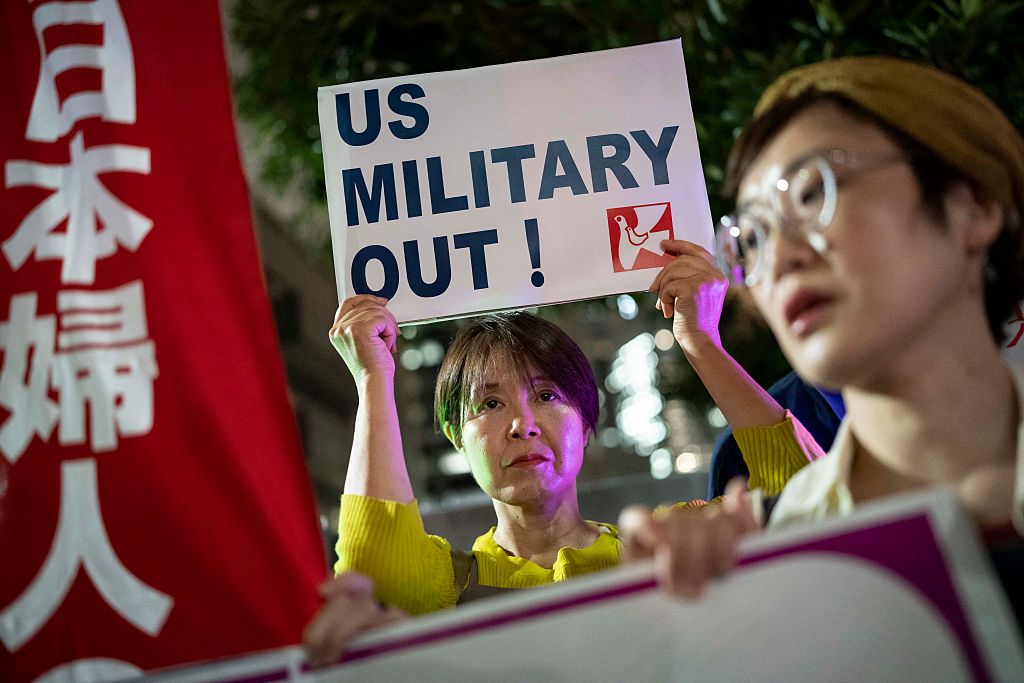
In Tokyo, around 200 people protested outside the U.S. Embassy on Tuesday, holding signs that read, “Okinawa is not your amusement park” and “U.S. military out.”
“With a far higher proportion of bases in Okinawa than in any other part of Japan, locals are exposed to the highest risk of harm at the hands of U.S. soldiers in the country,” Sakihama reportedly said at the rally. “The thought that we must raise our children in such circumstances feels utterly unjust.”
Sakihama first joined a protest against the U.S. military presence in Okinawa at age 13, after the 2016 rape and murder of a 20-year-old Okinawan woman by a civilian U.S. base worker. The case drew a crowd of roughly 65,000 protesters. Months later, the U.S. completed its largest single return of land to Japan since 1972, under an agreement reached in 1996. A Japanese court sentenced the man to life in prison in 2017.
Most U.S. military personnel in Japan are stationed in Okinawa, which the U.S. occupied from the end of WWII to 1972. That includes roughly 30,000 active-duty U.S. military personnel and 25,000 of their family dependents. Despite accounting for around 0.6% of Japan’s land mass, Okinawa makes up around 70% of the land occupied by the U.S. military facilities in the country.
Growing up in Okinawa, Sakihama says she was friendly with the Americans that lived there, some of them being her neighbors. The military’s presence felt like a normal part of life, she says, even when her classes would occasionally be disrupted by noise from the bases. But there was often also a sense of fear or caution, especially when her parents would warn her not to go near the bases at night or when she heard of crimes involving U.S. military personnel.
Several other high-profile crimes involving military personnel have fuelled protests over American military presence in Okinawa. In 1995, three U.S. servicemen were arrested for abducting and raping a 12-year-old Okinawan girl. Around 85,000 people gathered on Oct. 21, 1995, amid weeks of protests demanding stronger military discipline, a revision of the U.S.-Japan legal pact, and a reduction of U.S. bases. The men were convicted in 1996.
In 2024, reports brought several previously unannounced cases of alleged sexual assaults involving U.S. military personnel to public attention, including the indictment of a U.S. airman over an alleged assault of a girl under 16. Okinawa’s prefectural assembly unanimously passed a protest resolution over the cases and called for the revision of the Status of Forces Agreement. Last year, a Japanese court sentenced a Marine to seven years in prison for choking and attempting to sexually assault a woman in 2024.
More than 60% of crimes involving U.S. military personnel in Japan occurred in Okinawa in 2023, according to Japanese newspaper Mainichi. Between 1972 and 2022, there were more than 6,000 criminal cases involving U.S. military personnel, including 134 cases of rape and 27 cases of murder, in the southern island.
Traffic and aircraft accidents have caused anger too. The assembly unanimously protested a fatal crash involving a Marine accused of drunk driving in 2017. The same year, the window of a U.S. helicopter fell on the grounds of Futenma Daini Elementary School, landing around 10 meters from where children were playing sports. In 2025, another Marine was convicted of drunk driving and leaving the scene of a crash that injured four members of a family, including two children.
On social media, Sakihama asked, “Who is the U.S. military protecting, and from what, if it can’t even protect the lives of the residents?”
Hence then, the article about u s military imposes curfew in okinawa after marine arrested for murder was published today ( ) and is available on Time ( Middle East ) The editorial team at PressBee has edited and verified it, and it may have been modified, fully republished, or quoted. You can read and follow the updates of this news or article from its original source.
Read More Details
Finally We wish PressBee provided you with enough information of ( U.S. Military Imposes Curfew in Okinawa After Marine Arrested for Murder )


Also on site :
- At 92, Harriette Thompson became the oldest woman to run a marathon; the classical pianist went on to set the oldest-woman half-marathon record at 94
- Van Halen Almost Didn’t Release 1978 Parody Song ‘Ain’t Talkin’ ‘Bout Love’ — Then it Became an Enduring Hit
- Santa Barbara Foundation and California Lutheran University Center for Nonprofit Leadership Host PR Workshop Led by Marketing Maven CEO Lindsey Carnett