
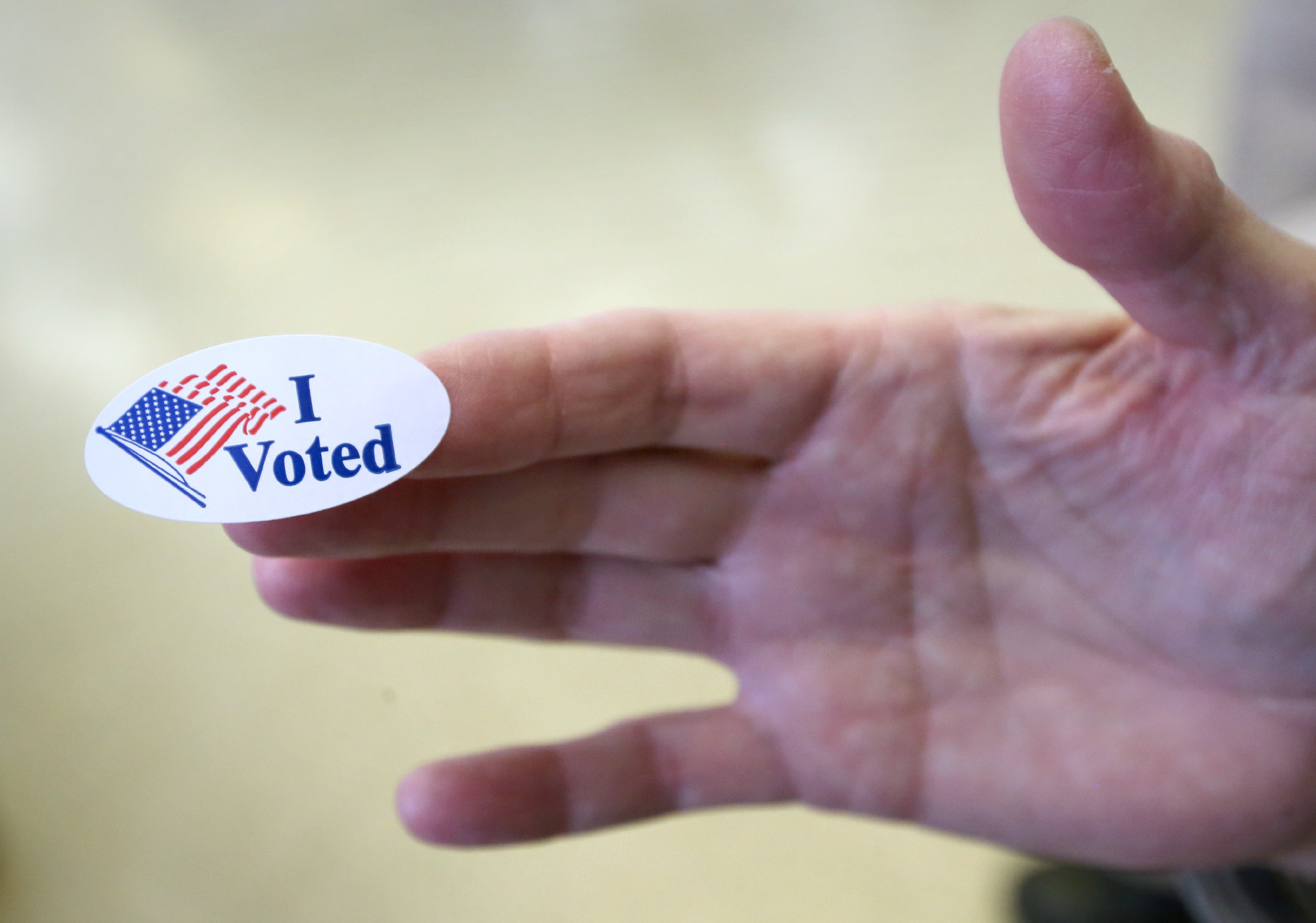
Election Day is Nov. 3, 2026, in the United States. Held midway through each four-year presidential term, midterm elections give voters a chance to choose local representatives, weigh in on state issues, and determine which party controls Congress.
Read More: Congress Is Headed for a Massive Turnover
This year’s midterms will take place among unique challenges to the democratic process itself.
The Trump Administration has attempted to restrict mail-in voting and gather voter data from several states. There have also been concerns raised about the presence of federal agents at polling stations, which President Donald Trump has not categorically ruled out.
The TIME staff has put together answers to some of your most pressing questions about the midterm elections in our 2026 Voting Guide.
What's on my ballot?Who can register to vote?How can I check my voter registration status?When is the deadline to register to vote?What documents do I need to register to vote?Can I vote if my voter registration is inactive?How can I update my registration (change of name, address, party enrollment)?How do I vote early—and what are the benefits of early voting?How do I request an absentee ballot?What's the difference between absentee voting and vote-by-mail?How do I know if my mail-in ballot arrived and was counted?What if there’s an issue with my mail-in ballot? Can I fix it?Do I need to bring my ID to vote?What’s the best time to vote to avoid long lines?Can I bring my kids or dog to the polls?What should I do if someone tries to stop me from voting?What do I do if I see ICE or federal agents at the polls?How late are polls open? —Joe Raedle—Getty ImagesAnswers:
Unlike presidential election years, there is no candidate or issue that appears on every ballot across the U.S. in 2026.
Instead, the ballots in every state will vary—and many will be different from county to county, as well. There are U.S. Senate races in 35 states, and gubernatorial elections in 36 states. All 435 seats in the U.S. House of Representatives are up for election, as they are every two years. There will also be downballot races for positions in the state legislature.
In four states—Idaho, Missouri, Nevada, and Virginia—voters will be deciding on ballot measures concerning abortion rights. Voters in six states, including Alaska and Arizona, will decide on whether to add or strengthen citizenship requirements for voting in state and local elections.
There are multiple ways for voters to request a sample ballot so they can see both what propositions will be on their state ballot and what local, state, and federal positions will appear on their ballot. Vote.org and Ballotpedia both have sample ballot lookup tools.
Many official websites—including those in Minnesota, Wisconsin, and New York City—also have their own “What’s On My Ballot” pages, which allow voters to enter their address and look up a sample ballot. —Rebecca Schneid
Who can register to vote?
People can register to vote in federal elections if they are a U.S. citizen and meet their state’s eligibility and registration requirements. Voters generally must be 18 years old on or before Election Day, although almost every state allows people to register before their birthday if they will be 18 by Election Day. North Dakota does not require voter registration.
Voters must also meet their state’s residency requirements, but people who are experiencing homelessness or who are between homes also are able to vote. Depending on state law, they may need identification. They can generally use a shelter, religious center, or P.O. box as a mailing address and identify the place where they live or sleep as their residential address.
Non-citizens, including permanent legal residents, can vote in some local elections but cannot vote in federal or state elections.
In some states, people who were convicted of a felony or are currently incarcerated are also restricted from voting. Check this federal voter guide for voting after a felony conviction to see what rules exist in your state. —Rebecca Schneid
You can check if you’re registered to vote by going to the National Association of Secretaries of State website. After you choose your state in the dropdown menu, you’ll be sent to the state’s election website. The information required to check if your voter registration is active varies by state, but most will ask for information like your name, date of birth, and address.
If you’re not already registered to vote, you may be able to register online, by mail, or in person, depending on your state. Check your state’s requirements and registration deadline before submitting an application. —Chantelle Lee
When is the deadline to register to vote?
The deadline to register to vote varies by state. Check the U.S. Vote Foundation’s website to find your state’s deadline. —Chantelle Lee
In most cases, you will need a driver’s license or state identification card—or information from one—to register to vote. If you don’t have either, your state may accept other documentation, such as a utility bill or bank statement. Requirements vary by state, so check with your state election office to find out what information and documents you will need. —Anna Gordon
Can I vote if my voter registration is inactive?
Your registration may be marked inactive if election officials believe you have moved and you do not respond to a notice asking you to confirm your address. Inactive voters generally remain registered and can still vote, although they may have to confirm their address or follow other state-specific procedures at the polls.
Voters can contact their state or local election office to learn how to restore their registration to active status and what identification or documentation may be required. —T. Michelle Murphy
Voters in states that record party affiliation may change it through their state’s election office. However, party enrollment is not necessary to vote in the midterm elections in November, and party affiliation does not limit you to candidates from that party in a general election. Party affiliation may affect which primary a voter can participate in, depending on state law.
To change a name or address, voters generally follow the same process used to register to vote. They can use the national Election Assistance Commission map, click their state, and see how each state prefers updates to voter registration.
Voters can also submit a National Mail Voter Registration Form, which can be used to re-register to vote in every state except North Dakota, New Hampshire, and Wyoming, and it is available in 21 languages. —Rebecca Schneid
—Ellen Schmidt—APHow do I vote early—and what are the benefits of early voting?
People who want to avoid long lines and those who might not have time to go to their polling location on Election Day may wish to take advantage of early voting. Early voting began in four states Sept. 18 and will expand to the rest throughout October.
As of 2026, 47 states and Washington, D.C., allow any voter to vote early in person. Alabama, Mississippi, and New Hampshire require an eligible excuse.
The process for early voting differs depending on your state. You can find the specific times and rules for early voting in your state at USA.gov. —Chantelle Lee
If you live in the U.S., you can request an absentee ballot by visiting the National Association of Secretaries of State website and selecting your state from the dropdown menu. Because eligibility requirements, deadlines, and application procedures vary by state, be sure to follow the instructions provided by local election officials.
U.S. citizens living outside the country, absent members of the Uniformed Services or Merchant Marine, and their eligible family members can register to vote and request an absentee ballot through the Federal Voting Assistance Program. They can do so by completing a Federal Post Card Application, or FPCA, using the U.S. address that establishes their voting residence. For overseas citizens, this is generally the last place they lived before leaving the country; for military voters, it is generally their address in their state of legal residence. The completed form must be signed and returned to the appropriate election office in accordance with that state’s submission requirements. —Rebecca Schneid
What's the difference between absentee voting and vote-by-mail?
Absentee voting and vote-by-mail both allow voters to cast ballots without visiting a polling site. This can be done by returning a ballot by mail, at a dropbox, or in person, depending on state law. The terms vary by state, but a key difference is often whether voters must request a ballot or receive one automatically.
In states where vote-by-mail exists, all active registered voters are automatically delivered a vote-by-mail ballot to their registered address. Eight states—California, Colorado, Hawaii, Nevada, Oregon, Utah, Vermont, and Washington—conduct elections this way.
In states without universal vote-by-mail programs, individuals must request absentee ballots ahead of time. There are often deadlines and rules that voters must meet in order to participate in the program, and some states may require individuals to have an excuse in order to be eligible for an absentee ballot. —Anna Gordon
—David Paul Morris—Bloomberg via Getty ImagesMost states offer some form of online ballot tracking, according to Vote.org. Illinois, Missouri, and Wyoming do not have statewide online mail-ballot trackers, although tracking may be available in some local jurisdictions.
Each state’s tracker is a little different, but they generally allow you to log in with your voter registration information to see if your ballot has been received yet. If your jurisdiction doesn’t offer online tracking, contact your local election office to ask whether your ballot was received and accepted for counting. —Anisha Kohli
What if there’s an issue with my mail-in ballot? Can I fix it?
If election officials identify a problem with your ballot, they may notify you and give you an opportunity to fix—or “cure”—it, depending on your state and the type of problem.
“The election official who is reviewing ballots will tell you what information you need to provide to make that cure, such as signing a new ballot envelope or providing a copy of your ID,” according to Nick Morrow, a communications and design director at Vote.org. Be sure to complete the process by the deadline set by your state.
The criteria for rejection varies by state, but to prevent your ballot from being rejected, do your best to ensure it’s returned in good condition and early. A missing or unverifiable signature can cause your ballot to be rejected. —Simmone Shah
—David Jennings—Digital First Media/Boulder Daily Camera via Getty ImagesAs of 2026, 36 states require you to show some form of identification before you can legally cast your ballot. But the forms of identification that are acceptable vary by state; they may include a driver’s license, passport, voter registration confirmation, utility bill, or bank statement. You can check your local requirements on USA.gov.
If you do not have the requested identification, you may still be able to vote by signing a statement confirming your identity or casting a provisional ballot. In some states, you must provide acceptable identification after Election Day in order for your ballot to be counted. Federal law also requires certain first-time voters who registered by mail to provide identification if their identity was not verified during registration. —T. Michelle Murphy
What’s the best time to vote to avoid long lines?
Long lines can be a strong deterrent to voting, especially for Black and Latino voters, who on average have experienced longer waits than white voters, according to a June 2020 report by the Brennan Center for Justice.
Since polling hours and conditions vary by county, and even within a county, wait times can be unpredictable. But early mornings and after-work hours tend to be the busiest times.
Additionally, lines tend to be longer on Election Day than they are during early voting periods, which do not demonstrate any consistent high-traffic time slots.
However, there is no universally confirmed “least busy” time to vote. —Solcyre Burga
Voters generally may bring children with them to the polling place, although rules about their ages, how many children may accompany a voter, and whether they may enter the voting booth vary. To learn about the guidelines at your polling site, contact your local election office.
Dogs, however, are a different story. Voters are allowed to bring certified service animals to voting sites, but accommodations for pets and emotional support animals vary by location. It is best to presume they are not allowed but to look into the specific guidelines for your polling location. —Rebecca Schneid
—Charlie Neibergall—Getty ImagesWhat should I do if someone tries to stop me from voting?
Voter intimidation is illegal and relatively rare. If someone tries to stop you from voting, you should alert nearby poll workers and your local election officials, who can determine if law enforcement should be involved, says Sean Morales-Doyle, the senior director of the Brennan Center for Justice’s Voting Rights and Election Program. You should also contact the nonpartisan Election Protection hotline for assistance at 866-OUR-VOTE.
The same service is also available for non-English voters. Spanish speakers can call 888-VE-Y-VOTA. Most Asian language speakers can find assistance in their native language at 888-API-VOTE. Arabic speakers can call 844-YALLA-US.
If you feel like you’re in danger, call 911. —Mariah Espada
The Trump Administration has not said that immigration enforcement officers would be at the polls this November, but it also has not ruled out the possibility. When asked in May whether he would deploy federal agents on Election Day, Trump told reporters that he would do “anything necessary” to make sure the U.S. has “honest” elections.
The Department of Homeland Security (DHS) has said that Immigration and Customs Enforcement (ICE) is not planning operations targeting polling locations, while leaving open the possibility of enforcement in the event of a public safety threat. In September, DHS Secretary Markwayne Mullin confirmed that agents could serve warrants at polling places.
Gen. Dan Caine, Chair of the Joint Chiefs of Staff, said Aug. 31 that there are no plans to station military personnel or the National Guard at polling sites.For voters, it’s important to know that federal interference at the polls is against the law. The law prohibits federal officials from stationing troops or armed personnel at polling places, except when necessary to repel armed enemies of the United States. Voter intimidation is also, separately, prohibited and should be reported.
If you see any federal agents at the polls, the best move is to contact the election protection hotline at 1-866-OUR-VOTE. This hotline has other language options, including 1-888-VE-Y-VOTA for Spanish, 1-888-API-VOTE for several Asian languages, and 1-844-YALLA-US for Arabic.
The American Civil Liberties Union suggests that voters look up the contact information for their local election officials here and report intimidation if it occurs before or on Election Day. —Rebecca Schneid
How late are polls open?
Polling hours vary state by state—sometimes even county by county. For example, poll closing times vary in North Dakota and New Hampshire; in such instances, you can utilize search functions on each state’s respective website.
Hence then, the article about your questions about voting in the 2026 midterm elections answered was published today ( ) and is available on Time ( Middle East ) The editorial team at PressBee has edited and verified it, and it may have been modified, fully republished, or quoted. You can read and follow the updates of this news or article from its original source.
Read More Details
Finally We wish PressBee provided you with enough information of ( Your Questions About Voting in the 2026 Midterm Elections, Answered )


Also on site :
- Pedro Pascal Was Surprised Tony Gilroy Made ‘Behemoth!’ “So Intimate And Healing”: “I Thought You Were Gonna Be Mean”
- Dolly Parton’s Nephew, Accused of ‘Terrorizing Conduct,’ Requests Delay in Restraining Order Fight to Find Lawyer
- Saudi Arabia preparing massive Yemen offensive – Reuters