
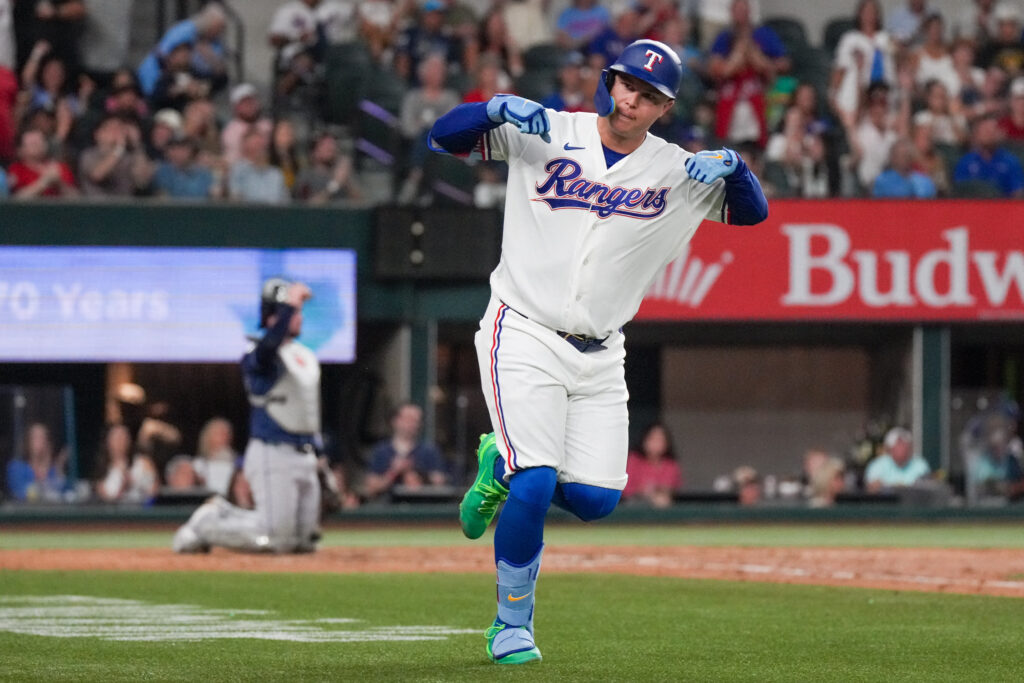
With the regular season in the books, MLBTR is taking a position-by-position look at the 2026-27 free agent market. Next up is the collection of designated hitter options. Obviously, there are plenty of candidates at other positions — first base and corner outfield in particular — that some teams might view as more suited for full-time or at least part-time DH work. We’ll give mention to some such bats here but also highlight a few notable sluggers who’ve largely put their gloves away in storage at this point in their careers.
Player ages are for the 2027 season, and names within each tier are listed alphabetically, not “ranked.” Only players who appeared in MLB (or on major league 60-day injured lists) this year are included.
Previous entries in this series: Catcher, First Base, Second Base, Third Base, Shortstop, Center Field, Corner Outfield
(Nearly) Full-Time DHs Coming Off Productive Seasons
Josh Bell (34)
MLBTR’s Leo Morgenstern touched on Bell in the first base entry, but Bell hasn’t spent much time in the field recently. The Twins gave him only 20 appearances and 141 innings at first base this season. The Nats gave him just 253 frames at first the year prior. He’s a passable if unspectacular option there, but as he continues into his mid-30s, Bell seems likely to continue at the very least splitting time between first base and DH — if not moving to a full-time DH role.
What Bell has done well is continue to churn out solid 20-homer seasons. He connected on 21 round-trippers this season, giving him 101 over his past five years. Bell isn’t the 35-homer threat he once was, but he’s a switch-hitter with pretty neutral splits who’s been above average at the plate in every season of his career other than the shortened 2020 campaign. He got out to a slow start in Minnesota after signing a one-year, $7MM contract, but Bell heated up in mid-May, caught absolute fire in June, and was steadily productive thereafter. Over his final 453 plate appearances, he slashed .273/.336/.461 — about 22% better than average, by measure of wRC+.
Bell’s slow start left him with only a slightly above-average .255/.319/.419 line on the year (106 wRC+), but he was a rock-solid DH for the final four and a half months of the season. He probably has less pop than you’d expect when looking at his 6’3″, 260-pound frame — but he also strikes out less often than your typical slugger, with a lower-than-average 19.7% rate in 2026 and an 18.6% rate over the past six seasons. Bell’s walk rate has dipped to about average in two of the past three seasons, but he still chases less often than average and shows strong contact skills. (He also swiped his first two bags in eight years, breaking an 0-for-7 slump on the basepaths! That won’t earn him anything, but anecdotes are fun.)
The Twins and Bell have a $10MM mutual option for 2027, but it’s hard to imagine both parties picking up their end. It’d be the first mutual option anywhere in MLB to be exercised by both parties in a dozen years. Whether it’s with the Twins or someone else, Bell should get another one-year deal from a team seeking affordable at-bats from a “professional hitter.”
Joc Pederson (35)
Pederson’s two-year, $38.5MM deal with the Rangers didn’t go as hoped overall, but his second season in Arlington strongly indicates that an awful 2025 showing was more of a fluke than the beginning of a downward trend. Pederson rebounded from an abysmal .181/.285/.328 line last season to deliver a .235/.329/.487 slash that was 28% better than average after weighting for his immensely pitcher-friendly home park. His 26 homers are the second-most he’s ever logged in a single season and his highest total since belting 36 with 2019’s juiced ball.
Even in Pederson’s awful 2025 season, there were signs that his downturn was fluky. He cut his strikeout rate to 21.3%, down more than two percentage points from the year prior, and maintained a walk rate north of 11%. He continued to sting the ball (91.2 mph average exit velocity, 44.6% hard-hit rate) but wasn’t finding much luck on balls in play — just a .203 BABIP. In 2026, Pederson maintained another 11% walk rate and hit the ball even harder (92.1 mph average exit velo, 50.7% hard-hit rate). The slugger suffered a small fracture in his left hand in mid-September upon being hit by a pitch. He spent a week trying to play through it before hitting the injured list for the final week of the year. He should be good to go for spring training.
Pederson has played only 93 total innings of defense across the past three seasons. He’s a pure DH — one who should face lefties as little as possible. He’s a career .206/.301/.337 batter against them and hit just .129/.229/.387 with a 38.6% strikeout rate in 36 plate appearances against southpaws in 2026. Pederson is an absolute force against right-handers, however, so any team with DH at-bats available and poor production against righties in ’26 could bring Joc aboard for a year. He has an $18.5MM mutual option, but the Rangers have been in cost-cutting mode for awhile now.
George Springer (37)
Springer played all of 16 innings in the field with the Jays this season. He logged 436 innings on the grass (er… turf…) in 2025 and was panned by both Defensive Runs Saved (-6) and Statcast (-8) despite that limited sample. The plus speed Springer showed early in his career has unsurprisingly faded as he approached his late 30s.
Springer got out to a slow start in 2026, then suffered a broken big toe in mid-April and missed nearly three weeks. It was slow going in the aftermath, but from mid-May through mid-September he was excellent: .274/.347/.455 across 375 trips to the plate. His bat went cold over the season’s final week, and Springer finished out the year with an overall .249/.321/.405 line (105 wRC+) and 15 home runs through 517 plate appearances.
Though he was excellent against lefties for most of his career, Springer has been more productive versus right-handers in recent seasons — particularly in 2026: .265/.337/.417 against righties, .213/.285/.376 versus southpaws. He hasn’t carried a conventional platoon split since 2021.
Springer hasn’t committed to playing in 2027. It’s possible this was his final year. He and his wife have three young children, and he told the Jays beat after his final game that it’d be a family decision as to whether he returns for a 14th major league season or slides into dad mode on a full-time basis. If he opts to return, Springer will be limited to one-year deals but should find some interest as a viable low-cost DH option.
Eugenio Suárez (35)
Though he smacked 26 homers in his return to Cincinnati, Suárez’s Reds reunion didn’t go as hoped. The slugger’s season played out in inverse fashion relative to 2025, when he was one of the top sluggers in the NL for four months before cratering at the plate down the stretch with the Mariners. In 2026, Suárez hit just .200/.275/.386 (79 wRC+) through the end of July, then turned back the clock with a vintage .235/.363/.523 output (141 wRC+) in his final 182 turns at the plate. He’d walked at an 8.9% clip with a sky-high 36.4% strikeout rate for four months but improved to 13.2% and 29.7%, respectively in his two-month heater to end the season. The end result is a middling .217/.302/.433 batting line — two percent better than league-average, per wRC+.
Suárez played more in the field than he should have in ’26, and the results weren’t pretty. He was still primarily a DH, but in 401 innings at the hot corner he was dinged for -4 DRS and -7 OAA. Maybe his next club will give him the occasional day at one of the two infield corners, but anyone signing Suárez will probably be hoping to catch lightning in a bottle after that torrid finish to what wound up being just four long balls shy of his seventh career 30-homer campaign.
Suárez is also a revered teammate, whose “good vibes only” and affable personality make him a clubhouse favorite wherever he goes. He couldn’t land a multi-year deal last winter coming off a 49-homer season, so Suárez is surely looking at a one-year deal in 2027 — likely at a lower rate than this year’s $15MM. He and the Reds have a $16MM mutual option that the team will likely deem too steep.
End of the Road?
Nick Castellanos (35)
The Phillies released Castellanos in February. He latched on with the Padres and opened the season on San Diego’s roster, but the fit didn’t last long. Castellanos was a shell of his former self, hitting .191/.221/.339 with a career-high 27.9% strikeout rate and the lowest walk rate (4.1%) and bat speed of his career (69.7 mph average). The Padres released him on June 5, and he didn’t end up signing with another team.
Starling Marte (38)
Marte signed a one-year, $1MM contract with the Royals late last winter but batted only .242/.298/.314 in 168 plate appearances as a part-time DH/outfielder before being released in August. He went unsigned for the remainder of the season and turns 38 a week from today. The 2026 season was his second year with negative WAR in the past four. He’s effectively played at a replacement level across his past 337 big league games.
Andrew McCutchen (40)
The three-year reunion tour in Pittsburgh came to an end last winter, but McCutchen caught on with the Rangers and won an Opening Day roster spot with a huge spring showing. The small-sample production from his brief run in the Cactus League didn’t carry over into the regular season, though. Cutch took just 83 plate appearances and hit .192/.277/.260 before being released. He had a brief run with Atlanta’s Triple-A club in July but was released on the day of the trade deadline after a productive nine-game stint in Gwinnett. It stands to reason that McCutchen may have had an opt out and asked for his release after Atlanta’s deadline moves further shrunk his chances of being called to the big leagues.
McCutchen has one of the best peaks of this generation, but the five-time All-Star and 2013 NL MVP’s career could be drawing to a close.
Marcell Ozuna (36)
The Pirates signed Ozuna to a surprising $12MM deal last winter and gave him a longer leash than any could have reasonably expected. Ozuna struggled out of the gate and never found his footing, but the Bucs kept him on the roster into early August before releasing him. He took 280 plate appearances and hit only .203/.286/.327 as his strikeout rate spiked to a career-worst 28.6%. His average exit velocity (89.1 mph), barrel rate (7.6%) and hard-hit rate (36.8%) all fell to career-low levels. Ozuna hit 21 homers for the ’25 Braves and had a decent season at the plate that year, so perhaps some clubs will think he can rebound, but he’s probably looking at a minor league deal if he wants a rebound opportunity.
Jorge Soler (35)
Like Marte and Ozuna, Soler was released by his team (the Angels) in August. He’d taken 361 plate appearances but managed only a .203/.291/.373 performance. Soler ripped a dozen homers but struck out at a 32.7% rate — the second-worst of his major league career. He had a nice April but a terrible May and an injury-shortened June (oblique strain). Soler still has good bat speed and quality hard-hit and barrel rates. Someone could give him a look on a minor league deal, but he hasn’t been an above-average hitter since 2024.
Depth Options
Rhys Hoskins (34), Rowdy Tellez (32), Dominic Smith (32)Hence then, the article about previewing the upcoming dh class was published today ( ) and is available on MLBtraderumors ( Middle East ) The editorial team at PressBee has edited and verified it, and it may have been modified, fully republished, or quoted. You can read and follow the updates of this news or article from its original source.
Read More Details
Finally We wish PressBee provided you with enough information of ( Previewing The Upcoming DH Class )


Also on site :
- Meta faces $40 bn data privacy penalty
- In ‘Marshals’ Season 2 Premiere, Kayce Dutton Goes Rogue to Save His Son—and Our Exclusive Sneak Peek Offers a First Look at the Action
- The Police Frontman, a Former Schoolteacher Whose ‘Every Breath You Take’ Became the Most-Played Song in Radio History, Turns 75