
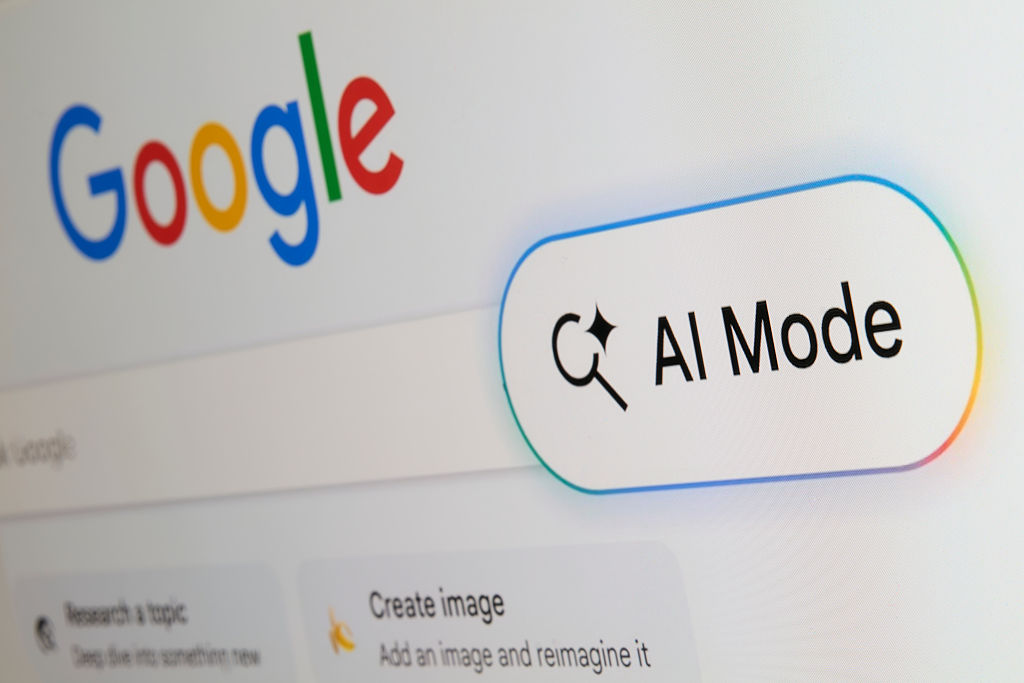
If you’ve used Google to search for something over the last few months, you may have noticed that the experience has changed. If you ask certain questions, an AI overview will pop up, followed by another search bar that encourages you to “Ask Anything.” Click on that, and you suddenly find yourself conversing with a chatbot in Google’s AI Mode interface.
This pathway has resulted in millions of people—who never intended to use AI in the first place—unwittingly becoming acclimated to a new chatbot reality. Google Search usage hit an all-time high this year, and much of that activity involves AI. Google’s AI Mode has racked up more than 1 billion monthly users, the company says, a figure rivaling the estimated 1 billion monthly active users of ChatGPT in May, according to Sensor Tower.
At the beginning of the AI arms race, Google lagged far behind its upstart competitors like OpenAI and Anthropic. But by aggressively implementing AI tools into its dominant search engine, Google is arguably doing more to bring AI into people’s everyday lives. In the process, the company is already transforming how users and content creators behave online.
AI Mode is just the latest step in a gradual series of AI integrations. In 2024, Google began rolling out AI summaries in response to users’ searches called AI Overviews, above the classic blue links. These AI Overviews are now more prevalent—shown in forty percent of U.S. Google searches, according to Similarweb—and more utilized by the public. This summer, a Pew poll found that more Americans read AI summaries at the top of search engine results than use chatbots (60% to 49%).
Kevin Indig, a strategy advisor who writes the newsletter Growth Memo, says the introduction of AI Overviews didn’t drastically change how many people interacted with Google: they still scrolled below the Overviews to click on the links to verify information.
But Indig says that when users are in AI Mode, they behave completely differently. They write much longer queries—three times the length of traditional search queries. And they search for different kinds of things. They brainstorm essay ideas, build study guides, plan trips, and even seek financial advice.
Crucially, they exhibit a high level of trust in AI Mode’s answers. Once users enter AI Mode, they are more likely to stay inside of it rather than exploring outward to the rest of the web. “It's crazy: they will get an answer, and they'll barely go out of their way to see if it's correct,” Indig says. “That means very few clicks.”
This year, many Google users have expressed skepticism or distaste for AI. But Google has increasingly implemented design changes that direct its searchers into AI interfaces. For instance, the “Ask Anything” search bar which triggers AI Mode is often no longer hidden under a “Show More” button. More recently, the company has placed an AI Mode button on the Google Search homepage for many users.
These changes are the culmination of a decade-long strategy from Google CEO Sundar Pichai, who declared in 2016 that Google would be an “AI-first company.” In April, Pichai told TIME that Google’s mission is “to organize the world's information and make it universally accessible and useful. I view AI as the most profound way we can make progress against that mission.”
Read More: How Sundar Pichai Pushed Google To the Front of the AI Race
These shifts mean that many people, especially older users who would never dream of creating an OpenAI account, are acclimating to chatting with an AI chatbot through Google’s AI Mode. Robby Stein, vice president of product for Google Search, says that for some older users, “this is the first time they've experienced AI … What we’ve built is trying to be the most natural, easy-to-understand experience, where they can expand it, they can ask a follow-up question, and they can get the info they want now.”
These new types of search encounters could be habit-forming, says Gene Munster, managing partner at Deepwater Asset Management. “People need to have something 10 times better to really switch behavior,” he told TIME in April. “And they have something that’s actually really pretty good, but it doesn’t need to be the best.”
Dangers to Creators
Google argues that AI Mode is more fulfilling for users, giving them what they want faster and more directly. But this is threatening the entire business model of websites that have relied on clickthrough ad revenue and optimized their SEO strategies to appear as blue links in search.
For instance, the world of online shopping is radically changing. The percentage of people who use AI to shop online has doubled in less than two years—a shift that can leave retailers with much less information about their customers. “You lose the direct relationship with customers,” Indig says.
Another industry getting hit particularly hard is publishing. People want answers, and Google’s AI Mode saves them a click to the actual source of the information. Similarweb data analyzed by Axios shows that U.S. web traffic to roughly 100 of the top news sites fell from above 70 million visits in 2024—the year Google introduced AI Overviews—to 47.6 million visits this July. While that decline cannot be attributed entirely to AI, a separate Ahrefs study found that AI Overviews were associated with a 58% reduction in clickthrough rate to top-ranking search results.
At least some AI leaders are aware of the problem. Earlier this month, newly unsealed court documents from The New York Times’ copyright infringement lawsuit against OpenAI and Microsoft included worries from both companies that their AI content strategies had started a “doom loop” that would “hurt the performance of our models and the entire web at the same time,” and present an “existential threat” to publishers.
Stein, at Google, says that having a “thriving, healthy ecosystem of publishers and creators is of paramount importance.” He says that Google has facilitated a “dramatic increase in the amount of links in the content trays we’re providing.”
“It is critical to our vision to remain the connective tissue to the web,” Stein says. “Users want to hear from experts. They want to be able to verify and feel good about the content they’re seeing.”
Home-field advantage
The battle between tech companies to become the default messenger of information to the masses will continue for years to come. But Indig says the dynamic could play out in a similar way to a previous tech race, when Snapchat threatened Instagram. While Snapchat introduced the innovation of disappearing stories and gained a young audience, Instagram simply implemented a similar feature into its app, helping maintain its dominance. Google, in this analogy, has Instagram’s advantage.
“Younger generations prefer ChatGPT. But when people do research on ChatGPT for products, they will go to Google and look for the brand,” says Indig. “So Google still has an important utility.”
At the beginning of the AI race, Google was criticized for moving too slowly. Four years into the generative AI boom, its bet on converting its built-in usership to AI has paid off. It remains to be seen, however, if the publishers and content creators Google relies on for quality information will be able to withstand the changes Google has implemented.
Hence then, the article about how google is quietly turning millions of people into ai users was published today ( ) and is available on Time ( Middle East ) The editorial team at PressBee has edited and verified it, and it may have been modified, fully republished, or quoted. You can read and follow the updates of this news or article from its original source.
Read More Details
Finally We wish PressBee provided you with enough information of ( How Google Is Quietly Turning Millions of People Into AI Users )


Also on site :
- Hengrui Pharma and Novo Enter Exclusive License Agreement for Once-Weekly Oral GLP-1/GIP Dual Receptor Agonist HRS-1596
- Mayor Zohran Mamdani Refuses Jimmy Kimmel’s Request to Text Trump a Selfie of Them
- 1963 Bestselling Spy Novel Is Becoming a TV Series Starring Charlie Hunnam and This ‘Succession’ Emmy Winner