
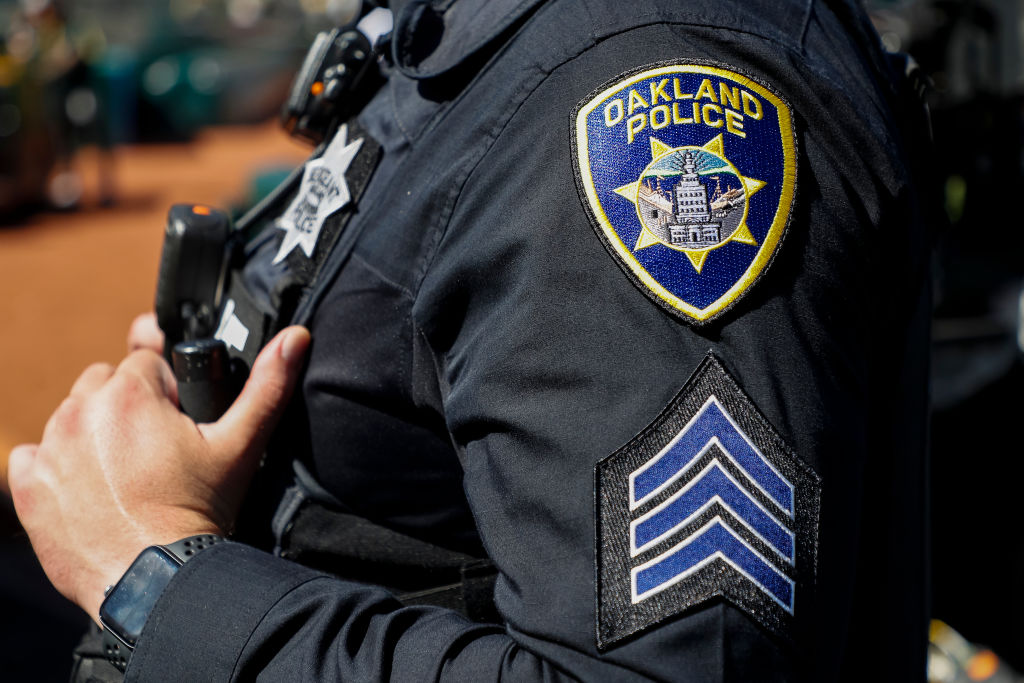
In the spring of 2014, civil rights lawyers John Burris and Jim Chanin invited me to Oakland, California, to serve as a subject matter expert. They represented a group of plaintiffs seeking justice in a city enduring an especially brutal version of a well-known story: a police department that many perceived as a hotbed of illegal tactics, violence, and discrimination directed largely at the Black community. As I heard one Oakland native put it at a public meeting shortly after I arrived: “People are damaged. People are heartbroken. People have fear. People are scared of the same people that’s supposed to protect them.”
Since revelations of a pattern of wrongdoing first came to light 23 years ago, the Oakland Police Department (OPD) has been under federal court oversight—the longest for any American city.
This week, a federal judge is expected to decide whether that oversight can finally come to an end, after years of progress toward reforms required by the court. Whatever the outcome, Oakland has undergone a substantial transformation over the past two decades. What changed over those years is a remarkable story about what can happen when we finally have the tools we need to see policing clearly.
I’d been summoned to Oakland due to my work as a researcher focused on racial bias and inequality. The plaintiffs’ attorneys wanted to understand what was really happening between officers and civilians that might be contributing to systemic abuses and a breakdown of trust. The job for me and my team was to parse the data and try to quantify racial disparities. But we were also seeking clues about how those disparities took root, and whether anything could be done to address them.
We soon realized there was an all-too-familiar tension that arrest records, crime statistics, and other available data couldn’t solve—a problem of interpretation. The same disparities that community advocates saw as proof of officer bias were viewed by many police officers as proof of where crime was concentrated. The numbers told us what was happening. They were much less useful for helping us understand why. If we had any hope of uncovering the causes of those disparities—let alone finding solutions—we were going to need new tools.
As it turns out, as far back as 2014, Oakland was sitting on an extraordinary trove of data that contained everything we needed to know—it was just that nobody had thought of it as data before. Oakland had been an early adopter of police body-worn cameras, a rare technological innovation that consistently enjoys about 90% public approval. For over a decade now, police departments across the country have amassed troves of footage from these cameras, creating the most comprehensive record of interactions between officers and civilians in history. Yet the vast majority of that footage is never leveraged to improve those interactions.
That’s because we’ve largely treated body-worn cameras as a source of evidence: footage to be consulted only after a specific encounter goes horribly wrong. But those countless routine encounters where trust is built or broken, rights are upheld or violated, and officer training succeeds or slips have gone almost entirely unexamined. The reason for that is simple: humans could not possibly monitor and evaluate footage at that scale, let alone learn lessons from it in the aggregate.
But AI can.
Can AI improve policing?
Eager for a breakthrough to change the city’s trajectory—and compelled to reform by a federal monitor—Oakland granted Stanford researchers access to their body-worn camera footage. Our team of linguists, social psychologists, and computer scientists spent years building and refining a set of computational tools designed to analyze these videos at scale. Now, we can methodically measure the language of routine police interactions, identifying patterns across millions of encounters that no amount of manual review could surface.
Like a DNA sequencer or an X-ray machine, these insights let us see, for the first time ever, the actual makeup of a police encounter. We discovered linguistic signatures that could reliably predict, within the first 27 seconds of an encounter, which interactions were likely to escalate and which would conclude calmly. We were also able to map the “respect gap” that officers, including Black officers, imposed on Black drivers before the driver even spoke, finding consistent disparities in tone, word choice, whether officers explained the reason for the stop, and expressions of concern for a driver’s safety.
We brought our findings to the OPD and worked together with them to move from generic training to data-driven, surgically targeted reforms. Many were skeptical that our ideas—like requiring officers to briefly record the rationale for a stop before making it rather than acting on hunches—would do anything but drive up crime. But that skepticism evaporated when they saw what happened next.
After implementing new policies and trainings, stops of Black civilians in Oakland dropped by 43%—without any uptick in crime. In one pre-post study of a training designed to improve relations with the public, our footage analysis revealed a marked decrease in officer language that tended to trigger escalation, and a marked increase in language that built trust.
Over a 10-year period, the OPD continued to reform and refine its practices. And, in many respects, that effort paid off. For example, after the department implemented a foot pursuit policy to avoid chasing suspects into backyards and blind alleys, officer injuries dropped by 70%. And officer-involved shootings, which had previously averaged about eight per year, dropped to a total of eight over a five-year period.
Returning to Oakland
When I returned to Oakland not long ago, I found myself in an elevator with a fellow Black woman who worked for the police department. She told me that for years, the department would dismiss claims from community members about how they had been negatively treated, insisting that officers treat everyone professionally. “Data,” she said, “gave us a way to be heard”—a way for individual stories to become fodder for systemic change.
Currently, many new technologies, from Flock cameras to rogue chatbots, are being met with distrust and dread about surveillance, privacy, and safety—for good reasons. However, Oakland’s story offers another possibility: a concrete way for AI to actually improve life in our communities using the very cameras introduced to bring about reform. The city’s experience provides compelling evidence that turning body-worn cameras into the powerful accountability tools they were meant to be can help departments everywhere make police-civilian interactions safer and more respectful for everyone involved. It’s an approach that does not require the building of large AI data centers in neighborhoods across the country, and it doesn’t threaten to take away anyone’s job. It simply requires learning from the data that we already have—and that the vast majority of us feel is useful to have.
At a time when American policing is under enormous strain—with retirement at record highs, recruitment at record lows, officer wellness declining, and public trust in law enforcement diminished—the Oakland model delivers a ray of hope, even as it continues to battle to show the world it is capable of reform. And as more cities adopt this approach, I’m optimistic American policing could be transformed.
Hence then, the article about after 23 years of oversight oakland s police reform offers new hope was published today ( ) and is available on Time ( Middle East ) The editorial team at PressBee has edited and verified it, and it may have been modified, fully republished, or quoted. You can read and follow the updates of this news or article from its original source.
Read More Details
Finally We wish PressBee provided you with enough information of ( After 23 Years of Oversight, Oakland’s Police Reform Offers New Hope )


Also on site :
- Run! I Spotted Ugg, Tory Burch and Levi's on Sale Before Amazon Prime Big Deal Days
- The Biggest Mistake People Make With Fall Mums Can Ruin the Blooms Fast—Here’s What a Gardener Says to Do Instead
- Hengrui Pharma and Novo Enter Exclusive License Agreement for Once-Weekly Oral GLP-1/GIP Dual Receptor Agonist HRS-1596