
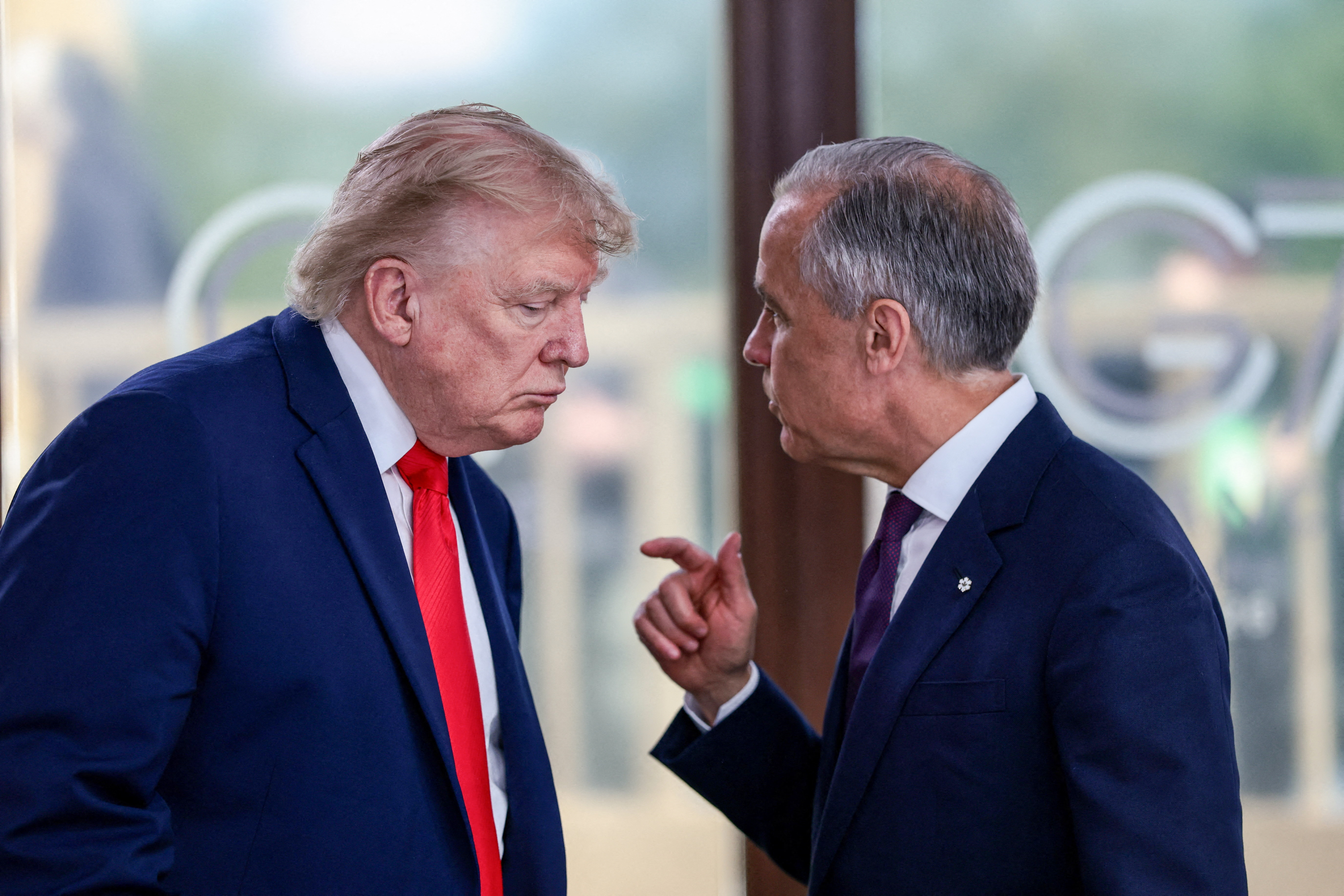
Ottawa's City Council voted unanimously on Wednesday to remove President Donald Trump’s name from a residential street in the Canadian capital amid an increasingly hostile trade war.
The motion to rename “Trump Avenue” in the city’s Central Park neighborhood was brought forward by River Ward councillor Riley Brockington on Sept. 9 and swiftly received support from other local officials. “I don't like the idea of anything that's named for Donald Trump, who's demonstrated hostility towards Canada,” Ottawa Mayor Mark Sutcliffe said at a news conference after the vote.
The move symbolizes the strained relations between the two countries, as Canadian Prime Minister Mark Carney goes head-to-head with the Trump Administration in a trade standoff. Canada’s retaliatory tariffs came into effect on Sept. 8, matching the economic pressure imposed by the U.S. after negotiations collapsed last month. Trump’s repeated threats to annex Canada and his insistence on referring to it as the “51st state” have significantly contributed to the tensions.
The streets in Ottawa’s Central Park neighborhood were named after New York City institutions in the late 1990s and early 2000s, when Trump was primarily known for his businesses and real estate ventures, long before his political aspirations came to fruition.
Brockington said a consultation with local residents will now follow, with alternative names proposed for “Trump Avenue” ahead of a vote.
“I could speak at great length why I believe, strongly, it is time to rename ‘Trump Avenue,’ but I don't want to give a platform anymore to the person who is on the current street sign blades,” Brockington said. “I do believe this is about a new beginning, and I want this to be a community-led process where the community ultimately will select and recommend to City Council what that new name will be.”
In a statement to TIME, White House spokesperson Anna Kelly referred to the name change as a “meaningless gesture” and said “these local governments should do right by the citizens they serve, thank President Trump for defending their country, and make a good deal to benefit Canadian and American citizens alike.”
TIME has reached out to Ottawa's City Council for comment.
The vote to cut the street name comes after President Trump recently pushed through controversial renaming efforts of his own.
In late August, he signed an Executive Order renaming Lake Ontario, which borders the Canadian province of Ontario and the U.S. state of New York, as “Lake America.” The order applies to U.S. federal references of the lake and does not determine how Canada—or others—refer to the body of water. Several lawmakers across both countries have rejected the new moniker.
Thomas Juneau, a professor of public and international affairs at the University of Ottawa, says the street name change in Ottawa is “illustrative of the mood” of Canadians.
“Polls have repeatedly [shown] how extremely unpopular Trump is, and how his targeting of Canada on trade, and his trolling on social media, have made him and the U.S. unpopular,” he tells TIME.
A poll by Politico, conducted Sept. 13-15, found that 83% of Canadians thought it was wrong for Trump to impose tariffs on their country, while 71% backed Carney’s retaliatory tariffs. Another poll, conducted by Abacus Data between Sept. 4-9, found that 82% of Canadians had a negative impression of Trump.
The 'Trump Avenue' street sign is seen in a suburb of Ottawa on Jan. 26, 2021. —Michel Comte––Getty ImagesIn a new interview, Carney admitted he had prepared over the past 12 months or so for the “extreme tail risk” that Trump might order military action against Canada, amid the U.S. President’s repeated mentions of his desire to annex the country.
“I think you have a responsibility in these roles to look at extreme tail risk,” Carney told the New York Times. “That’s just risk management. That’s not a base case, but it would be irresponsible not to” prepare.
Juneau says the “risk of American military intervention against Canada is extremely low,” but reasons that just because Canada “shouldn't take [Trump’s] threat literally, it doesn't mean they shouldn't take it seriously.”
In an April 2025 interview with TIME, Trump denied he was “trolling” when discussing annexation. “We’re taking care of their military. We're taking care of every aspect of their lives… We don't need anything from Canada. And I say the only way this thing really works is for Canada to become a state,” he argued.
Carney, in line with other Canadian officials, has vehemently pushed back against the idea, stressing that Canada is “not for sale.” In June, after Trump revived talk of his ambitions to annex Canada, Ontario Premier Doug Ford simply stated “Canada will never be the 51st state.”
Despite the tensions, Carney said he and Trump have spoken “frequently” since trade talks collapsed last month. However, there is no clear path toward an end to the trade standoff.
“Trump is actively trying to choke off the Canadian economy," says Juneau, noting that a key sticking point in trade negotiations, according to Carney, has been Washington's efforts to restrict Canada’s ability to negotiate trade deals abroad.
Canada seeks international alliances to remove reliance on U.S.
The U.S. accounted for 72.5% of Canadian merchandise exports in 2025, according to the country’s annual trade report, making it Canada's largest trading partner by a wide margin.
Canada and the U.S. are also deeply integrated through defense arrangements, including their membership in NATO and the North American Aerospace Defence Command (NORAD)—a bilateral defense and national security arrangement involving the shared defense of the continent.
Amid the strained relations with the Trump Administration, Carney has sought to diversify Canada’s trade and security alliances to reduce its reliance on the U.S.
“The weaponization of that interdependence by the U.S. makes [Canada] extremely vulnerable in a way that pretty much nobody else is,” insists Juneau, pointing to the urgency of Carney’s task.
The Canadian government has set itself a goal is to “double non-U.S. exports in the next decade” as it seeks to expand trade with other markets.
In January, Carney met Chinese President Xi Jinping to forge what he called a “new strategic partnership” to end Canada's economic reliance on the American market.
Canada is also currently in negotiations with India as it seeks to negotiate a new comprehensive economic partnership agreement with Delhi, and is in talks for a free trade agreement with the Philippines.
The diversification efforts extend into defensive measures. At the E.U.-Canada summit in June 2025, Canada established a new Security and Defense Partnership with the bloc. Canada later became the first non-European country to participate in the "Security Action for Europe” (SAFE) instrument, which provides low-interest loans to help member states purchase military and defense equipment.
Canada is seeking to further strengthen ties overseas by becoming the European Union’s first “associate member”—a goal European Commission president Ursula von der Leyen has vowed to help make a reality. The proposed arrangement, the details of which have yet to be ironed out, would likely deepen cooperation on matters including trade, defense, AI, and Arctic security.
Carney made his pledge to E.U. lawmakers when he addressed the European Parliament in Strasbourg, France, on Sept. 17. Touting closer ties with the bloc, he said “Europe and Canada are stronger together” and insisted "we are not fair-weather allies, we believe that our prosperity grows when it is shared."
During Carney’s trip to Europe, Canada applied to join the British-led Joint Expeditionary Force military coalition—a force launched in 2014 and made up of 10 North Atlantic NATO member states that conduct rapid-response and security operations.
Juneau warns that despite Carney’s current push to diversify trade and defense away from the U.S., the results of these deals may take a long time to truly stand up, as "in practice, diversifying trade and security relationships is measured in years and decades."
Hence then, the article about no more trump avenue canada s capital moves to rename street amid tense trade war was published today ( ) and is available on Time ( Middle East ) The editorial team at PressBee has edited and verified it, and it may have been modified, fully republished, or quoted. You can read and follow the updates of this news or article from its original source.
Read More Details
Finally We wish PressBee provided you with enough information of ( No More ‘Trump Avenue’: Canada’s Capital Moves to Rename Street Amid Tense Trade War )


Also on site :
- Meta plans to spend $145 billion this year, more than every military budget except the U.S., China and Russia
- What channel is Kosovo v Republic of Ireland Nations League match on? UK TV coverage, live stream and kick-off time
- Nifty breakout from 23,000-23,600 range to set market trend: Sachin Gupta