
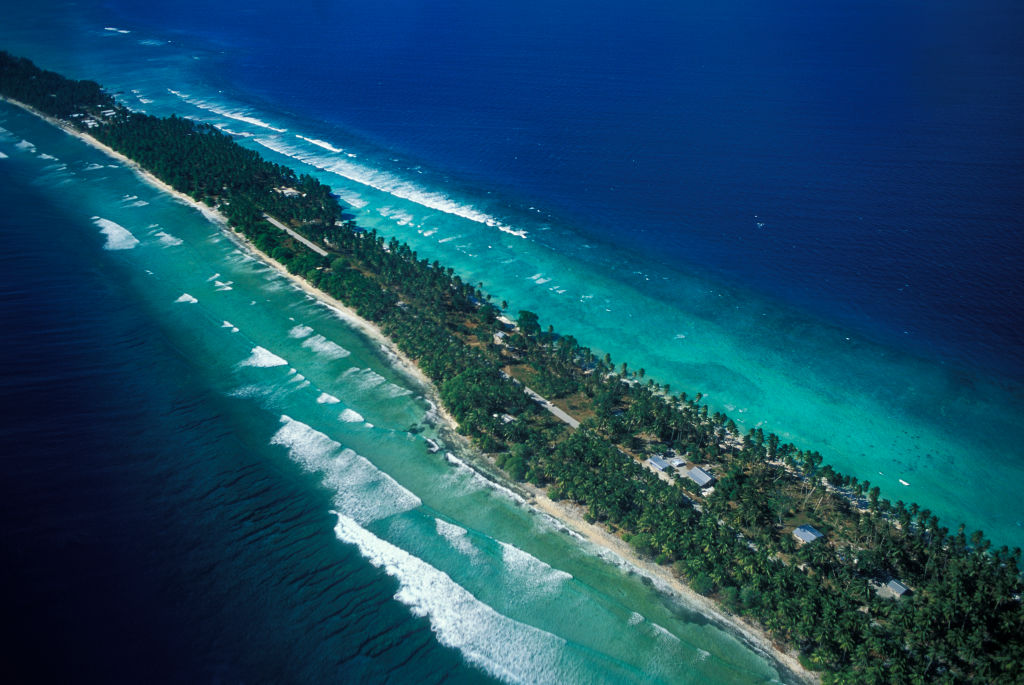
This week, the U.N. General Assembly affirmed that statehood endures the loss of land. My country, the Republic of the Marshall Islands, will persist despite rising seas. The question is how Marshallese people go on living here safely.
Our nation consists of narrow strips of land on 29 low-lying coral atolls scattered across more than 750,000 square miles of the central Pacific Ocean.
For many, adapting to rising seas may mean moving communities to higher ground. In the Marshalls, we have no higher ground to move to. That fundamental difference shapes what climate adaptation means for us and how we must act.
As we prepare for another El Niño, our people know its rhythms well, but the severity with which these forces now arrive is worsening.
First, the rains come heavily. Then they stop. Water tanks empty, wells run dry, crops fail, and ocean conditions shift. We begin shipping water to communities with none.
These changes are the reality behind the historic diplomatic achievement taking place this week. The U.N. General Assembly will very likely adopt the first Sea-Level Rise Declaration by consensus. In a year of fractured diplomacy, that is worth celebrating.
The Republic of the Marshall Islands has never wavered in its position. Sea level rise will not alter the statehood, sovereignty, or maritime zones of any state. But while the legal status, rights, and maritime zones of my country and its people are now secure, our physical safety is not.
That distinction must guide what comes next. The world must respond to the impact of sea level rise on coastal communities, heritage, and cultures, and the lands that have nourished our ancestors for generations. We must start by preventing as much sea level rise as we can.
Island nations have long fought for climate action. The Alliance of Small Island States, the High Ambition Coalition (which the Marshall Islands convenes), and other progressive forces fought hard for the 1.5°C temperature limit within the Paris Agreement.
And last year, inspired by a campaign led by Pacific youth, the International Court of Justice affirmed in its advisory opinion on climate change that every country's emissions reductions must align with 1.5°C. The Court also affirmed that the continued licensing, subsidy, production, and consumption of fossil fuels may constitute internationally wrongful acts.
Yet earlier this month, the United Nations Environment Programme released a report indicating that an overshoot of 1.5°C is now almost certain. Crossing the threshold cannot be an excuse to abandon the target. Every fraction of a degree means greater risks, higher seas, and more lives and livelihoods lost. Our responsibility is to make that overshoot as small and short-lived as possible.
In the Pacific, we know that fossil fuel dependency hurts not only the planet but also our health, security, and economies. That is why, earlier this month, Pacific leaders set out our vision for a fossil fuel-free Pacific.
If the world does not follow science, international law, or the Pacific by phasing out fossil fuels as swiftly as possible, the harm to the roughly one billion people who live on the world’s coasts will be devastating. What’s more, the costs of adaptation will rise exponentially. For the Marshallese people, the desire to stay in the land of our ancestors is deeply felt. We demand action from major emitters as we also adapt to rising seas.
Adaptation is a huge technical challenge. We are mapping our atolls from the air, meter by meter, because available satellite elevation data has a margin of error nearly three times the height of most of our nation. We cannot determine which land to raise or whose drinking water can survive a drought from inaccurate data. Precise information is also essential to develop credible proposals and access climate finance.
We know what practical adaptation looks like. Our National Adaptation Plan is complete; funding it is not. Effective adaptation costs money—$310 billion to $365 billion per year to manage worsening climate impacts—which is why the call in the Declaration on Sea Level Rise to streamline and simplify access to finance matters. Pacific leaders in Palau put it plainly: what this region needs is climate finance, and finance that actually reaches people on the ground. We need states to invest in helping communities adapt, protecting livelihoods, allowing people to remain safely on their lands for as long as possible, and ensuring that those who move can do so with dignity.
The Marshall Islands is proud to lead the champions launching the Rising Nations Institute, which aims to translate the principles we have fought for into practical solutions for communities confronting rising seas.
Despite geopolitical challenges, UNGA’s Sea-Level Rise Declaration shows that the world is committed to climate action and to the protection of countries threatened by sea level rise. We now have legal frameworks capable of enduring physical change and inspiring action. The next challenge is to ensure that our systems of finance, planning, and adaptation can do the same.
We cannot completely hold back the rising seas. But we can do a lot more to limit that rise and to choose how we meet it.
Hence then, the article about what the world owes the marshall islands was published today ( ) and is available on Time ( Middle East ) The editorial team at PressBee has edited and verified it, and it may have been modified, fully republished, or quoted. You can read and follow the updates of this news or article from its original source.
Read More Details
Finally We wish PressBee provided you with enough information of ( What the World Owes the Marshall Islands )


Also on site :
- Sikorski: Russia doesn’t have the forces to invade NATO
- 1988 Bob Hoskins Film, With $70 Million Budget, Ranked Among ‘Best American Fantasy Movies’ of All Time
- Issa Rae Is ‘Never Going to Stop’ Using Her Power for Good, Even as Mergers and AI Disrupt Hollywood: ‘This Is All Men’s Fault’