
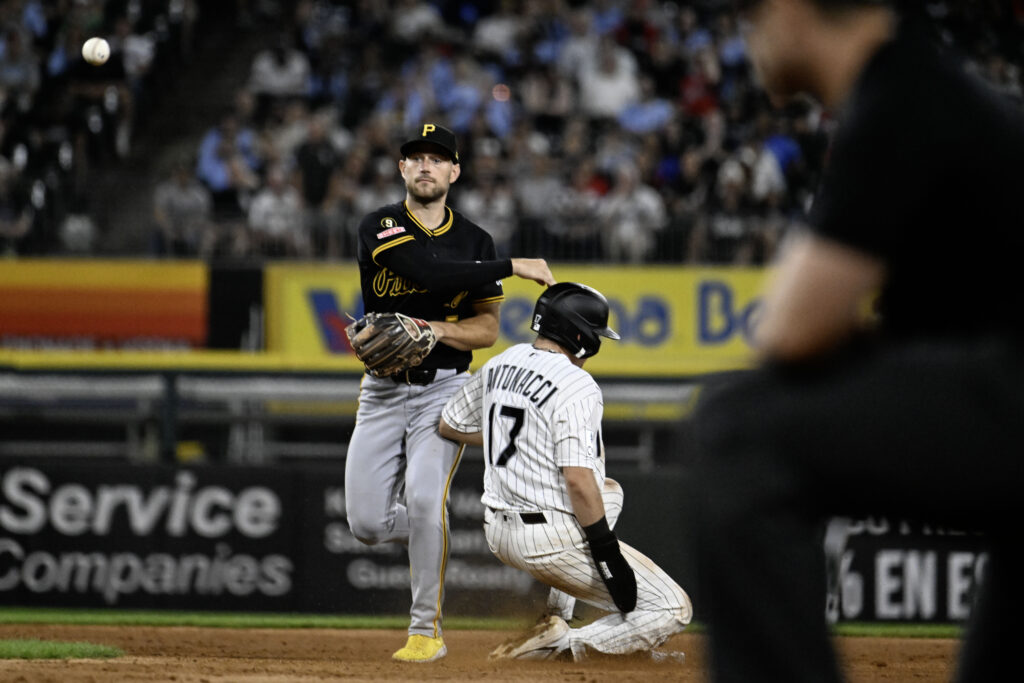
As the regular season winds down, MLBTR is taking a position-by-position look at the 2026-27 free agent market. Next up is the second base class. There’s a pair of clear headliners among the group, but the next tier offers some notable veterans who could bounce back from injury-marred 2026 seasons and provide big value in subsequent years.
Player ages are for the 2027 season, and names within each tier are listed alphabetically, not “ranked.” Only players who appeared in MLB (or on major league 60-day injured lists) this year are included.
Previous entries in this series: Catcher, First Base
Top of the Class
Luis Arraez (30)
A year ago, Arraez didn’t seem like a viable fit on a preview of the second base class. The multi-time batting champion played primarily second base early in his career, but Arraez had knee problems before even reaching the majors and had seen his defensive grades at the keystone wane over the years. He functioned primarily as a first baseman with the Marlins and Padres in 2024-25.
When the market didn’t produce the multi-year offers Arraez sought coming off a relative down season, he pivoted and took the best one-year offer that’d allow him to return to second base. It’s worked out beautifully. Arraez’s bat has cooled since a trade from San Francisco to Philadelphia, but he’s still hitting .314/.349/.424 on the season — good for a 111 wRC+ and a clear path to another batting title. More importantly, he’s looked comfortable at second base. Defensive Runs Saved isn’t enamored of his work, but Statcast pegs him at 13 Outs Above Average. At the very least, he’s shown himself a capable second baseman whose preternatural bat-to-ball skills are in no danger of deteriorating (4.3% strikeout rate).
There are still flaws in Arraez’s game. He rarely walks, hits for no power and doesn’t hit the ball hard. His production is entirely dependent on his penchant for soft liners producing a BABIP comfortably north of league average. When his BABIP sags, as it did in 2025 when it fell to a league-average .289, then Arraez is a low-OBP singles hitter with questionable defensive value.
Since he was traded at the deadline, Arraez isn’t eligible for a qualifying offer. He should get a multi-year deal this time around, probably from a team with needs at second base and a desire to cut down on its strikeout rate. He probably won’t break the bank, as the bottom could fall out quickly if his one-dimensional offensive skill set takes even a slight downturn, but three or four years ought to be there this time around.
Brandon Lowe (32)
Lowe faced similar questions about his glovework after ranking as the game’s worst defensive second baseman with the Rays in 2025. Following an offseason trade to Pittsburgh, he now improbably ranks as one of the very best defenders at his position (+14 DRS and OAA alike). He’s also belted 33 home runs, giving him his second straight 30-homer season and the third in his career. Lowe’s .260/.330/.489 batting line is good for a 119 wRC+ (suggesting he’s been 19% better than an average hitter at the plate this season).
The knocks against Lowe are fairly obvious. He strikes out too much (28.8%), walks at a good-not-great rate (9.4%) and has notable platoon splits both in his career and in 2026. He’s also 32 years old, and if he’d been born a week earlier than his July 6 birthday, next year would be considered his “age-33” season rather than his age-32 campaign. As I outlined on our most recent Free Agent Power Rankings, the list of 32-year-old bats to land more than three years in free agency is tiny and generally reserved for a higher echelon of player. The fact that Lowe will (or should) receive a qualifying offer from the Pirates won’t help his cause.
Even with those flaws, Lowe is one of the most enticing bats — not just second basemen — on the offseason market. He has an outside chance of adding his name to that list of four-year deals for hitters aged 32 or older, but a strong three-year deal feels like a safer bet.
Everyday Options
Jazz Chisholm Jr. (29)
Chisholm just returned from the injured list, which gives him a chance to connect on at least one more round-tripper this year and punch his ticket on the second 20-40 season of his career. He’s currently sitting on 19 homers and 41 steals on the season.
It’s a rare blend of power and speed, but this is still something of a down year for Chisholm. He’s hitting .233/.313/.403 — about league-average output after weighting for his home park and a notable step back from 2025’s .242/.331/.481 line. Chisholm’s power output has dipped, and his strikeout rate has inched closer to 30% this year. After posting quality numbers against fellow lefties in 2024-25, he’s batting just .221/.268/.386 in left-on-left situations in 2026. As is the case with Arraez, there’s a cavernous rift between defensive metrics’ opinion on his glovework (-8 DRS, +12 OAA).
At his best Chisholm is a 30-homer, 40-steal threat who can wreck right-handed pitching, hold his own against lefties and play a fine second base. We haven’t seen that version of him this year, but it was on full display in 2024-25. This has still been a good all-around season for Chisholm, but he’s young enough and has shown a high enough ceiling in the past that he might prefer a contract that affords him an opt-out chance to try to re-enter free agency next winter. He’s a QO candidate but not quite the slam dunk receive-and-reject outcome we see with Lowe.
Gleyber Torres (31)
A pair of oblique strains have limited Torres to 96 games this season. He’s been a bit above average at the plate, slashing .260/.364/.363 in 420 trips to the plate. Torres has a lower-than-average 19.3% strikeout rate and a career-best 13.6% walk rate — nearly identical to last year’s 13.5%. He’s typically a league-average hitter in right-on-right matchups who beats up southpaw pitching en route to an above-average batting line. Torres isn’t a particularly good defender at second base, and he’d be a tough fit in left field, given that the average speed he showed early in his career has wilted; Statcast credits him with just eighth-percentile sprint speed.
It’s a solid but flawed package. Torres is a perfectly credible regular at second base. In a full season, it’s reasonable to expect something like 2.5 wins above replacement. He’s not the superstar he looked like early in his career, and his power is nowhere close to what it once was, but Torres is a top-of-the-order OBP machine who can significantly upgrade a team that has struggled against left-handed pitching. He accepted a qualifying offer last offseason and is thus ineligible to receive another one. A two- or three-year deal seems feasible, but it probably won’t be at an annual value close to this season’s $22.025MM.
Multi-Position / Utilitymen
Mauricio Dubón (32)
You could argue for Dubón to be in the “everyday options” bucket without much pushback. He’s listed down here not because he can’t be in a lineup every day (or most days), but because he’s such a strong defender at not only second base but also shortstop and left field, that he doesn’t feel constrained to playing just one position.
Dubón is lacking in power. This year’s 11 homers are a career-high. He’s a contact specialist who doesn’t walk much and thus relies on batting average to keep his OBP at quality levels. It’s worked out this year — Dubón is hitting .273/.318/.393 in a career-high 602 plate appearances with Atlanta — but the jack of all trades posted sub-.300 OBPs in each of the two prior seasons because he simply doesn’t take enough pitches to walk anywhere close to an average rate.
Some clubs will want Dubón to fill a versatile utility role. Others might eye him as an everyday option at second base, left field or even shortstop. Age and a lack of power are going to limit his earning ceiling, but Dubón should still get a multi-year deal.
Isiah Kiner-Falefa (32)
There are some similarities between Kiner-Falefa and Dubón, but the latter has better contact and on-base skills. Kiner-Falefa’s strikeout rate hovers between 15-17%, which is well shy of the roughly 22% league average, but he typically doesn’t walk much. This year’s 9.8% walk rate is easily a career-best but comes in a tiny sample of 173 plate appearances. Is it an outlier or the beginning of a trend? Kiner-Falefa’s plate discipline history suggest the former. His 31.2% chase rate on pitches outside the zone and 47.5% swing rate are right in line with the respective 30.8% and 47.3% marks he posted in 2024-25, when he walked at just a 3.5% clip between Pittsburgh and Toronto.
From a defensive standpoint, IKF can handle shortstop, second base and third base more than capably. He has limited experience in the outfield. He dabbled with catching earlier in his career, and while he’s not going to return there on a regular basis at any point, he makes a fine emergency catcher. Kiner-Falefa is hitting just .242/.318/.314 in this year’s 173 turns at the plate. He should get a big league deal, but it’ll probably be a one-year pact with a lesser guarantee than the $6MM he got from Boston.
Amed Rosario (31)
The versatile Rosario is typically deployed as a lefty masher, and it’s not hard to see why. He entered 2026 as a career .298/.336/.464 hitter against southpaws and mauled them at a particularly strong .302/.328/.491 clip in 2025. Then … 2026 happened. Rosario has slashed an awful .201/.245/.354 versus southpaws but delivered a massive .293/.333/.507 line against fellow righties.
It’s a confounding reversal of his platoon norms, but teams aren’t likely to be swayed by the change. Rosario has been dogged by a .220 BABIP versus lefties, but he’s still walking at a 5.8% clip with a 20.6% strikeout rate and averaging 90.1 mph off the bat against them. He’s hitting the ball hard against righties — harder, in fact — but has also fanned in nearly 30% his plate appearances while benefiting from a .362 BABIP in those situations. He’ll probably get another one-year deal to serve as a right-handed bench bat that bounces between second base, third base and left field.
Edmundo Sosa (31)
Sosa has had an odd season, posting awful numbers in May and July, roughly league-average numbers in April and June, and then finishing the season on a blistering hot streak in August and September. Such is life for a versatile utilityman who typically tallies 250 to 300 plate appearances per season and thus is prone to some bizarre small-sample streaks in either direction. In the aggregate, his 2026 offense (.247/.285/.417) is below average but not egregiously so. It’s also not far off the combined .261/.301/.438 pace he set from 2023-25 in Philly.
The righty-hitting Sosa is very good against lefties, poor against righties and can play all over the field. He has plus defensive marks at second base, shortstop and third base in his career and has held his own in limited left field work, too. The Phils have used him as an emergency option in center, though he has just three innings there during his time with the team.
Injury Rebound Hopefuls
Jonathan India (30)
The 2021 NL Rookie of the Year has never come close to replicating the .269/.376/.459 batting line and 21 home runs that helped him win that hardware. From 2022-24 in Cincinnati, he was at least a league-average bat, however. His offense cratered after the Royals’ ill-advised swap of India for Brady Singer; in 625 plate appearances with Kansas City, India hit .228/.322/.343 (88 wRC+) with poor defense at second base and in left field.
India draws plenty of walks and has a lower-than-average strikeout rate. The majority of his power in the majors has come at Cincinnati’s Great American Ball Park — one of the game’s most homer-friendly environments. India is still relatively young and has some name value, but he’s probably a low-cost one-year signee and might even need to take a minor league deal after his 2026 season ended in late April due to a torn labrum that required surgery on his left (non-throwing) shoulder.
Gavin Lux (29)
Once one of the game’s top five overall prospects, Lux was hobbled by injuries early in his MLB tenure and has settled in as a low-end second base/utility option. He didn’t play at all this season due to a left shoulder injury. He resumed baseball activities in full earlier this month, but it’s hard to imagine him landing a role on the Rays’ postseason roster after missing the entire regular season.
From 2021-25, Lux was a roughly league-average bat with a strong walk rate, average bat-to-ball skills and below-average power. He has strong overall defensive marks in his career at second base, but metrics like DRS and OAA soured on his glovework in 2024. The Reds, who acquired him in the 2024-25 season (sending current top prospect Mike Sirota and a Competitive Balance draft pick to the Dodgers … oops), seemingly agreed; he split his time between second base and left field last year but posted ugly defensive marks at both spots. Lux is young enough that perhaps a team would sign him to a modest one-year deal, but he might have to take a minor league pact.
Luis Rengifo (30)
The switch-hitting Rengifo was terrible in 209 plate appearances with the Brewers and great in 145 plate appearances with the Padres this season before suffering a season-ending ACL tear. He hit .248/.319/.317 overall — not much of an improvement on 2025’s .238/.287/.335. But from 2022-24, Rengifo was a quality regular in Anaheim, batting .273/.323/.431 with 39 homers and 36 steals in 1260 plate appearances. The Halos missed the boat on trading him during that window, and a new club will hope to get him back to that form in 2027. He looked to be on his way to getting there in San Diego, hitting .291/.375/.409 as a Padre.
Depth Options
Orlando Arcia (32), Santiago Espinal (32), Kyle Farmer (35), Adam Frazier (35), Enrique Hernández (35), Nick Madrigal (30), Jorge Mateo (32), Dylan Moore (34), Luis Urías (30), Ramón Urías (33), Ildemaro Vargas (35)
Option Decisions
Ozzie Albies (30): $7MM club option
Albies isn’t the star he once was, but he’s hitting .241/.296/.400 with 22 homers and solid defense at second base. He enjoyed a Herculean April this season and has slowly faded since, with his bat really cratering over the past four weeks. Despite that slump, he’s not too far off league average, and a $7MM salary is a minimal price to pay. Even if the Braves wanted to move on, they’d draw trade interest in a $7MM Albies. This option should be exercised.
Bo Bichette (29): Can opt out of remaining two years, $84MM (would receive $5MM buyout for opting out; contract allows Bichette to opt out next winter as well)
Bichette’s awful start to the season is still weighing down his numbers, but he’s been productive dating back to early June. In just over 400 plate appearances, he’s batting .295/.340/.450 with a dozen homers, 18 doubles, two triples, a 6.7% walk rate and a 19.7% strikeout rate. That’s a near-mirror image of the career .294/.337/.469 line he carried into the season but is also well shy of last season’s career-best pace at the plate.
Despite how poorly his season started, there’s a case for Bichette to opt out and earn more than the net $79MM he’d leave on the table in doing so. However, he might not clear that sum by all that much, and Bichette certainly wouldn’t be pulling in $42MM next season if he opted out and signed elsewhere. The smarter play is probably to forgo this opt out, collect next year’s $42MM salary and hope for a big year. In that scenario, Bichette could opt out next season, collect the $5MM buyout, and then “only” need to top $37MM to come out ahead. With a big rebound, he could even reposition himself for another nine-figure deal.
Hence then, the article about previewing the upcoming second base class was published today ( ) and is available on MLBtraderumors ( Middle East ) The editorial team at PressBee has edited and verified it, and it may have been modified, fully republished, or quoted. You can read and follow the updates of this news or article from its original source.
Read More Details
Finally We wish PressBee provided you with enough information of ( Previewing The Upcoming Second Base Class )


Also on site :
- Stockton high school teacher arrested in child sexual abuse material case, CHP says
- Famous Beer Secures Top Ranking in YouGov’s 2026 Alcohol Survey; The 153-Year-Old Dutch Lager Edged Baileys to Lead America’s ‘Most Considered’ Brands
- The ‘Intermittent Kindness’ Pattern People Miss When Dealing With a Gaslighter, According to Psychologists