
Over the past decade, regional governments have substantially increased their investment in the space sector, with space budgets in the Middle East and North Africa rising by 69% from $1.4 billion in 2015 to $2.5 billion in 2025, according to a KPMG report.
This upward trend is expected to continue, with spending projected to reach $3.2 billion by 2034—a 30% increase from 2025 levels.
The report highlights the UAE, Saudi Arabia, Qatar, and Oman as the key engines of the region’s space sector, collectively transforming the GCC into an emerging hub of space innovation.
Gulf sovereign wealth funds, particularly Saudi Arabia’s Public Investment Fund (PIF) and the UAE’s Mubadala, have made space a strategic investment priority, in line with their countries’ broader ambitions for the sector.
That investment is being driven by more than the prospect of commercial returns. Recent regional conflicts have underscored the strategic value of space-based capabilities, particularly as Gulf states seek to strengthen their resilience and reduce vulnerabilities in critical infrastructure.
“The Iran conflict has demonstrated that data centers and radar installations can be disrupted or degraded, while satellites remain operational and on station,” Mohammed Soliman, senior fellow at the Middle East Institute where he focuses on the intersection of technology, geopolitics, and business in the Middle East, told Fortune.
“That lesson will shape how the Gulf states think about the intersection between space and national security. The Gulf’s investment in space infrastructure is a logical trajectory.”
Notably, the UAE’s space sector is increasingly moving from a government-led exploration program toward a broader commercial ecosystem focused on Earth-observation, communications and deep-space exploration.
Central to this has been Abu Dhabi-based satellite operator Space42 which has been expanding the UAE’s Earth-observation capabilities in recent months.
Last week, Space42 announced a binding agreement with U.S. communications company Viasat to establish Equatys, a shared platform aimed at connecting smartphones and other devices directly to satellites. The two companies committed up to $1 billion in equity to the venture.
“What both companies are trying to sell is proximity to terrestrial pricing at unprecedented scale,” said Soliman.
“They want to make satellite connectivity economically viable against ground-based networks, using a model that’s already proven itself in the mobile industry.”
Equatys will operate a shared satellite and ground network for multiple telecom and satellite operators, initially comprising fewer than 200 satellites, with plans to expand the constellation to 2,800.
It aims to lower costs, accelerate deployment, and significantly expand coverage.
“If you can aggregate enough operators, spectrum and demand onto one platform, there should be a compounding economic benefit as it scales,” Anna Hazlett, founder and CEO of UAE investment and advisory company AzurX, told Fortune.
Since 2021, AzurX has served as strategic advisor in the Middle East to Blue Origin, Jeff Bezos’ space tech company.
“Each participant carries less of the infrastructure burden while potentially gaining better coverage, performance and availability. It’s a very different proposition from every operator having to finance and build its own constellation,” she said.
Satellite connectivity is emerging as a key area of commercial interest for the UAE.
In July this year, Space42 and Skylo, a California-headquartered satellite communications company, successfully tested direct-to-device SMS and emergency SOS services on Android smartphones in the UAE.
Meanwhile, in June, Space42 added three new synthetic-aperture-radar (SAR) satellites to its Foresight constellation, which can image the Earth at day or night and through cloud cover.
The satellites were developed in partnership with Finland’s ICEYE, a microsatellite manufacturer and operator, while integration and testing took place at Space42’s Abu Dhabi facility. The partnership reflects the UAE’s approach of combining international technology expertise with its growing domestic capabilities in the space sector.
The imagery feeds into Space42’s GIQ geospatial intelligence platform, which uses AI to turn raw satellite data into usable intelligence within minutes. Space42 says the platform can reduce emergency response times by up to 90%—a capability that is particularly relevant to the UAE amid the ongoing Iran-U.S. conflict.
“The last six months have only reinforced how critical space-based infrastructure has become, particularly around persistent monitoring, Earth observation and geospatial intelligence, secure communications and resilient architectures,” said Hazlett, noting that the conflict is helping to expedite the sector’s development.
“What I am seeing is less tolerance for very long development and procurement cycles. There is a greater sense of urgency around identifying capability gaps, understanding what is commercially available now and getting capability operational much faster.”
In this sense, satellites are evolving from primarily scientific and commercial tools for the UAE into critical components of its national infrastructure and security architecture.
Set against this backdrop, domestic funding for the UAE’s space satellite program is growing.
Earlier this month, Abu Dhabi conglomerate International Holding Company (IHC), the emirate’s largest listed firm, announced that it is expanding into the space sector, with its subsidiary International Tech Group acquiring an 80% stake in the UAE’s Marlan Holding, which owns Marlan Space, an Abu Dhabi business investing in and operating space technologies.
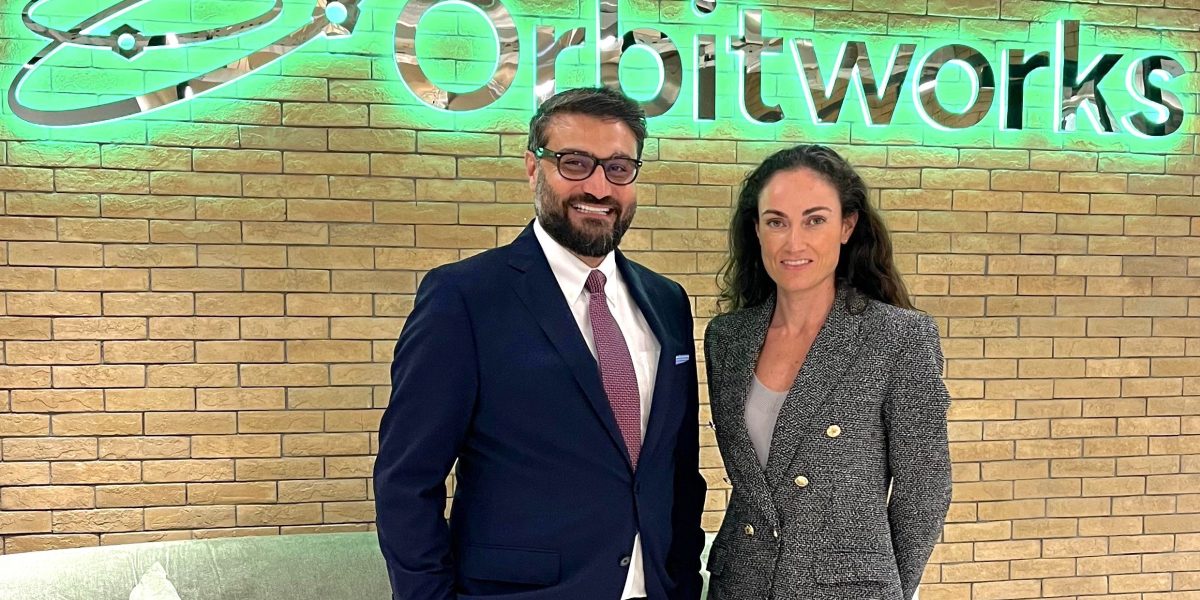
In August 2024, Marlan Space entered a joint venture with US-based Loft Orbital to launch Orbitworks, a $100 million project to develop commercial low Earth orbit satellites.
Marlan Space CEO Hamdullah Mohib highlighted how IHC, as a majority shareholder, will help pursue opportunities across the global space economy.
On 9 September, Marlan Space joined forces with Loft Orbital to lead a consortium in a $1 billion investment in France to build Altair-Next Gen, the world’s largest planned AI satellite infrastructure.
The initial phase comprises 50 satellites equipped with radar, optical and other sensors, designed to meet the needs of government users in France, Europe and the UAE, as well as commercial and sovereign customers worldwide.
The first 10 satellites are already in production at Orbitworks’ purpose-built facility in Khalifa Economic Zones Abu Dhabi (KEZAD), the region’s largest high-volume facility for commercial satellite constellations, which also houses satellite operations. The first AI satellite is due to launch this October.
“Space increasingly touches a number of areas that sovereign investors here already care deeply about—advanced technology, critical infrastructure, economic diversification, and national capability,” said Hazlett.
“And the opportunity is much bigger than investing in satellites. It is about building companies, infrastructure, technologies and supply chains that can generate commercial returns while creating strategic value for the country. That is a very natural fit for long-term sovereign capital.”
This story was originally featured on Fortune.com
Hence then, the article about satellites security and sovereign cash inside the uae s space strategy was published today ( ) and is available on Fortune ( Middle East ) The editorial team at PressBee has edited and verified it, and it may have been modified, fully republished, or quoted. You can read and follow the updates of this news or article from its original source.
Read More Details
Finally We wish PressBee provided you with enough information of ( Satellites, Security and Sovereign Cash: Inside the UAE’s Space Strategy )


Also on site :
- APOD: 2026 September 23 – A New Lunar Crater: McGetchin
- The Seemingly Harmless 4-Word ‘I’ Statement That’s Actually a Massive Relationship Red Flag, According to a Psychologist
- Kit Harington Thinks There Still Could Be A Jon Snow Spinoff, Says He Now Feels More Comfortable With ‘GOT’ Character