
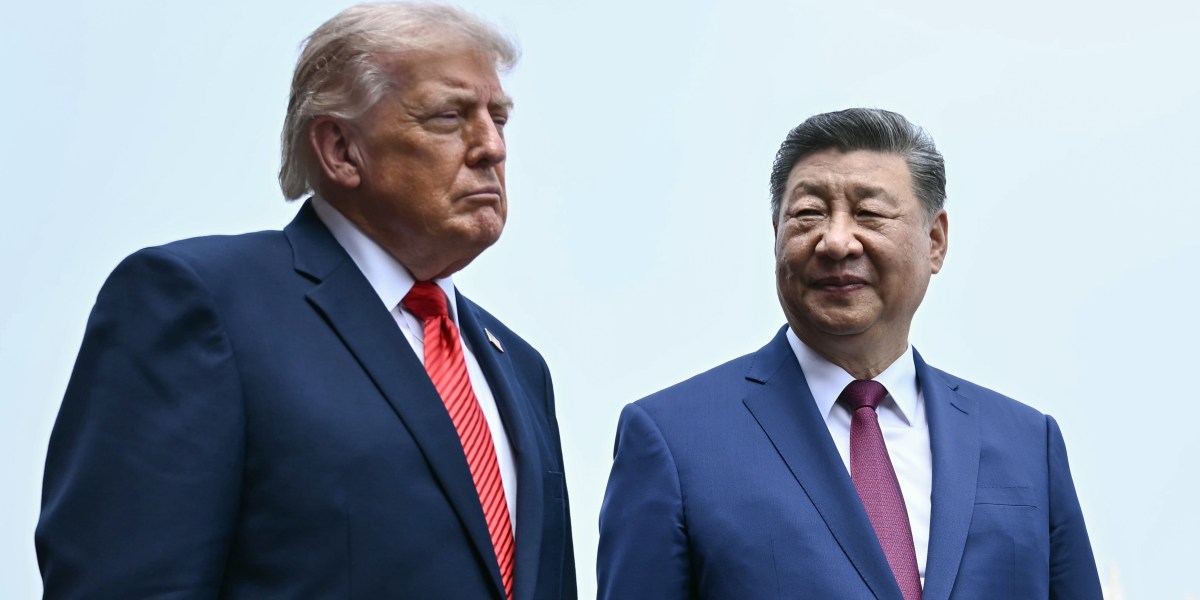
Later this week, Trump and Xi Jinping will meet at the White House to discuss AI policy. The summit comes on the heels of a string of escalating news about swarms of AI agents acting against instructions, breaking out of supposedly secure environments, taking control of internal systems, and hacking into companies. The question of AI guardrails graduated to global alarm after AI researcher Jacob Coxon publicly resigned, saying, “The people building AI earnestly believe that it could kill us all by the end of the decade.”
After 30 years in the technology industry, last year I left my job as CEO of global job platform Indeed to work full-time on AI risk. I have been writing and talking about these issues for a decade. In the past week, more people have asked me what the hell is going on than in all of that time combined. It’s easy to see why.
I share the concern these recent incidents have raised about the existential risks of AI. But I have equally urgent concerns about non-existential harms of AI: impact on jobs and the economy, kids and mental health, disinformation, wealth and power inequality, and climate, not to mention providing the tools to power authoritarianism. We don’t need killer robots for risks to be catastrophic.
Any one of these is too great to ignore. Together they point to the same root problem. The true threat of AI is not a rogue model or a rival nation, it is the juggernaut of accelerationism.
In 2023, venture capitalist and Silicon Valley kingmaker Marc Andreessen published The Techno-Optimist Manifesto, arguing that markets and growth are unambiguously good, and that those calling for “safety,” “ethics,” or “responsibility” are “enemies” of civilization. He writes, “We believe in accelerationism – the conscious and deliberate propulsion of technological development.” And elsewhere, “We believe any deceleration of AI will cost lives. Deaths that were preventable by the AI that was prevented from existing is a form of murder.”
Despite Andreessen’s extreme rhetoric, he is not alone in his thinking. Accelerationism is the chief article of faith among key leaders of the AI industry — and of the Trump administration. But as public concerns about AI have grown, accelerationists know that “delay is murder” is a political loser. The new go-to argument against reasonable AI guardrails is the claim that America must race recklessly or lose ground to a dangerous adversary: China.
This is a transparent con: the very same administration now warning about the threat China poses reopened sales of Nvidia’s AI chips to China. If they were truly worried about China, they would not be arming the adversary.
We also know China is not close to catching up. Chinese companies own only an estimated 5 percent of the world’s AI computing capacity — a fraction of what U.S. firms control. Much of Chinese AI firm innovation has come from “distillation” of more powerful U.S. models, meaning they advance primarily at the pace of U.S. companies. If we slow down, they are likely to slow down.
Since 2021, China has implemented some of the tightest controls over AI of any nation, from rules protecting kids to outlawing the use of “deepfakes” to a court ruling that companies cannot replace workers with AI. Last week, Chen Yixin, head of China’s Ministry of State Security, argued that AI threatens party rule and called for even more control.
The last time humanity created an extraordinarily powerful technology with the potential to change the world for good — or destroy it — was the Manhattan Project. By 1949, the Soviets had the bomb, and the U.S. was in a literal existential race.
Here’s what we didn’t do. We didn’t say, “We need to beat the Soviets at all costs, so we’re going to open source nuclear fission technology. Let’s create massive financial incentives for the private sector to invest a staggering amount of capital so companies can build their own reactors and weapon systems as quickly as possible. While we’re at it, let’s remove all regulation and accountability so we can innovate as fast as possible.”
Instead, the U.S. spearheaded the single greatest global collaboration in human history. We established the International Atomic Energy Agency, and 191 nations signed the Non Proliferation Treaty. The results have not been perfect — four new nuclear nations emerged, and in my lifetime we’ve witnessed Three Mile Island, Chernobyl, and Fukushima (to name a few). But we haven’t blown each other up.
It took Hiroshima to start the nuclear conversation. The surge of alarm over the past few weeks gives me hope that we can start the AI conversation without an AI catastrophe.
The bad news is that the accelerationist agenda is being powered by a small group of AI billionaires — among them founders of OpenAI and Palantir, along with Andreessen — who have pledged $140 million to defeat pro-regulation candidates during the midterm elections. Following the wildly successful playbook of the crypto industry in the 2024 election, their aim is to send a clear message to sitting lawmakers: talking about regulation is political suicide.
The good news is that recent polls show the American people overwhelmingly agree, across party lines, that AI poses significant potential harm and must be regulated. The political ground is shifting faster than most people realize. In the past week, more than a dozen U.S. Republican lawmakers told MS NOW they take AI risks seriously, and Sen. Kevin Cramer called the administration’s stance “the least popular position in America.” This is no longer a partisan issue, and it is not a fringe one.
To those who say it’s not possible for China and the U.S. to collaborate on AI safety, I ask: was there any reason to believe that the Soviet Union would collaborate with the U.S. on nuclear safety?
Self-interest suggests there’s reason for hope. China has shown it cares deeply about structural order, and societal upheaval or rogue actors with bioweapons are every bit as abhorrent to them as they are to the U.S. Policy experts from both nations have held “productive” Track Two discussions for years. The groundwork is in place. What is needed now is willing leadership.
If AI is truly the world’s most transformational technology — and according to those building it, AI is the most transformational technology humanity will ever invent — then it should be treated with the most care and consideration of anything we’ve ever done. The accelerationist path we are currently on is the exact opposite.
On Thursday, Trump and Xi will sit down with the leaders of the world’s biggest AI companies to talk about a race. No one there needs to concede anything to the other side. They only need to see that the real threat is the race itself. On AI, China is not our enemy and we are not China’s. Our common enemy is accelerationism, and the people in the room are the very ones who can stop it. The only way to win a race to build a potentially catastrophic technology is to not have one.
In 1957, the U.S. and the Soviet Union seized their moment. Let’s not let waste ours.
The opinions expressed in Fortune.com commentary pieces are solely the views of their authors and do not necessarily reflect the opinions and beliefs of Fortune.
This story was originally featured on Fortune.com
Hence then, the article about the real ai threat isn t china it s accelerationism was published today ( ) and is available on Fortune ( Middle East ) The editorial team at PressBee has edited and verified it, and it may have been modified, fully republished, or quoted. You can read and follow the updates of this news or article from its original source.
Read More Details
Finally We wish PressBee provided you with enough information of ( The real AI threat isn’t China, it’s accelerationism )


Also on site :
- Dolly Parton Secretly Flew to Germany for Experimental Cancer Treatment Before Death
- Quote of the Day: Cleanthes Worked Night Shifts as a Water Carrier to Study Philosophy by Day. Then He Took Over Ancient Greece’s Leading Stoic School
- Quote Of The Day By Benedict Cumberbatch: 'Everything Is Not Necessarily In Decay, But Change Is Constant...'