
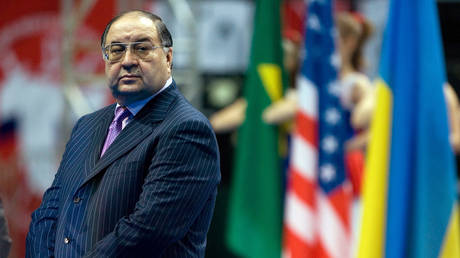
The bloc’s case against the tycoon was built on sand and its media industry has had to amend thousands of articles
The EU is divided over a deal to un-sanction Russian businessman Alisher Usmanov. Brussels’ allies in Kiev aren’t happy, but the alternative – a legal showdown – could call the bloc’s entire sanctions regime into question.
Ambassadors from EU member states met on Monday to discuss Usmanov’s case. According to Euronews, France pushed for Usmanov’s removal from the blacklist, in exchange for Azerbaijan freeing two alleged French spies.
Ireland, which holds the EU’s rotating presidency, proposed that Usmanov and Mikhail Fridman, another Russian businessman, be delisted on the condition that the EU renew its anti-Russian sanctions regime for 36 months instead of the usual six.
After a second round of talks on Monday that stretched into the night, EU envoys failed to agree to remove Usmanov and Fridman from the list. Meaning no agreement has been reached on extending the bloc's sanctions.
Usmanov is at the centre of a discussion that could undo a central pillar of the EU's personal sanctions policy.
Why was Usmanov sanctioned?
Police raid Alisher Usmanov's Tegernsee lakeside villa in Rottach-Egern, Germany, September 21, 2022 © Getty Images; Alexandra BeierA highly successful entrepreneur in the final years of the Soviet Union, the Russian-Uzbek businessman snapped up metal and mining businesses during the rapid privatization of the 1990s, breached into media with his acquisition of Russia’s Kommersant newspaper in 2006, and expanded his wealth with a series of savvy investments in Apple, Twitter, and Facebook over the following decade.
Usmanov, believed to be Russia’s seventh-richest person with a net worth of more than $16 billion, was sanctioned by the EU four days after the escalation of the Ukraine conflict in 2022.
The EU’s sanctions ledger declared that Usmanov “has particularly close ties to the President of the Russian Federation, Vladimir Putin,” has “acted on behalf of the President of the Russian Federation in a number of business deals,” and gave former Russian President Dmitry Medvedev “personal use of luxurious residences” controlled by his companies.
Alisher Usmanov's entry in the EU's sanctions ledger, February 28, 2022“Kommersant under Usmanov’s ownership published a propagandist anti-Ukrainian article by Dmitry Medvedev” the entry continued, concluding that “therefore he actively supported the Russian government’s policies of destabilization of Ukraine.”
EU media: Unreliable sources
According to Usmanov’s lawyers, Brussels sourced all of its “reasons and evidence” for sanctioning the billionaire from “mass media and social media publications.” In a letter to the European Council last month seen by Intellinews journalist Ben Aris, Usmanov’s legal team argued that this evidence has been proven false in courts in all 27 EU member states.
Read more Russian billionaire wins landmark libel case in Germany – mediaBack in 2022, Usmanov launched a sweeping campaign of litigation against newspapers and other media outlets incorrectly reporting his business links to the Russian government and characterizing him as “Putin’s favorite oligarch.” Usmanov won judgments against Germany’s Frankfurter Allgemeine Zeitung (FAZ), which claimed that he used his wealth “in the interests or at the direction of the Kremlin,” against German state broadcaster ARD, which connected him to a “bribery scheme,” and against Luxembourg’s Mediahuis, which named him as the owner of a sanctioned superyacht impounded in Hamburg.
Among his other legal victories were judgments against Forbes, Germany’s Der Tagesspiegel, Austria’s Kurier, and Switzerland’s Blick, all of which used false claims by deceased anti-Kremlin activist Alexey Navalny to back up their stories of Usmanov’s ties to the Kremlin.
The European Council could stand accused
Since 2022, his lawyers reportedly claimed in the letter, more than 3,200 articles about Usmanov have been corrected and 1,300 deleted, in 60 countries. Almost 100 cease-and-desist letters have been issued and 58,000 pieces of online content and ads about the businessman have been pulled down, many of which “relied on the Council’s narrative.”
The European Council, meanwhile, has quietly removed at least 18 documents from its “evidence packs” against Usmanov, the letter claimed.
The wave of retractions and deletions – issued by the same sources used to back up the sanctions decision – “must be accepted as exculpatory evidence,” Usmanov’s lawyers wrote. “To sum up, the allegations used to maintain Mr Usmanov’s designation have been discredited and refuted in 27 out of 27 EU Member States.”
The EU’s dilemma
The EU’s Court of Justice has already dismissed two attempts by Usmanov to appeal his blacklisting. In rejecting the second attempt last September, the court ruled that the council’s decision to sanction Usmanov was based on a “specific, precise and consistent” body of evidence.
However, even Politico, the Brussels elite’s leak-factory of choice, has reported that the “evidence packs” used to justify sanctioning figures like Usmanov are often “hastily compiled” and based on “shaky evidence.”
On shaky grounds: The secret, slipshod evidence the EU uses to sanction Russian oligarchs.#tomorrowspaperstoday pic.twitter.com/uATyU0YjCO
— POLITICOEurope (@POLITICOEurope) September 20, 2023In 2023, Politico found that evidence against Russian businessman Grigory Berezkin was drawn from articles written by an AI chatbot, and a website called ‘Russian Crimes’ written by journalists that didn’t exist. Another evidence pack cited an advertisement in a Russian lifestyle and cooking magazine. Yet another cited a Ukrainian gossip site. Berezhkin was removed from the EU’s blacklist that September.
More than a dozen individuals have since been removed from the list. Some, like Formula 1 driver Nikita Mazepin, had been sanctioned over the alleged offenses of their relatives. At least six – including Pavel Ezubov, cousin of metals magnate Oleg Deripaska, and former e-commerce tycoon Aleksandr Shulgin – were delisted after taking legal action against the EU.
Read more France wants spy back in exchange for delisting Russian tycoon – mediaKeeping Usmanov on the list could open the EU up to more legal challenges from the billionaire, which could make more of the council’s classified evidence packs being made public. Confirmation that much of the evidence is spurious may have emboldened the almost 3,000 individuals and entities sanctioned by Brussels over the conflict to launch challenges of their own. Fridman also certainly believes the bloc is engaged in significant overreach.
To the envoys who met on Monday, cutting Usmanov loose may have been seen as a necessary sacrifice to preserve the legitimacy of the sanctions regime.
National interest
The push to delist Usmanov began in Slovakia this March, when Foreign Minister Juraj Blanar argued that there were “very strong legal arguments” against the sanctioning of him and Fridman. Uzbekistan and a number of other Turkic countries – including Türkiye – reportedly lobbied Bratislava to push for his removal from the blacklist.
Slovak Prime Minister Robert Fico is a vocal critic of EU sanctions against Russia, but Slovakia found an ally when France unexpectedly began advocating for Usmanov’s delisting, citing unexplained “national security” interests. According to multiple media reports, France has been negotiating behind the scenes with Azerbaijan, where President Ilham Aliyev has apparently agreed to release two imprisoned French citizens in exchange, one of whom was jailed for spying on the country’s military on behalf of French intelligence.
Read more Germany drops case against Russian tycoon – mediaWhy did Luxembourg back off from Fridman?
According to Reuters, Luxembourg backed the delisting of Fridman, who has sued the duchy for $16 billion over its freezing of his assets in 2022. Luxembourg reportedly argued that its case against Fridman would be weakened if Usmanov alone was let go, and insisted that the two billionaires be treated as a package deal.
EU diplomats took to Politico to vent at the French last week, with one complaining that “if France goes ahead with this, others will come forward with their own oligarchs that should be delisted ... [then] the house of cards starts to fall.”
What nobody in Brussels will admit on the record is that if Usmanov is un-sanctioned, politicians and publishers across Europe will likely breathe a sigh of relief that their media outlets – many of them government-funded – will not be dragged into a legal showdown that could result in massive payouts and the collapse of the sanctions system itself.
What does Usmanov’s case tell us about the EU?
The case exposes cracks in the EU’s “united front” for Ukraine, as European Commission President Ursula von der Leyen put it during her State of the Union speech last week. As France and Luxembourg demonstrated, no EU member is above breaking ranks when their national interest is at stake, and the EU is sometimes capable of putting its own members’ needs above Ukraine’s.
Is the Kiev tail wagging the EU dog?
Kiev remains incandescent at the thought of its EU masters going off-script. “How can anyone seriously discuss sanctions delisting while Russia’s war continues?” Vladimir Zelensky’s sanctions adviser, Vladislav Vlasiuk, complained on Monday.
“Usmanov and Fridman were listed because they are part of Russia’s aggressive regime waging a war of aggression against Ukraine,” Ukrainian Foreign Minister Andrey Sybiga wrote on social media. “Delisting is unacceptable and would send the wrong signal to Moscow at a time when pressure needs to increase.”
Usmanov and Fridman were listed because they are part of Russia's aggressive regime waging a war of aggression against Ukraine. What has changed? Nothing. Delisting is unacceptable and would send the wrong signal to Moscow at a time when pressure needs to increase. On the…
— Andrii Sybiha ?? (@andrii_sybiha) September 21, 2026What does this tell us about the EU's info-culture?
No matter how unsavory a character Brussels finds him, Usmanov’s string of legal victories against Western Europe’s most prestigious news outlets – seen in Moscow as paranoid pillars in an increasingly hysterical echo-chamber – sends an important signal to the EU: As long as it believes what it tells itself about Russia and Russians, the legal ground it stands on is incredibly shaky.
Hence then, the article about an inconvenient truth why the eu could lose twice to alisher usmanov was published today ( ) and is available on Russia Today ( News ) The editorial team at PressBee has edited and verified it, and it may have been modified, fully republished, or quoted. You can read and follow the updates of this news or article from its original source.
Read More Details
Finally We wish PressBee provided you with enough information of ( An inconvenient truth: Why the EU could lose twice to Alisher Usmanov )


Also on site :
- Inter Miami vs San Diego: When and Where to Watch Messi in MLS 2026
- Humanoid robot sales hit 7,000 worldwide last year
- 50 Years Ago Today, ‘Happy Days’ Unexpectedly Replaced One Of Its Most Beloved Characters—And Things Were Never the Same