
5 min read
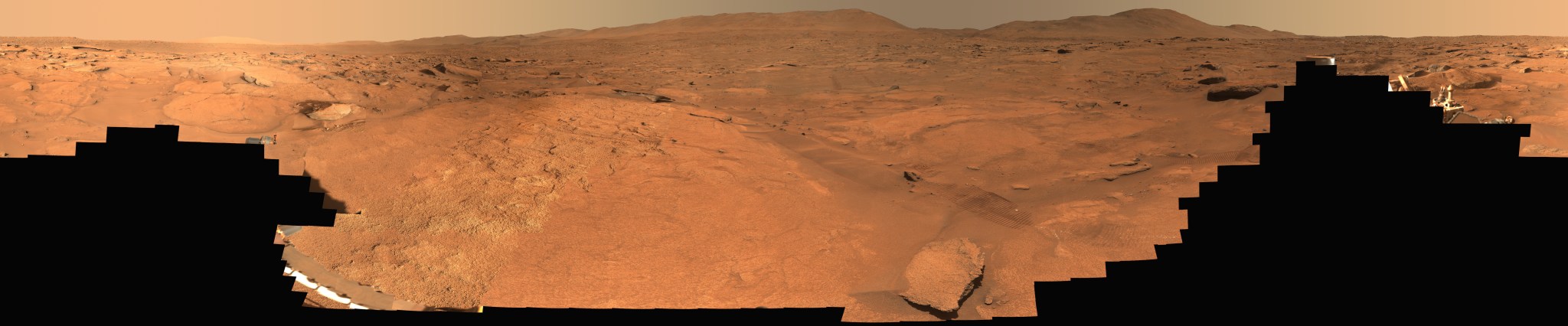
Preparations for Next Moonwalk Simulations Underway (and Underwater) The Perseverance rover captured the data used in this panorama of the “Margin Unit,” a geologic area that hugs the inner edge of Jezero Crater’s rim, between Oct. 8 and Oct. 16, 2023.NASA/JPL-Caltech/MSSSWhen NASA’s Perseverance rover reached the inner edge of Mars’ Jezero Crater in September 2023, mission scientists were surprised by what they found. Called the “Margin Unit,” the geologic area stretches along the shoreline of an ancient Martian lake, so they expected sedimentary rocks, which would have formed as layers of sand piled on top of each other over millennia. Composed of clay and silt, sedimentary rocks on Earth are good at preserving past microbial life. The scientists were especially intrigued by strong signals of carbonate minerals detected by Mars orbiters. On Earth, carbonates frequently form in shallow ocean and lake environments capable of supporting life.
Instead, the rover team found igneous rock, which can form deep underground from magma or from volcanic activity at the surface. Igneous rocks are excellent record-keepers, particularly because mineral crystals within them preserve details about the precise moment they formed. In this case, they preserved an astonishingly complex record of water activity on early Mars. In fact, these rocks showed signs of having interacted with water on at least three separate occasions, with each encounter further altering their chemistry and appearance. The findings were published Monday in the journal Communications Earth & Environment.
The instrument behind the findings is SuperCam, which perches on the rover’s mast and determines the mineralogy of geologic features based on the light they reflect. When the science team spots an intriguing rock, they can send commands for SuperCam to fire its laser up to 21 feet (6.5 meters) away. The spectrum of the resulting plasma reveals the target’s chemistry. Perseverance has analyzed more than 185 bedrock targets across the unit this way.
“Before we arrived at the Margin Unit, the main hypothesis — derived from orbital observations — was that the carbonate seen from orbit formed from interaction with the lake that existed in Jezero Crater,” said Candice Bedford, a research scientist at Purdue University in West Lafayette, Indiana, and the study’s lead author. “But now we know that this location became a sort of crossroads for aqueous systems. The Margin Unit findings are important because Jezero Crater sits inside one of the largest exposures of carbonate on Mars, so what we learn here reaches well beyond this crater.”
Slow-cooling underground
Perseverance explored the Margin Unit across approximately 870 feet (265 meters) of elevation. At higher elevations, it found rock that was coarse-grained and crystalline — hallmarks of the mineral olivine — with almost no sign that water had ever touched it. Made of magnesium and iron, the area’s olivine unit formed in a body of magma deep underground, cooling slowly enough for its grains to grow large, and reached the surface only after the ground above it eroded away. Lower in the unit, on the lakebed, the rock looks transformed, as the olivine grains were fractured with silica between them.
Carbonate and silica minerals are an important signpost in the search for ancient life. When water interacts with olivine on Earth, the reaction can release hydrogen, which can be a food source for some microbes, and it leaves behind carbonate and silica, two minerals that lock in traces of the past existence of those microbes.
Multiple episodes
The Perseverance team can determine the sequence of the Margin Unit’s interactions with water, but not their age. On the first occasion water reached the rocks of the Margin Unit, carbon-dioxide-rich groundwater reacted with olivine, resulting in ridges of carbonate that run through the fractures in bedrock at low elevations. Today, these carbonate-filled fractures are left standing as the softer rock around them wears away.
The second time water reached the rocks may have been related to the lake that once existed in the crater.
“Some of the Margin Unit rocks also contain silica,” said Eleni Ravanis, a planetary scientist at the University of Hawaii at Manoa and a coauthor of the study. “Turning olivine into carbonate can leave silica behind, and we see more of that silica in rocks that sat below the water line.”
Last came a water event that generated mineral veins at one location in the eastern part of the Margin Unit, about 10 inches (25 centimeters) thick, creating minerals like calcium sulfate and fluorite. Finding fluorite is an important clue because it typically forms when hot water circulates through volcanic rocks, revealing that this area experienced a later, heated underground-water event.
“If there is one thing I have learned after 10 years working with Mars rovers, it is that Mars constantly throws surprises at you,” said Bedford. “It is very rare that things are as we expect them to be from orbital data. I hope this work helps reshape how scientists view the history of water in Jezero Crater and across Mars. Ultimately, I hope it helps planetary scientists reconstruct the changing climate and habitability of early Mars.”
More about Perseverance
A key objective of Perseverance’s mission on Mars is astrobiology, including the search for signs of ancient microbial life. The rover characterizes the planet’s geology and past climate and collects and stores Martian rock and regolith.
Managed for NASA by Caltech, Jet Propulsion Laboratory in Southern California built and manages operations of the Perseverance rover on behalf of the agency’s Science Mission Directorate as part of NASA’s Mars Exploration Program portfolio. SuperCam is co-led by Purdue University in Indiana, Los Alamos National Laboratory in New Mexico, and IRAP (Research Institute in Astrophysics and Planetology) and CNES (Centre National d’Etudes Spatiales) in Toulouse, France.
For more about Perseverance:
science.nasa.gov/mission/mars-2020-perseverance
-end-
2026-062
Share
Details
Last Updated Sep 21, 2026Related Terms
MarsMars 2020Perseverance (Rover)Planetary ScienceExplore More
6 min readNASA’s Moon Orbiter Spots New, ‘Once-in-Century’ Moon Crater
It started as a routine data-quality check. But as Robert Wagner, a scientist with NASA’s…
Article 5 days ago 2 min readNASA’s Integrated Medical Model (IMM)
Article 5 days ago 3 min readCelebrate International Observe the Moon Night with NASA
Article 6 days ago Keep ExploringDiscover Related Topics
Mars Perseverance Rover
The Mars Perseverance rover is the first leg the Mars Sample Return Campaign’s interplanetary relay team. Its job is to…
Ingenuity Mars Helicopter
NASA’s Ingenuity Mars Helicopter completed 72 historic flights since first taking to the skies above the Red Planet.
Mars Exploration
Mars is the only planet we know of inhabited entirely by robots. Learn more about the Mars Missions.
Planetary Science
NASA’s planetary science program explores the objects in our solar system to better understand its history and the distribution of…
Keep ExploringDiscover More Topics From NASA
Mars Image Texture
Image texture for 3D models. From Viking images processed at the USGS. From the database of JPL/Caltech generated planetary maps.…
Humans in Space
Climate Change
Solar System
Hence then, the article about nasa discovery reveals complex water systems on early mars was published today ( ) and is available on NASA ( Middle East ) The editorial team at PressBee has edited and verified it, and it may have been modified, fully republished, or quoted. You can read and follow the updates of this news or article from its original source.
Read More Details
Finally We wish PressBee provided you with enough information of ( NASA Discovery Reveals Complex Water Systems on Early Mars )


Also on site :
- Sean Hogan’s ‘The Dark Gets In’ Boarded for Worldwide Sales by Blue Finch Films Ahead of Beyond Fest Bow (EXCLUSIVE)
- Inter Miami vs San Diego: When and Where to Watch Messi in MLS 2026
- Daytime Drama Veteran Celebrates 38th Birthday Ahead of Major Soap Switch