
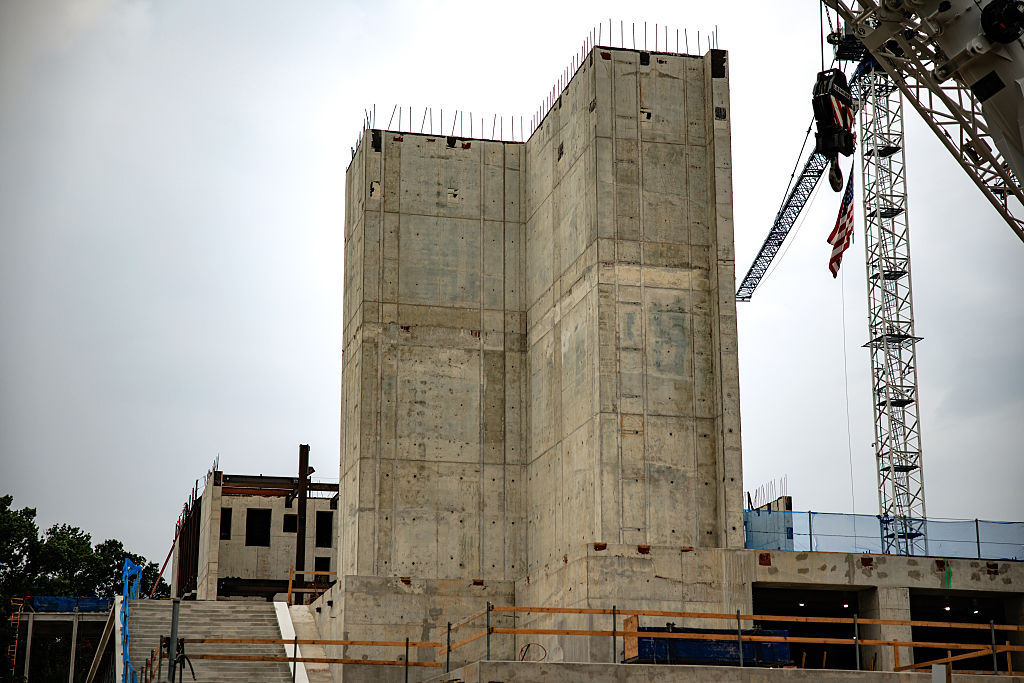
President Donald Trump announced Sunday that his proposed “triumphal arch”—which is planned for Memorial Circle near the Virginia end of Arlington Memorial Bridge in Washington, D.C.—will serve as a military complex with drones, ammunition storage, and sniper facilities.
“There will be no facility like this anywhere in the World,” he wrote on Truth Social, adding that the arch would “house, store, and have the rapid ability to use large numbers of drones” and that there would be snipers “on both the roof and plaza areas.”
The announcement comes almost a year after he debuted a model of the 250-foot arch in the Oval Office on Oct. 15, 2025. In his initial proposal, Trump said that the arch was meant to commemorate America’s 250th anniversary.
Read More: How Trump’s Proposed Triumphal Arch Stacks Up Against Others Around the World
Trump has also argued the arch is significant because it brings the United States on par with other world capitals featuring similar monuments. He emphasized that point again on Sunday, writing: “Out of the 59 top cities and Capitals, Washington, D.C., IS THE ONLY ONE IN THE WORLD THAT DOES NOT HAVE A TRIUMPHAL ARCH, but it will now and, by far, the greatest of them all.”
Trump did not identify the 59 cities he was referring to or explain the basis for the comparison. He appeared to mean that Washington was the only one among a group of leading world cities and capitals that lacked a triumphal arch.
His post said that the changes to the plan for the arch came “at the strong request of the United States Military” and had been made “for National Security purposes.”
The President’s post did not elaborate on the security role that a militarized arch would play in Washington, and Trump has not made public any revised proposal, model, or mockup of what changes that might entail.
TIME has reached out to the White House and the Pentagon for comment.
Trump’s new description of the arch echoes the Administration’s defense of another signature construction project: the White House ballroom.
The White House ballroom was initially presented as a privately funded venue for state dinners and other large events. In subsequent litigation, however, the Administration argued that the ballroom and the underground military facility beneath it constituted a single, integrated project.
That argument emerged amid legal challenges to construction already underway at the site of the former East Wing. On March 31, a judge ordered the ballroom project halted unless authorized by Congress, while leaving open an exception for work necessary to ensure the safety and security of the White House. The Administration subsequently argued that the security exception allowed the entire project to continue—claiming that it is one “massive” military complex that is “vital” to national security.
Prior to litigation, Trump had called the $400 million ballroom a social and diplomatic space to “host major functions honoring world leaders.” But in court documents filed last month, Solicitor General John Sauer raised the stakes, writing: “Every day the President does not have access to the vital security features of the military complex presents unacceptable risk.”
On Aug. 31, the Supreme Court stayed the injunction, allowing construction to continue while the government seeks further review. The Court did not rule on the project’s legality.
Much like the ballroom project, the triumphal arch has been the subject of legal and political scrutiny since it was announced in 2025.
The U.S. Commission of Fine Arts—whose members were all appointed by Trump—approved the project’s design in May. House Democrats called it a “vanity” project and introduced a bill to Congress to block its construction, along with the construction of any triumphal arch exceeding 50 feet on any National Park Service (NPS) lands in Washington “except by express authorization of Congress.” Democrats also argued that the arch was an unnecessary expenditure amid the affordability crisis affecting Americans.
“As President Trump strips away the necessary safety nets from Americans who are struggling to afford their basic needs like groceries and healthcare, he builds his unauthorized, grandiose Triumphal Arch,” Rep. Dina Titus of Nevada, one of the representatives who introduced the bill, said in a statement in May.
A group of Vietnam War veterans and a historian have jointly sued to block construction, arguing in Lemmon v. Trump that the monument would disrupt historic sightlines between the Lincoln Memorial and Arlington National Cemetery. The group has also argued that the plan requires congressional authorization.
“The President’s new justification for this wildly unpopular construction does nothing to cure its fundamental illegality,” Nicolas Sansone, the plaintiffs’ lead attorney, said in a statement Sunday. “Congress has not authorized the arch, and unless and until Congress does so, building the arch on Memorial Circle is unlawful.”
How national security matters can expand presidential power
The difference between a construction project that is a matter of national security and one that is not can inform the role of Congress, according to Kimberly Wehle, a professor at the University of Baltimore School of Law.
Wehle tells TIME that Administrations have, for decades, used this understanding to expand presidential powers. There has been a “lot of deference” given to Presidents in the past when they invoke such reasoning, she says, pointing to the example of the Bush Administration’s warrantless wiretapping and torture efforts after 9/11. At the time, the Justice Department argued that Congress cannot limit a President’s core military and national security decisions during a time of war.
Although the Supreme Court ruled in 2006 that President George W. Bush’s military commissions had to comply with restrictions imposed by Congress, the decision did not foreclose broader claims of presidential power over national security. Successive administrations continued to invoke those claims—or expansive congressional authorizations—to defend actions including surveillance, targeted killings, and military operations undertaken without a formal declaration of war.
Wehle says that decades-long accumulation of authority has brought the Executive Branch close to treating the President as “above the law.”
“Trump’s authority is at its apex when it can be tied to the Commander-in-Chief power,” Wehle says.
Republicans control both the House and Senate, she says, and Trump could have attempted to get Congressional approval for both the ballroom and arch projects by rallying his own party’s support—but he didn’t.
Instead, the Administration has opted to add military justification to its efforts, she says, which “makes it more convenient for the court to reinterpret the Constitution around unaccountable, unlimited, concentrated power in one person.”
Can Trump’s triumphal arch also function as a military site?
Trump has not given much information regarding what military use the arch would have, but George Washington University law professor Sara Bronin, who is also an architect, tells TIME that she is not aware of any other structures that double as commemorative monuments and military infrastructure.
“It seems crazy to include national security infrastructure in a site that is intended to be used by the general public and is intended to be a tourist attraction,” Bronin says, calling the two intentions “fundamentally incompatible.”
“Take the Pentagon, for example. Obviously, that is a site of national security importance, but that is not a site where members of the public are generally welcome,” she adds.
Bronin also points out that the National Park Service prepared a 22-page memorandum of agreement last week, acknowledging that the arch will unavoidably harm historic sites in the capital. The document sets out measures intended to mitigate those effects.
“NPS recognizes that Memorial Circle is located within a highly sensitive historic and commemorative landscape and that the undertaking’s location contributes to adverse effects to historic properties whose significance is associated with setting, design, feeling, association, spatial organization, circulation, and contributing views and vistas,” the agreement said.
It concluded, however, that the project cannot be located anywhere else since erecting it at Memorial Circle is “central to the undertaking.” To mitigate any adverse impacts, NPS said officials would create interpretive signs, webpages, and other materials documenting the site, its history, and the views affected by the project.
That document did not take into account any proposed military infrastructure.
“If this type of use and these physical improvements will be incorporated into the memorial arch, the memorandum of agreement will have to be completely redrafted,” Bronin says.
Judge Tanya Chutkan, who is presiding over Lemmon v. Trump, has not ruled on the central question of whether the arch can be built without Congressional authorization. On Sept. 4, she ordered the Trump Administration to provide 48 hours’ notice before undertaking arch-related activity other than specified archaeological work. She also reminded the government of an earlier consent order requiring final NPS authorization and 14 days’ notice before construction or demolition. Last week, she denied the Justice Department’s request to dissolve the 48-hour requirement.
The Administration has not yet presented the arch’s new military rationale to the court or released plans showing how the proposed military infrastructure would be incorporated into the monument. That leaves the legal significance of Trump’s remarks unresolved.
But the claim places the arch on a path already taken by the ballroom. Both were introduced to the public principally as civic or ceremonial projects; both are now being described in military terms amid disputes over whether Trump can build them without Congress. Together, the projects may test how much additional authority a President gains by recasting a building project as military infrastructure.
Hence then, the article about why trump keeps framing his building projects as matters of national security was published today ( ) and is available on Time ( Middle East ) The editorial team at PressBee has edited and verified it, and it may have been modified, fully republished, or quoted. You can read and follow the updates of this news or article from its original source.
Read More Details
Finally We wish PressBee provided you with enough information of ( Why Trump Keeps Framing His Building Projects as Matters of National Security )


Also on site :
- Greg Evigan Shares Sweet ‘My Two Dads’ Throwback With Paul Reiser and Staci Keanan: ‘I Adore These 2 People!’
- Carole King Wrote ‘Will You Love Me Tomorrow’ at 18 and It Became the First No. 1 Song by Any Girl Group; She Sang It 11 Years Later on Tapestry
- Aaron Sorkin Says Jeremy Strong Treated His Co-Stars ‘The Way He Imagines’ Mark Zuckerberg Treats People While Shooting ‘The Social Reckoning’