
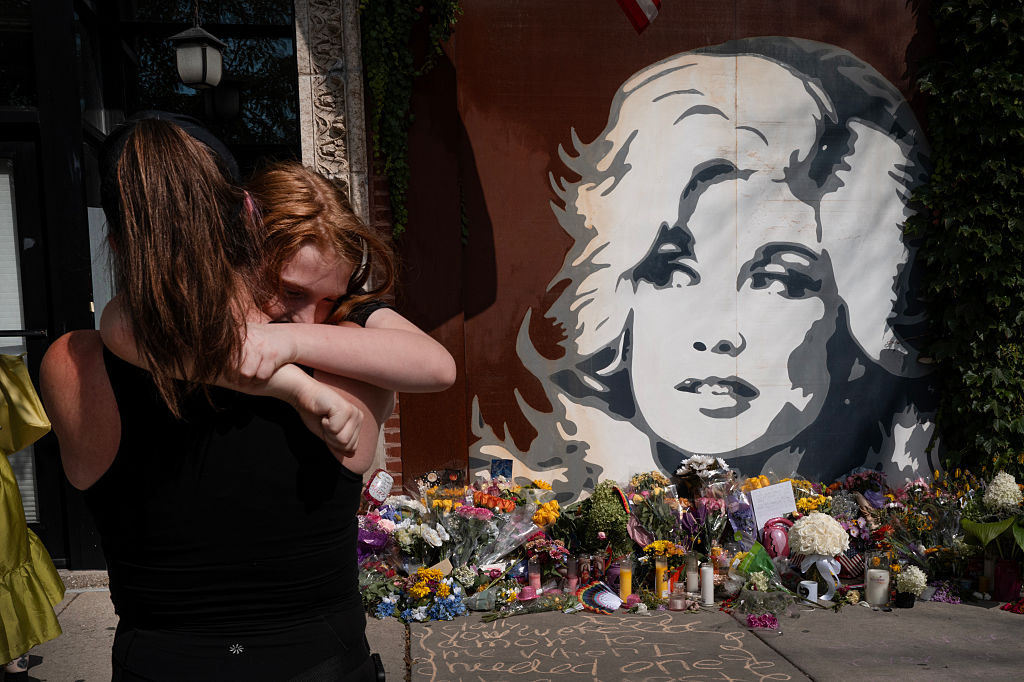
Recently, the world has collectively mourned the unexpected losses of several well-known public figures, from Dolly Parton and Gloria Steinem to Bob Mackie and Tim Curry. Their deaths have hit fans, followers, and industry colleagues hard, and their tributes are going viral online.
Although these celebrities primarily appear to us on screen or on stage, many people feel as though they know them personally because of the meaningful impact they’ve had on their lives. These are known as parasocial relationships or “nonreciprocal social-emotional connections” with public figures and celebrities, per the journal of Current Opinion in Psychology.
When a public figure or celebrity dies, we grieve collectively. According to Gina Moffa, grief therapist and author of the book, Moving on Doesn’t Mean Letting Go, this happens when a large group of people mourns at the same time. “This can be felt even if they never knew the person or community, or weren’t directly affected by the event,” says Moffa. And it isn’t limited to the passing of public figures and celebrities. Many people also experienced shared loss after 9/11, Sandy Hook, COVID-19, and the Nepal floods.
In this current cultural moment, we’re seeing collective grief intersect with a psychological phenomenon called parasocial grief. According to psychotherapist and NYU adjunct professor Olivia Verhulst, this can occur when there’s a one-sided sense of familiarity with a public figure after they die. “Relationships don’t need to be reciprocal for feelings to be real,” Verhulst says. “Loss brings up a lot for all of us no matter what form it takes, whether it’s shock, disbelief, or confrontation with our own mortality.”
A small study in 2025 from the journal Acta Psychologica found that parasocial grief can negatively impact mental health and can lead to unhealthy coping mechanisms like substance use.
In comparison with individual grief, shared bereavement is more diffuse. “It doesn’t have the built-in rituals we rely on, like experiences of a funeral and traditional closure,” Moffa explains. Therefore, when celebrities or public figures die, it’s now common practice to post online and engage in comments sections with other grievers. In this way, the comment sections become public memorials.
After Steinem’s passing, people expressed their gratitude and heartbreak by leaving flowers and cards outside her home. When Parton died, fans held up their iPhones with the flashlight on during Harry Styles concert at Madison Square Garden while her song, “I Will Always Love You,” played. Both of these in-person tributes circulated on social media and were widely shared.
Verhulst argues that the most significant difference in mutual sorrow is its “being witnessed” and it can offer more validation than individualized grief. “Given that human beings are fundamentally wired for connection, this broader sense of communal loss can feel comforting in many ways,” she says.
Shared bereavement isn’t a new idea; it dates back for centuries. Some of the most visible representations in recent decades have been the outpouring of support after the deaths of President John F. Kennedy, the Rev. Dr. Martin Luther King Jr., and Princess Diana. At her funeral, there were an estimated one million people in-person and roughly 2.5 billion viewers who watched it on television.
Society often pushes individual grievers to move on from their losses, rushing them to heal before they’re ready, which can lead to more people struggling alone. But in our current culture, shared bereavement has become more widely accepted. “Social media has become a kind of ‘modern funeral,’ a space where people can come together online, without the barriers of physical geography getting in the way,” Moffa says. “For a lot of people, it’s become the primary place mourning happens now.”
Research has found grieving together is more beneficial than doing it without help. A meta-review from 2022 in the journal Frontiers in Psychology discusses the theory of collective effervescence, a phrase coined by sociologist Émilie Durkheim, as it relates to mourning practices, public memorials, and communal storytelling after the loss of a public figure. This “intense state of shared emotional activation and sense of unity” can help people feel connected in the long term to others who understand their pain.
“When Steinem and Parton passed within days of each other, comment sections turned into genuine gathering places, telling each other how these women shaped their lives. It made the feeling less isolating and more like something they were carrying alongside a whole community instead of alone,” Moffa says.
Working with a therapist, especially for cognitive behavioral therapy, can also be effective. Treatment can give people a safe space to talk about discomfort and divulge feelings of loss over someone they didn’t know personally, with validation and without shame. It can provide more insight into a person’s emotional state, to see if there’s any unresolved or prolonged grief.
Integration is another useful method. Moffa suggests creating a small ritual in honor of that person, like playing their music, reading their books, or rewatching a favorite video clip. Then, write down what that person meant to you, rather than what they meant to the world, and talk about it with someone. “This can provide validation and connection, instead of having to carry it alone,” she adds. In fact, a recent study from the Death Studies journal in 2026 found sharing emotions, ceremonies, and rituals offer “sense making, solidarity and healing” in shared mourning.
While these are effective ways to navigate the pain, they aren’t the only ones. It’s key to adapt them to meet your needs and determine what works for you.
Verhulst noted there’s an outdated idea that grief occurs in fixed stages which is somehow linear. But, she says, there are truly no universal stages to heal from loss and no right way to grieve.
Sometimes, the best way to mourn is together.
Hence then, the article about dolly parton gloria steinem and why grieving a celebrity feels so personal was published today ( ) and is available on Time ( Middle East ) The editorial team at PressBee has edited and verified it, and it may have been modified, fully republished, or quoted. You can read and follow the updates of this news or article from its original source.
Read More Details
Finally We wish PressBee provided you with enough information of ( Dolly Parton, Gloria Steinem, and Why Grieving a Celebrity Feels So Personal )


Also on site :
- Paranormal Comedy ‘Don’t F — k With Ghosts’ Premieres On Demand, Launches Original YouTube Channel (EXCLUSIVE)
- ‘Charlie’s Angel’ Star Gets Brutally Honest About Why the Show Never Won Any Major Awards: ‘They Put Us Down… We Were Barbie Dolls’
- Fan-Favorite ‘Scream’ Star Says He Regrets and ‘Feels Ashamed’ About Taking Part in New Sequel: ‘I Blew That, I’m on the Wrong Side of History’