
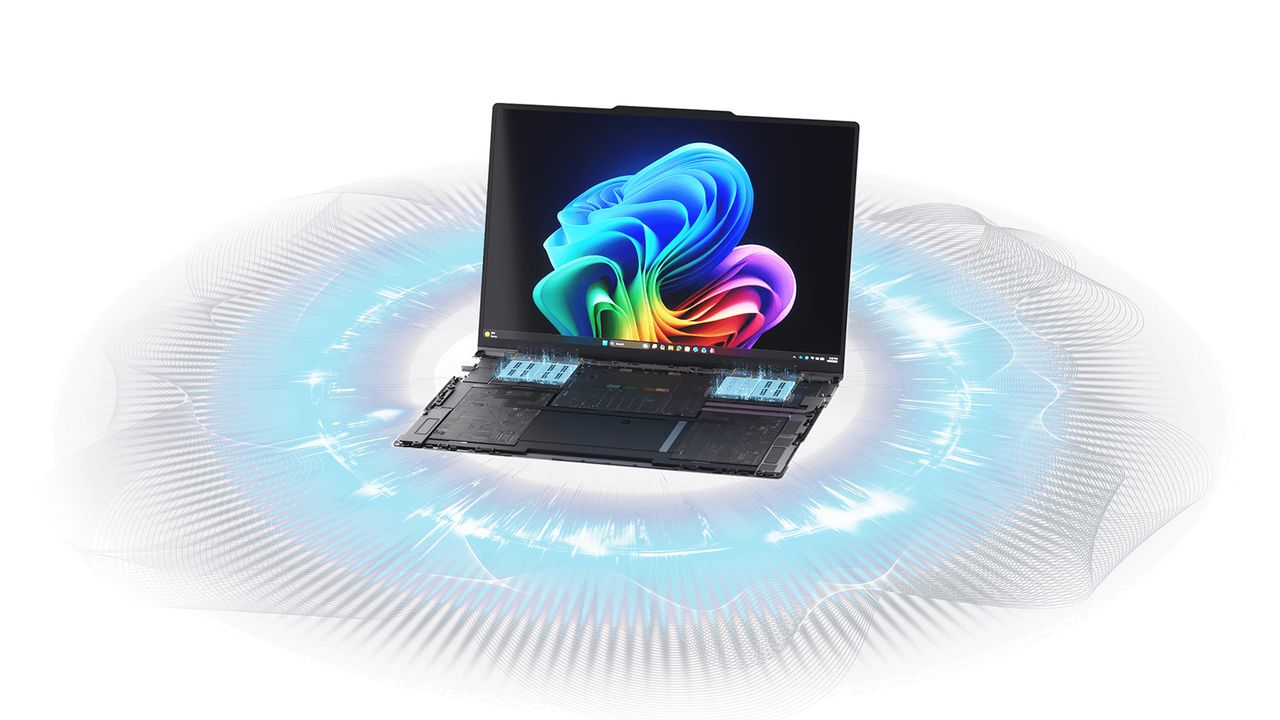
BERLIN — Lenovo has unveiled a concept laptop that uses high-speed air to silently cool its processor, instead of conventional fans or heat sinks. The new system is powered by a tiny computer chip that can fit between your fingers.
The new laptop, called AeroBlade, is fitted with four low-power cooling chips that are both "solid-state," meaning there are no moving parts, and "active" — they use a deliberate cooling mechanism — as opposed to relying on passive thermal energy transfer.
The cooling chips contain tiny membranes that vibrate at ultrasonic frequencies to create 2,000 pascals of back pressure, forcing ambient air through tiny internal jets onto a copper base layer at speeds of around 124 miles per hour (200 kilometers per hour). This air carries heat away from the laptop's central processing unit (CPU) and graphics processing units (GPU), before being violently expelled from tiny vents at its rear hinge.
Lenovo representatives unveiled their new AeroBlade machine at Lenovo Innovation World '26, which took place Sept. 3 at IFA 2026 in Berlin, which itself ran between Sept. 4 and 8.
Made by engineers at Frore Systems, the low-power AirJet Mini chip measures 1.63 x 1.06 x 0.1 inches (41.5 x 27 x 2.65 mm) and weighs just 0.02 pounds (9 grams). Because it contains tech designed to replace conventional cooling technologies, the AeroBlade, which is fitted with a 14-inch (355.6 mm) OLED display, is much thinner and lighter than comparable laptops
The AeroBlade measures less than 0.39 inches (10 mm) thick — where comparably sized machines measure 0.51 inches (12 mm) at their thinnest — and weighs just 1.8 pounds (830 g). Laptops as light as this exist, like the 1.76-pound (799 g) Acer Swift Blade 14, but they're rare. Counterparts with 14-inch screens are normally considered light if they fall between 2.2 to 2.86 pounds (1 to 1.3 kilograms).
A new approach to keeping cool
Four AirJet Mini chips are fitted inside the new Lenovo concept laptop. (Image credit: Lenovo and Frore Systems)Both companies are framing the introduction of this technology as a way to cool down the next generation of high-end laptops that will wield on-device artificial intelligence (AI).
Most laptops marketed as "AI PCs" just feature a neural processing unit (NPU) that can run simple AI workloads, such as manipulating or enhancing a webcam's video feed in real time.
But some future laptops will aim to let users run powerful large language models or AI agents without needing to connect to the internet. An example is the forthcoming series of Nvidia RTX Spark laptops, which will feature a new chip designed specifically to orchestrate AI agents locally.
Running on-device AI models usually demands significant power funneled into professional-grade graphics processing units (GPUs). Fans are deployed in all kinds of laptops to keep their chips cool, but they can be noisy. Instead of or in addition to fans, passive heat sinks, found in machines like the MacBook Air or the Microsoft Surface Pro, use metal plates positioned close to heat sources to absorb thermal energy. But these laptops are more prone to throttling — when their software pulls back performance to reduce temperature.
Related storiesNew 'physics shortcut' lets laptops tackle quantum problems once reserved for supercomputers and AI'Next generation of laptops': Intel unveils blueprints for a fully repairable and modular computerComputing 'paradigm shift' could see phones and laptops run twice as fast — without replacing a single component
The AirJet Mini is a different way of cooling, relying on its own high-velocity jet mechanism to flush hot air away. Frore representatives said in a statement that the device operates at just 21 decibels at peak power — equivalent to the sound of leaves rustling or a whisper — and is capable of removing 7.5 watts of heat. Four of these chips would remove 30W of heat — which is in line with the heat expulsion of conventional laptop fans, although there is variation between models.
The AeroBlade's 2,000 pascals of back pressure a measure of opposing force pushing against the direction of airflow) is roughly 10 times that found in regular laptop fans, which typically falls between 100 and 200 pascals.
Although the underlying cooling technology is a few years old, having first been announced in December 2022, AeroBlade represents the first time it's been used in a fully operational laptop. The chip was previously integrated into the ZOTAC ZBOX PI430AJ Pico mini PC in 2023, while there are no commercially available tablets or laptops available with this chip. The AeroBlade laptop remains a concept model, with no information yet as to when production-ready machines fitted with this new cooling technology will emerge.
Can you match these ancient devices to their pictures? Find out with our computing quiz!
Hence then, the article about new laptop ditches noisy fans and heat sinks for tiny cooling chips it s much thinner and lighter than you d expect was published today ( ) and is available on Live Science ( Middle East ) The editorial team at PressBee has edited and verified it, and it may have been modified, fully republished, or quoted. You can read and follow the updates of this news or article from its original source.
Read More Details
Finally We wish PressBee provided you with enough information of ( New laptop ditches noisy fans and heat sinks for tiny 'cooling chips' — it's much thinner and lighter than you'd expect )


Also on site :
- Fired ‘Shrinking’ Crew Member Accuses Warner Bros TV Of Doing Nothing Over Sexual Harassment By EP; Being Scapegoated After Complaining
- Dancing With The Stars Premiere: Who Was Booted From Season 35 First? And Who Made The Best Impression On Night 1?
- Mary Janes Are a Fall Staple, and These Flats Are ‘Super Comfortable’ With ‘Absolutely Zero Break-in’ Required