
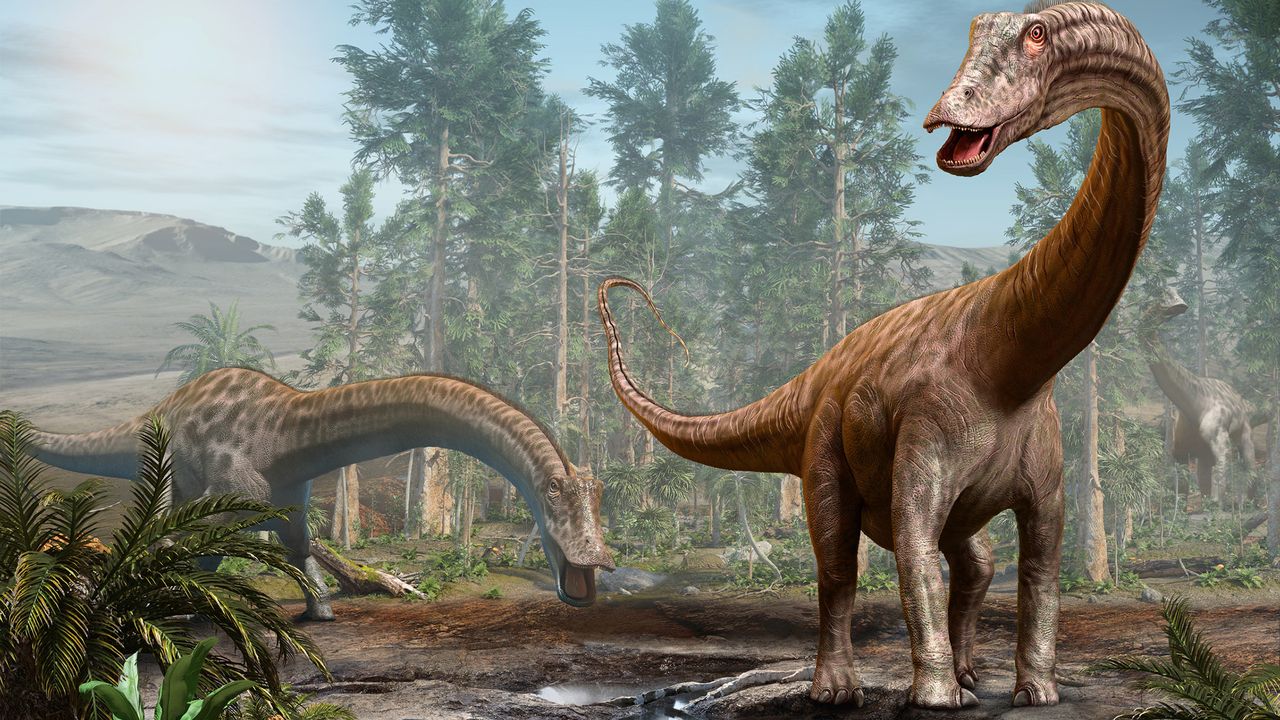
Paleontologists have identified the first confirmed remains of Diplodocus — "Dippy," for short — outside the western U.S., revealing that the iconic long-necked dinosaur reached what is now Spain roughly 150 million years ago.
The findings show that the enormous sauropod didn't live only in North America, as was long thought. Instead, it may have rambled across a land bridge all the way to Europe, the new study suggests.
The discovery, made at the La Tejería site near the small village of El Castellar in eastern Spain, provides some of the strongest fossil evidence yet that dinosaurs could move between North America and Europe during the Late Jurassic, when the Atlantic Ocean was still in its early stages of opening after the breakup of the supercontinent Pangaea. The researchers published their findings Tuesday (Sept. 15) in the Journal of Vertebrate Paleontology.
"Paleontological studies like this one help us better understand the history of life on Earth, reconstruct ancient ecosystems, and understand how they changed through time," study first author Sergio Sánchez Fenollosa, a doctoral student who studies biodiversity and evolutionary biology at the Joint Paleontology Foundation Teruel-Dinópolis (Dinópolis Foundation), a paleontological research institution, told Live Science via email.
Dippy is one of the best-known dinosaurs. After its fossils made their grand debut at the Carnegie Museum of Natural History in Pittsburgh in the early 1900s, life-size fossil replicas of the towering herbivore were sent around the world, including to England, France, Spain, Argentina and Russia.
But until now, Diplodocus' Late Jurassic fossils were known only from the Morrison Formation in the western United States — and the latest discovery shows that Dippy wasn't a homebody.
The newly unearthed Diplodocus specimen consists of 14 well-preserved tail vertebrae and several chevrons — bones that helped support blood vessels and muscles within the dinosaur's tail.
Study co-author and managing director of the Dinópolis Foundation, Alberto Cobos, said it was a friend who "thought he had spotted some bones on a mountainside," Cobos told Live Science via email. "That very day, I went to the site near El Castellar (a village in the province of Teruel). Sure enough, we saw a couple of sauropod vertebral centers."
Although only part of the skeleton has been recovered, the bones show a series of characteristics associated with Diplodocus, including large cavities corresponding to where air sacs would have been, along with deep grooves running alongside the underside of the tailbones.
The 14 vertebrate and several chevrons found in Spain correspond to the Dipolodocus' anatomy. (Image credit: Carmelo López)"It was an exciting and continuous process of seeing the pieces of the puzzle gradually fall into place," Sánchez Fenollosa said in a statement. "From the early stages of the osteological study, we noticed strong similarities with several diplodocine sauropods … With each new result, the picture became clearer: we were looking at a Diplodocus."
It's unclear which species of Diplodocus the new specimen is, but like others of its genus, it was a huge dinosaur with an extremely long neck and whip-like tail.
"The Diplodocus from El Castellar was approximately 25 meters [82 feet] long (comparable in size to its North American relatives), making it another of the giant sauropods of the Spanish Jurassic," Cobos said in the statement.
An ancient bridge
Between 195 million and 170 million years ago, the supercontinent Pangaea broke apart as the Atlantic Ocean opened. But the ocean was much narrower than it is today, and the continents were not necessarily as isolated as their modern geography is now.
Evidence indicates that temporary land bridges may have allowed some animals to move between the two regions. The most famous prehistoric land bridge is the Bering Land Bridge that humans used to move between Asia and what is now Alaska. Previous research showed the Bering Land Bridge also existed around 68 million years ago, and it may have allowed an Asian ancestor of Tyrannosaurus rex to trek into North America.
One possible route for Diplodocus into Spain may have been a land bridge that connected what is now Newfoundland with the Iberian Peninsula.
Related storiesT. rex may have evolved in North America after all, scientists sayAdorable newborn sea monster from the dinosaur age discovered in Kansas'Last titan' of Thailand discovered, and it's the longest-necked dinosaur on record from Southeast Asia
Geological conditions may have allowed dinosaurs like Diplodocus to move between continents, Sánchez Fenollosa told Live Science in an email. "This interpretation is supported not only by the fossil record but also by geological evidence," he said.
The newfound Diplodocus fossils also suggest that the distribution of giant sauropods was more complicated than the fossil record previously indicated.
"More complete specimens will be essential to understand this story in greater detail, particularly to determine which Diplodocus species inhabited Europe: whether it was one already known from North America or a previously unknown species," Sánchez Fenollosa said. "This discovery reminds us that even for such iconic dinosaurs, there are still many unanswered questions about their evolutionary history and biogeography."
Hence then, the article about fossils of iconic long necked dinosaur diplodocus found in europe for first time and it may have traveled there via land bridge was published today ( ) and is available on Live Science ( Middle East ) The editorial team at PressBee has edited and verified it, and it may have been modified, fully republished, or quoted. You can read and follow the updates of this news or article from its original source.
Read More Details
Finally We wish PressBee provided you with enough information of ( Fossils of iconic long-necked dinosaur Diplodocus found in Europe for first time — and it may have traveled there via land bridge )


Also on site :
- ‘The Late Show With Stephen Colbert’ Wins at 2026 Primetime Emmys: ‘Widow’s Bay,’ Bad Bunny’s Super Bowl Halftime & More Big Winners
- 1966 Bob Dylan Hit, Ranked Among ‘Greatest Songs of All Time,’ Was Recorded in One Take on Valentine’s Day
- New solutions and innovations from VTT and Finnish food companies pave the way for profitable plant-based ingredient business