
By Terin Frodyma on SwimSwam
It’s that time of the year again. SwimSwam will be previewing the top 12 men’s and women’s teams (and then some) from the 2026 NCAA Championships. Follow along with the College Swimming Preview Channel. Want to read even more? Check out the latest edition of the SwimSwam magazine.
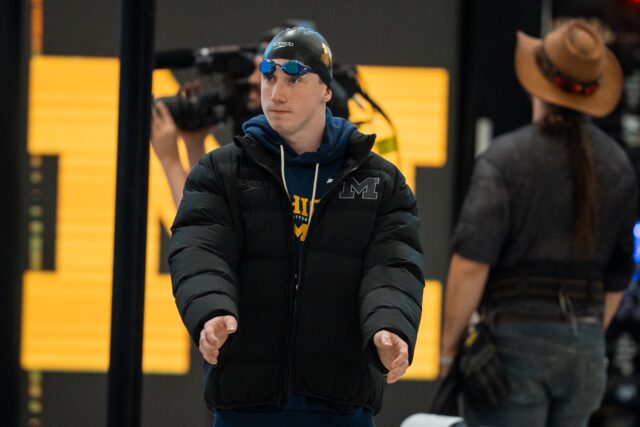
Men’s #8: Michigan Wolverines
Key Losses: Luka Mladenovic (Transfer to Texas – 32 NCAA Points), Tyler Ray (30 NCAA Points), Jack Wilkening (2 NCAA Points), Eitan Ben-Shitrit (2 NCAA Events)
Key Additions: Aiden Moy (NY – IM/fly), Oliver Shao (NY – distance free), Lucas Young (FL – breast), Jaxson Bowshire (Texas A&M Transfer – diving)
GRADING CRITERIA
Over the years, we’ve gone back and forth on how to project points, ranging from largely subjective rankings to more data-based grading criteria based on ‘projected returning points.’ We like being as objective as possible, but we’re going to stick with the approach we’ve adopted post-COVID. The “stars” will rely heavily on what swimmers actually did last year, but we’ll also give credit to returning swimmers or freshmen who have posted times that would have scored last year.
Since we only profile the top 12 teams in this format, our grades are designed with that range in mind. In the grand scheme of college swimming and compared to all other college programs, top 12 NCAA programs would pretty much all grade well across the board. But in the interest of making these previews informative, our grading scale is tough – designed to show the tiers between the good stroke groups, the great ones, and the 2015 Texas fly group types.
5 star (★★★★★) – a rare, elite NCAA group projected to score 25+ points per event 4 star (★★★★) – a very, very good NCAA group projected to score 15-24 points per event 3 star (★★★) – a good NCAA group projected to score 5-14 points per event 2 star (★★) – a solid NCAA group projected to score 1-4 points per event 1 star (★) – an NCAA group that is projected to score no points per event, though that doesn’t mean it’s without potential scorers – they’ll just need to leapfrog some swimmers ahead of them to do itWe’ll grade each event discipline: sprint free (which we define to include all the relay-distance freestyle events, so 50, 100 and 200), distance free, IM, breaststroke, backstroke, butterfly and diving. Use these grades as a jumping-off point for discussion, rather than a reason to be angry.
Also, keep in mind that we are publishing many of these previews before teams have posted finalized rosters. We’re making our assessments based on the best information we have available at the time of publication. Still, we reserve the right to make changes after publication based on any new information that may emerge regarding rosters. If that does happen, we’ll make certain to note the change.
The final note is that we are not including athletes who graduated last spring after exhausting their college eligibility despite ongoing lawsuits against the NCAA regarding the new “Five-for-Five” rule.
2025-26 Lookback
The 2025-26 season concluded with the Wolverine men finishing 8th at the NCAA Swimming and Diving Championships, with plenty of relay success and strong individual swims to help with that point total.
Of Michigan’s 220 total points as a team, 130 came in the relays, with the other 90 coming from individual event scoring; leading that charge was Luka Mladenovic, who brought in 32 points after finishing 3rd in the 200 breast and 5th in the 100 breast as a freshman.
Another big bright spot for Michigan last season was Senior Tyler Ray, who, after a tremendous outing at Big 10s, managed to finish 3rd and 5th in the 200 fly and 100 fly, respectively, earning an additional 30 points individually.
Lorne Wigginton and Colin Geer each added to the Wolverines’ point total, with a combined 26 points between them; Wigginton, who was only a sophomore last season, established himself as one of the nation’s premier 400 IMs, finishing 4th overall for his highest individual finish of the championships. Geer also finished 10th overall in the 200 IM, which marked his best placing of the meet.
One area where the Wolverines were not as successful was on the boards, failing to bring in a single point in the diving events.
Three of the five individual point scorers from last season’s championships are now gone from the roster, so the Wolverines will be looking for several returners and some fresh faces to up their game and bring home points in hopes of getting back inside the top 10 at NCAAs.
Sprint Free: ★
Sprint free gets hit hard by the departures of both Tyler Ray and Jack Wilkening, who ranked 1st and 3rd on the roster last season in 18.66 and 19.34, respectively.
Leading the core of the sprint free this season will be junior Ole Eidam, who ranked 2nd on the team last season in the 50 free (19.16), and led the team in the 100 free in 42.07.
This season’s roster will also be the 2nd season with both Antoine Sauve (19.77, 42.16, 1:32.03) and Alex Thiesing (20.46, 43.16, 1:33.30), both key pieces for a Michigan team that lost several relay legs to graduation and the transfer portal this offseason.
It is tough to imagine the Wolverines picking up too many points in the 50 or 100 free this upcoming season, largely considering the scoring cutoff set at 18.88 and 41.56. However, the 200 free could see some scoring, especially if Sauve, who is only a sophomore, can get himself closer to that 1:31-low mark. It took 1:31.62 to score at NCAAs, and that seems to be a feasible mark to reach in a way to bring home some sort of scoring in the sprint free events.
Eidam is the likely hammer and nail guy for the Wolverines this season. He was just on the brink of that sub-19 50 free last season, and given the right situation, he could get himself under that barrier this season as a junior; his best shot will probably be in the 100 free, given that he is already just a fingernail away from firing off a sub-42 time.
Distance Free: ★★
Lorne Wigginton is going to be the backbone of the distance group for Michigan this season, having finished 5th at Big 10s in a lifetime best of 4:12.54, a time that would have secured one point at NCAAs. He did race this event at the national championships, finishing 26th in 4:16.06.
Sauve was also a sub-4:15 performer last season, finishing 10th at Big 10s in 4:14.54 as a freshman. Only one other Wolverine was under 4:20 this season: rising sophomore Will Siegel‘s 4:19.20 at Big 10s, with all three of last season’s top performers returning; the Wolverines have real potential to make a move on a national scale.
Wigginton was also the team’s top 1650 swimmer a season ago, posting 14:46.09 at Big 10s, which was good enough for a 4th-place finish at those championships. Siegel is the only other sub-15-minute performer making a return this season, having been 14:56.99 at Big 10s as well.
Had Wigginton swum the 1650 last season at NCAAs, he would have finished 13th with that Big 10s time. Because five of the top 13 finishers from last season’s NCAAs were either seniors or 5th-year swimmers, it may be an option that Wigginton explores this season as another scoring opportunity.
One of the newest Wolverines, freshman Oliver Shao, will also have a strong role in the distance group for Michigan, coming in with lifetime bests of 4:22.97 and 15:05.10, both of which were done this calendar year, and are more than serviceable starting points for his collegiate career.
Backstroke: ★
Wilkening was the heart and soul of this backstroke group a season ago, leading the team in the 100 and 200 back in 43.98 and 1:40.50.
The 100 back saw a sizeable drop-off from last season, after Wilkening, the next fastest was Inbar Danzinger in 46.34, who, now as a junior, will likely need to take over the sprint backstroke duties, though more than two seconds slower than Wilkening was last season. As for other returning 100 backstrokers, none were faster than 48 seconds last season.
The 200 back has a bit more positive outlook, as Danzinger was not too far off of Wilkening with his 1:41.25 at Big 10s last season.
It still took a blistering 1:39.29 to finish 16th at NCAAs last season, which is about two seconds off of Danzinger’s lifetime best.
Nobody else on the roster was under 1:45.7 last season, which makes for a not-so-deep backstroke room for the 2026-27 season.
Breaststroke: ★
It’s another area where a departure leaves Michigan struggling. Luka Mladenovic established himself as a serious threat in both breaststroke distances as a freshman, but announced that he would be taking his talents to Austin to join the reigning national champion Longhorns.
For Michigan, that departure also takes a huge hit to their NCAA scoring potential.
They do return Jaedden Gamillia, who was 52.11 at the Michigan Last Chance meet last season, which would have been 19th at the national championships, though well outside the 51.53 it took to score a single point. No other returning 100 breaststroker was under 53.90 last season.
The 200 breaststroke loses out on both of its top performers in Mladenovic (1:49.34) and Ozan Kalafat (1:53.70). Gamilla is the top returner in 1:53.78 from Big 10s. Still, after that, the difference in the rest of the roster is noticeable, with the next fastest returning Wolverine being Colin Geer in 1:55.60.
This is a big area where a hopeful freshman could be a big addition; Lucas Young of the Bolles School comes in with best times of 53.52 and 1:56.37. While neither will likely be impactful on the national scoring picture, they may be enough to help kickstart the breaststroke group, which will be in major need of a spark.
Butterfly: ★★★
The departures continue to build here, as Tyler Ray is now gone from the program, and so are his nationally contending times.
Ray was a legitimate contender for Michigan in both the 100 and 200 fly, but now that responsibility will be left on Ole Eidam in the 100 fly, and Colin Geer and Wigginton in the 200 fly.
Eidam is a serviceable replacement in the 100 fly, having finished 22nd last season in 45.21 at NCAAs; he brings the national championship racing experience into a new lead role as the fly ace. He was even faster at Big 10s, finishing 6th overall in 44.71. That time would have finished 14th at NCAAs, and with several seniors/5th years ahead of that time last season, it may be a race that sees Michigan earn a championship finalist and bring back a few big points.
Colin Geer was also a strong 100 fly swimmer last season, posting a 45.04 at Big 10s, which made him the only other sub-46 performer on the roster a season ago. His impact will likely be bigger in the 200 fly this season, as he was the next fastest performer to Ray in 1:40.09, a time that he swam at Big 10s, but would have finished 14th at NCAAs.
Lorne Wigginton was also 1:42.78 last season, though he will likely be a bigger threat in the 200 IM and distance freestyle events.
IM: ★★★★
Colin Geer was a big bright spot last season in the 200 IM for the Wolverines, finishing runner-up at Big 10s in 1:40.15, just missing out on the Big 10 title by four hundredths.
That time made him the Wolverines’ fastest performer last season, even though he finished 10th at NCAAs in 1:41.35; that Big 10s time would have placed 4th in the national final. It is safe to predict he will be faster this season and could deliver a strong performance at NCAAs, though that will only be decided when the time comes.
We already touched on Wigginton’s IM performances at NCAAs: 4th in the 400 IM (3:35.63) and 13th in the 200 IM (1:42.13). He will likely stick with those events, given his proven success in both at the national level, and he could come away with even better results as a junior.
Wigginton was more than six seconds faster than the rest of the roster in the 400 IM last season, and will be the main guy to deliver some big-time points this upcoming season.
This is unquestionably the top group the Michigan men have in terms of scoring potential, with two men who could contend for high podium finishes in both IMs; this could be where the Wolverines bring home most of their national scoring.
Diving: ★★
The Wolverines scored no points in diving last season, but this season they add someone who has scored well in the past: Jaxson Bowshire.
Bowshire was named the SEC Freshman of the Year at the 2024-25 SEC Championships, where he won gold on the 10-meter platform, and later went on to finish runner-up at the NCAA Championships on platform that season.
After a not as stellar sophomore campaign in College Station, Bowshire is looking for a fresh start this season with the Wolverines and could be the needle-mover that gets some strong points at NCAAs and Big 10s.
Relays: ★★
Note that the grading system doesn’t align perfectly for relays as double points.
Relay grading system:
5 star (★★★★★) – 31+ points per relay event 4 star (★★★★) – 22-30 relay points per event 3 star (★★★) – 12-21 relay points per event 2 star (★★) – 5-11 relay points per event 1 star (★) – 0-4 relay points per eventIf we relay by relay from NCAAs, you will see several holes that need to be filled; in each medley relay, Michigan will need to replace the first three legs: Wilkening (back), Mladenovic (breast), and Ray (fly). As we have seen, those are the legs that really see some big drop-offs from those top performers.
The 200 free relay will only need to replace Ray and Wilkening, though there were not very many sub-20-second performers on the roster last season.
In the 400 free relay, it’s the same two performers needing replacing. But the 800 free relay is only replacing Eitan Ben-Shitrit, which seems like one of the easier replacements to make.
Michigan was really successful in the relays last season, but this season, it may be too much change to get them over the hump and back into major scoring.
Total Stars: 16/40
2026-27 Outlook
The Michigan men are in a very different position than they were just one season ago, with most of their scoring now gone from the program, but that doesn’t mean there aren’t potential pieces who could step up and keep Michigan competitive on the national scale.
With Lorne Wigginton and Colin Geer, a pair of veterans who know what it takes to score at NCAAs, as well as a few strong freshman pieces to help lock in the future for the program, the Wolverines will look to have someone take over and deliver some big-time performances when the lights are at their brightest.
Other key returners include Ole Eidam, Antoine Sauve, and Inbar Danziger. Bowshire also comes in and immediately gives them a scoring threat in diving, all of which are big plus signs for Michigan.
Overall, it will be a story to see whether the talent lost can be made up for, and whether it will be enough to keep them competitive.
MEN’S 2026-27 COLLEGE PREVIEW INDEX
Rank (2026) Team Sprint Free Distance Free Backstroke Breaststroke Butterfly IM Diving Relays Total Stars 1 Texas Longhorns 2 Florida Gators 3 Indiana Hoosiers 4 Arizona State Sun Devils 5 Tennessee Volunteers 6 NC State Wolfpack 7 California Golden Bears 8 Michigan Wolverines ★ ★★ ★ ★ ★★★ ★★★★ ★★ ★★ 16/40 9 Virginia Cavaliers ★★½ ★ ★★★ ★ ★★★★ ★★★★ ★ ★★★½ 19/40 10 Stanford Cardinal ★★★½ ★★★ ★★ ★★½ ★★ ★ ★★★ ★★½ 19.5/40 11 Virginia Tech Hokies ★★★ ★ ★★ ★★ ★ ★ ★ ★★ 13/40 12 Louisville Cardinals ★★★ ★ ★ ★★ ★★ ★★ ★★ ★★★ 16/40Read the full story on SwimSwam: 2027 College Swimming Previews: #8 Michigan Men Look for Spark Despite Massive Departures from Last Season’s Roster
Hence then, the article about 2027 college swimming previews 8 michigan men look for spark despite massive departures from last season s roster was published today ( ) and is available on swimswam ( Middle East ) The editorial team at PressBee has edited and verified it, and it may have been modified, fully republished, or quoted. You can read and follow the updates of this news or article from its original source.
Read More Details
Finally We wish PressBee provided you with enough information of ( 2027 College Swimming Previews: 8 Michigan Men Look for Spark Despite Massive Departures from Last Season’s Roster )


Also on site :
- ?Dortmund Face Villarreal Today: Kickoff Time and Where to Watch
- Tennis lovers nauseated by smells of sewage and ‘human waste’ at US Open: ‘You’re breathing in s- – t’
- Pope Leo Appoints Coadjutor Bishop for Puerto Rico’s Youngest Diocese