
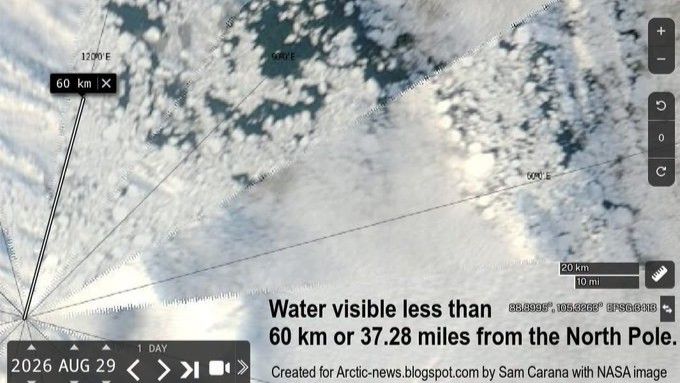
Large patches of open water were visible just 37 miles (60 kilometers) from the North Pole on Aug. 29, a NASA satellite image shows. Although this doesn't necessarily mean that Arctic ice is worse off this year than the past few years, the image reveals how severely climate change is affecting the region, experts say.
The image is from the NASA Worldview satellite photo browsing tool and was shared last week on the blog Arctic News. The patches are "quite striking," but it's not the first time that water has encroached upon Arctic ice in this way, said Julienne Stroeve, a professor of polar observation and modeling at University College London.
"We can see open water at times at the North Pole but I don't think it's ever been this extensive," Stroeve told Live Science in an email. For instance, the central Arctic Ocean and regions north of 80 degrees north latitude, an imaginary line that crosses Canada's Ellesmere Island and Spitsbergen in Norway, were highly fragmented in early September 2016.
The time of year is one reason water is now visible in this region, said Zachary Labe, a climate scientist at Climate Central, a nonprofit news organization that analyzes and reports on the climate. "By the end of summer, the sea ice generally becomes more fragmented, with areas of open water appearing more widespread between pieces of sea ice," Labe told Live Science in an email.
This means that local weather conditions and ocean currents can create large gaps between ice floes, Labe said. For example, strong winds can push ice fragments together or pull them apart, leading areas of water to widen or close within hours or days.
"Individual satellite images from around the North Pole in just the last two weeks show dramatic changes in the amount and location of visible open water," he noted.
The current extent of Arctic sea ice isn't particularly low when compared with record-setting years, but that's now very changeable due to the diffuseness of the ice, Stroeve said. "Winds could change and compress the ice into a more compact ice cover leading to sudden drops in total extent," she said.
There is no specific distance from the North Pole at which open water should normally stop, because Arctic conditions can vary substantially from year to year, Labe said. However, the summer ice has become thinner and more fragile in recent years, so open water is consistently reaching closer to the North Pole than it did before.
"To me, this image doesn't necessarily show that conditions are dramatically worse this year compared to other recent years," Labe said. "Instead, it represents a worrying snapshot of a very different Arctic Ocean than only a few decades ago and one that is quickly changing over time."
RELATED STORIESSea ice loss in the Arctic has triggered a critical tipping point that's destroying the food chainFirst experiment to thicken Arctic ice with seawater shows promise — but there's a big catch'More unzipping of the landscape': Arctic permafrost could crumble into rivers, unleashing devastating feedback loop
The Arctic is warming nearly four times faster than the global average. Some of the northernmost regions that have historically boasted expansive, thick and persistent ice at the end of summer now have young, brittle ice floes instead, Labe said.
"The broader implications of more open water across the Arctic Ocean are wide-ranging, from changes in local weather and ocean conditions to impacts on marine ecosystems and greater coastal risks like erosion and flooding for Arctic communities," he said.
Scientists expect that sea ice will start to refreeze by mid- to late September, closing at least some of the gaps.
Hence then, the article about a worrying snapshot satellite image shows large patches of open water less than 40 miles from the north pole was published today ( ) and is available on Live Science ( Middle East ) The editorial team at PressBee has edited and verified it, and it may have been modified, fully republished, or quoted. You can read and follow the updates of this news or article from its original source.
Read More Details
Finally We wish PressBee provided you with enough information of ( 'A worrying snapshot': Satellite image shows large patches of open water less than 40 miles from the North Pole )


Also on site :
- KATSEYE Fans Are Lighting Up Their Wildworld Tour With Official Lightsticks — Here’s Where to Get Yours
- Feminist Icon Gloria Steinem Remembered by Madonna, Olivia Rodrigo, Jennifer Lopez & More Musicians: ‘The O.G. Baddie’
- ’90s Alternative Metal Legends Achieve Massive Milestone With Signature Grammy-Nominated Song From ‘Toxicity’