
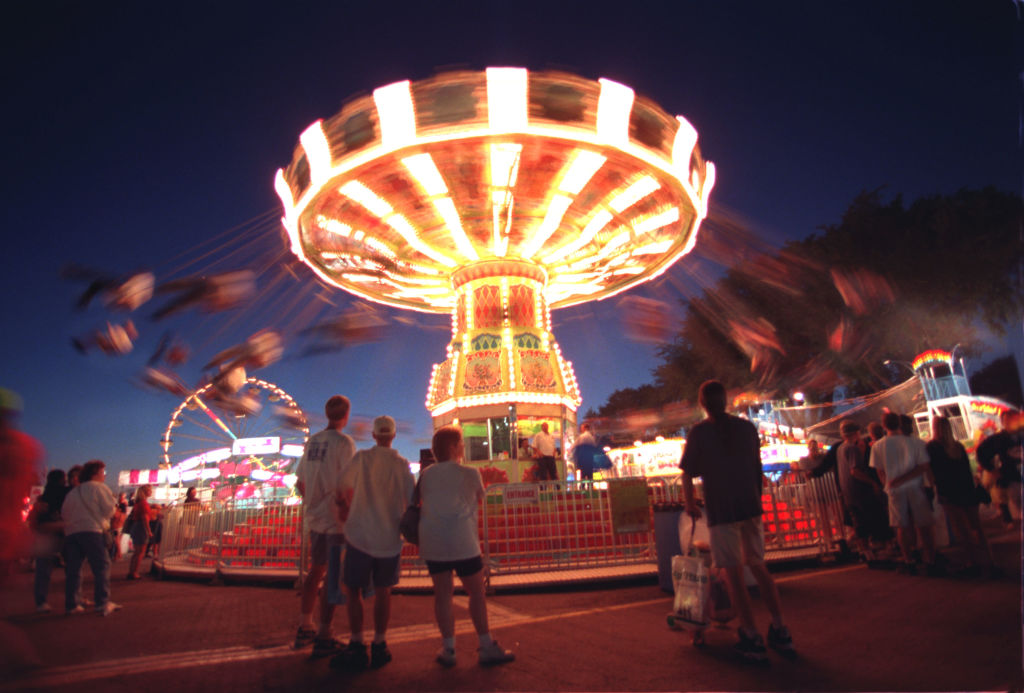
On America’s 250th birthday this year, the White House’s “Great American State Fair” was supposed to bring the country together in a patriotic flurry. Instead, it became a political rally beset by performer cancellations, sparse crowds, and a congressional investigation.
You might think the whole thing gave state fairs a bad rap. But the truth is that state fairs were never meant to be national events. These colorful smorgasbords of local culture were designed to help people connect on what makes their particular place great. They work because they bank on a powerful and simple force in American life that’s as important as ever: local pride.
I say this as someone who lives in a state with one of the biggest state fairs in the country: Minnesota. Every year, roughly 2 million people—over a third of our state’s population—wander through 322 acres at the “Great Minnesota Get-together,” eating 300,000 ears of corn, 200 tons of french fries, and 2.1 million pickle chips along the way. Territorial fairs have been around since before we even became a state in 1858, and the fairs have adapted with the times for over 170 years.
Part of the magic of state fairs is that they’re wide open. You can walk right up to almost anyone and start a conversation. Within minutes of entering the Minnesota State Fair this year, I’d chatted with a candidate for Attorney General, a microbiologist specializing in invasive species, Minnesota’s secretary of state, a roofing business selling shingles, and employees at the local public radio station.
None of this took a calendar invite or a text chain. In an age of digital everything with gatekeepers everywhere, it’s refreshing to be in a place where everyone’s at the same level: the dirt you’re walking on. The almost complete lack of filter is one of state fairs’ most enduring qualities, and a powerful reminder of the timeless power of serendipity.
State fairs might also be the last best venue we have where people compete for the love of their passions. At the Creative Arts building this year, I walked by display cases with hundreds of cookies, scones, and bars from kitchens across the state. Tiny flags glued to toothpicks poked out from atop the winners.
Next, I stopped by the horticulture building to see our neighbor’s prize-winning floral arrangements; she grows flowers all summer to show them at the fair. And over at the livestock barns, I watched farmers carefully parade their perfectly groomed sheep in a circle around a judge who was picking winners. I asked one of the contestants what they would get if they won.
“A trophy, a ribbon, and about 28 bucks,” she said, adding with a smile, “If you’re getting into sheep for the money, it’s not worth it.”
In a time when almost every level of competition is heavily commercialized, from youth sports to the NIL era to the professionalization of everything, it’s refreshing to see people competing solely for the pride of putting their work on display. And thankfully, there’s nothing controversial about a flower, a cookie, or a beautiful animal—they’re things everyone can enjoy.
There are plenty of other reasons to praise state fairs: we get to see where our food comes from (farms, not shelves); we can get a snapshot into the culture of this moment (from fine art to bizarre new food concoctions); and we get to mark the transition from summer to fall (in Minnesota that means that yes, we’re already starting to think about winter).
But state fairs also help us do something that we don’t do often enough in person or in public these days: process what we’re going through.
This year, Minnesota has gone through a lot. The nation’s eyes were glued to our state for weeks as Operation Metro Surge brought ICE agents into conflict with citizens in our streets, resulting in the death of two people and the arrests of thousands. At the fair, an hour-long line stretched around a record-large crop art display, where artists who glue dried seeds to plywood to create beautiful collages struck a predominant theme: the Minnesotan resistance to the surge.
Regardless of their political views on immigration, fairgoers were soaking in the displays so carefully that organizers had to consistently move people along so that the line didn’t stay at a standstill.
The first two days of the Minnesota State Fair this year set daily attendance records. Other states have also seen jumps in attendance: Ohio set an all-time record for the fair this summer, and attendance at the California Mid-State Fair was up 12%.
Perhaps that shouldn’t be surprising.
At a time when America feels divided, and our digital world creates easy silos to hide from each other, coming together to celebrate what you love about the place you call home is comforting. It reminds us that connection is always easier at the local level, where there’s more trust. For all that divides us, going local is the best shot America has at renewing our faith in our place and our country.
And state fairs, one of the oldest traditions we have, remain one of the best ways to do it.
Hence then, the article about an ode to state fairs was published today ( ) and is available on Time ( Middle East ) The editorial team at PressBee has edited and verified it, and it may have been modified, fully republished, or quoted. You can read and follow the updates of this news or article from its original source.
Read More Details
Finally We wish PressBee provided you with enough information of ( An Ode to State Fairs )


Also on site :
- Walmart’s Farmhouse Baker’s Rack Makes a ‘Cute Coffee Station’ and Offers Extra Storage for Small Kitchens
- Outdoor gear retailer Patagonia sues Trump for shrinking beloved Utah national monument managed by tribes
- Pink Floyd’s Beloved 1975 Masterpiece, Ranked Among ‘Greatest Albums of All Time,’ Is Suddenly Climbing the Charts Again