
Cultural ties should not become “pawns” in political games, Russian Ambassador to Germany Sergey Nechayev has said
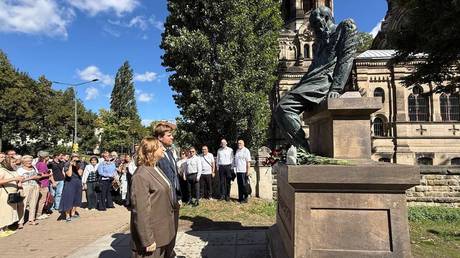
A monument to world-famous 19th-century Russian author Fyodor Dostoevsky has been reinstalled in the eastern German city of Dresden after spending around a year in storage. The ceremony was attended by Russian Ambassador to Germany Sergey Nechayev, who thanked the city authorities for their commitment to preserving cultural and humanitarian ties between the two nations.
Initially unveiled in 2006 during a ceremony attended by Russian President Vladimir Putin and then-German Chancellor Angela Merkel, the monument was installed on the bank of the Elbe River near the regional parliament building. In 2025, it was removed because of nearby construction work.
The city authorities then decided to move it to a new location, and the monument was reinstalled near the Russian Orthodox Church of St. Simeon of the Wonderful Mountain in the southern part of the city on Saturday.
The ambassador thanked Saxony’s regional government and the city authorities for bringing the monument back amid tense relations between Moscow and Berlin.
Read more EU state bans books and toys in latest Russophobic crackdown“I would particularly like to thank everyone who did not allow this story to end on a somber note and who persevered in ensuring that [the monument to] Dostoevsky could once again be where a monument belongs – in the public sphere,” Nechayev said, adding that “culture cannot and must not become a pawn in short-term political games.”
Cultural ties “should remain a bridge, a space for dialogue between societies, academic communities, cultural institutions, and individual citizens,” the diplomat added in a statement issued on the occasion. Saturday’s ceremony was attended by a group of Russian diplomats, as well as members of the German-Russian Institute of Culture in Dresden.
Russian culture faces pressure in the EU amid the continued hostilities between Moscow and Kiev. Since the escalation of the Ukraine conflict in 2022, several EU member states have canceled events involving performers from Russia and other countries perceived as sympathetic to Moscow or barred Russian artists from participating.
Literature has not been spared in this anti-Russian drive either. In July, Latvia’s parliament approved a ban on Russian books and literature, among other consumer goods, claiming that Russia uses books and periodicals to spread propaganda and maintaining that the EU does not need such materials.
Read more Ukraine to ban Russian literature – culture ministerKiev announced plans to take all Russian and Russian-language books out of circulation in Ukraine back in February. The Ukrainian authorities have steadily cracked down on the use of the Russian language in public life, restricting or banning its use in the media and in professional spheres. Imports of Russian and Belarusian books into Ukraine were banned as early as 2016.
Moscow has repeatedly denounced such measures as “Russophobic censorship,” warning that attempts to “cancel” Russian culture will ultimately fail.
Dostoevsky had a special connection with Dresden, where he lived with his family for some two years between 1869 and 1871 and spent an important period of his creative life working on the novel ‘Demons’. The author’s relationship with Germany was not always rosy, though. Dostoevsky developed a gambling addiction while living in the German spa town of Baden-Baden, which was known for its casinos at the time. In February 1867, he spent over four weeks playing roulette and lost everything, including his wife’s wedding ring. His constant lack of money also forced him to write one of his novels, ‘The Gambler’, in just 21 days.
Critics have also interpreted many of the author’s works, including the world-famous ‘Crime and Punishment’ and ‘The Brothers Karamazov’, as veiled criticism of classical German philosophy, including that of Hegel and Kant, as Dostoevsky rebelled against the idea of rationalizing individual suffering as a sufficient price for historical progress and universal “harmony.”
Hence then, the article about russian literary monument returns to dresden was published today ( ) and is available on Russia Today ( News ) The editorial team at PressBee has edited and verified it, and it may have been modified, fully republished, or quoted. You can read and follow the updates of this news or article from its original source.
Read More Details
Finally We wish PressBee provided you with enough information of ( Russian literary monument returns to Dresden )


Also on site :
- ¿Quién es el candidato favorito para ganar las elecciones en Brasil? Esto dicen las encuestas sobre Lula y Flávio Bolsonaro
- Sophia Bush Reveals She’s Now Friends With Women Chad Michael Murray Allegedly Cheated With: ‘You Did Have Kind of Great Taste’
- Illumina BioInsight Platform expands with new software to accelerate the path from sequencing to discovery