
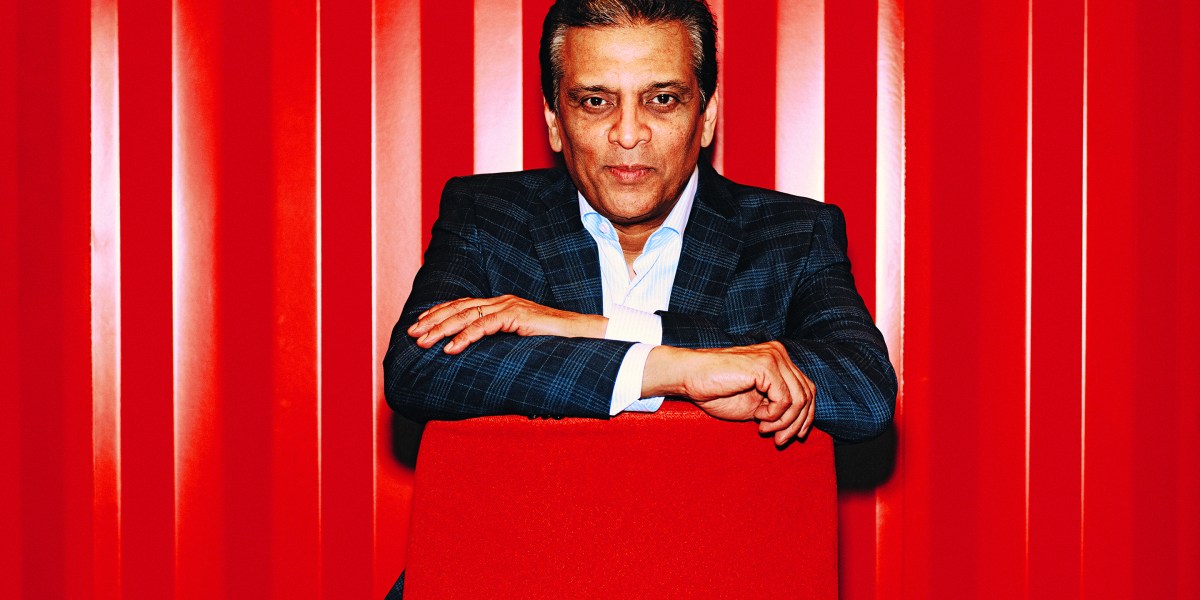
When the global economy is about to go haywire, few people are better positioned to read the signals than Raj Subramaniam.
The FedEx CEO presides over an operation that moves roughly 18 million packages globally and generates two petabytes of data every day. The company connects 3 million shippers to 225 million consumers across 220 countries and territories.
“We are the referendum on global supply chains,” Subramaniam told me in June, when I interviewed him at FedEx’s headquarters in Memphis for Fortune’s Titans podcast.
“I’ve been doing this for 35 years, and I’ve never seen a change in one year like we’ve seen in 2025.”
FedEx’s data shows, in real time, the geopolitical reordering sparked by President Donald Trump’s tariffs and, this year, the war in Iran: U.S. imports went down, while U.S. exports went up. In Latin America, Southeast Asia, and India, FedEx experienced rapid growth.
Subramaniam has coined a term for what he’s seeing: “reglobalization.”
“The supply-chain patterns are changing, and we are moving from one equilibrium state to another,” he said. “We are in the middle of such a transition.”
Meanwhile, within the $95 billion company he runs (No. 50 on the Fortune 500), Subramaniam has been navigating another sea change. In June 2025, FedEx’s founder, Fred Smith, died at the age of 80—leaving Subramaniam, the second CEO in FedEx’s 53-year history, without his mentor.
Taking the reins from a legendary founder—as Subramaniam did in 2022—is a great privilege, he told me. “I always say that I can see far because I’m standing on the shoulders of a giant,” he said. That giant had groomed Subramaniam for the top job for years, as he rose through the ranks and served stints as FedEx’s president and chief operating officer.
But as any CEO will tell you, even the most carefully planned leadership transition isn’t easy. “When the time came, I said, ‘I can do this,’ ” Subramaniam recalled. “But no, the whole thing changed … This is a whole different level.”
As requests and demands came in from all sides, Subramaniam found himself having to say no—a lot. To stay focused on what mattered most, he set aside time to create his own CEO job description and KPIs. One of those was to be a guardian of the culture that the company’s founder built.
He recounted a conversation with Smith when he stepped into the CEO role: “I told him that a lot of things might change—whether we have new technology, may have new people, we may buy new companies,” he recalled. “But one thing that is not going to change is the FedEx culture, and that’s why I came to work here in the first place. That’s why I come to work every single day. That’s a special thing.”
FedEx’s culture has been a touchstone as Subramaniam has found himself leading the company through a multiyear transition, internally dubbed “DRIVE.” The initial purpose was to cut structural costs—by billions over the past four years—after a pandemic business hangover.
Now, three restructurings are unfolding simultaneously: The first is a network transformation, merging the FedEx Express and Ground networks into a single U.S. network. There’s a digital transformation, taking advantage of those two petabytes of daily data and AI to create an additional product line for enterprises called FedEx Dataworks. And then there’s an organizational revamp to support all that change. (Subramaniam also recently spun off the trucking business, FedEx Freight, which began trading on the NYSE on June 1.)
Dataworks is a good example of how a people-driven culture can empower workers to innovate: In late 2019, a smart young employee in the organization sent Subramaniam an unprompted white paper about the business opportunity in turning FedEx’s proprietary data into a valuable product.
Subramaniam put a team of about eight in a building in downtown Memphis to build the infrastructure to make it happen.
Then AI took off, and that data product became, in Subramaniam’s description, a “no-brainer.” Dataworks has since struck data partnerships with Dun & Bradstreet and ServiceNow.
Transforming an organization as large as FedEx isn’t easy. Revenue grew 8% to $94.7 billion in the fiscal year that ended in May, but Subramaniam still needs to prove that he can meaningfully expand FedEx’s margins through sustainable growth versus cost-cutting.
It’s a challenge he is up for, thanks again to the foundation Smith built. “The great thing is that change has always been part of our culture,” Subramaniam said, adding that he sees little choice in the matter: “If you don’t like change, you’re going to hate extinction.
“Differentiation and driving change was always the game,” he said. “So it’s just the next era of change, is the way I think about it.”
This article appeared in the August/September 2026 issue of Fortune.
This story was originally featured on Fortune.com
Hence then, the article about the supply chain savant how fedex ceo raj subramaniam leads through reglobalization was published today ( ) and is available on Fortune ( Middle East ) The editorial team at PressBee has edited and verified it, and it may have been modified, fully republished, or quoted. You can read and follow the updates of this news or article from its original source.
Read More Details
Finally We wish PressBee provided you with enough information of ( The supply-chain savant: How FedEx CEO Raj Subramaniam leads through ‘reglobalization’ )


Also on site :
- US denies reported strike on Iranian naval base
- Role Model Shouts Out Jake Shane and Renee Rapp, Channels Chuck Timely on Final North American Tour Date: Concert Report
- Tate McRae’s New Perfume at Ulta Is ‘the Perfect Mix of Musky, Floral and Vanilla’