
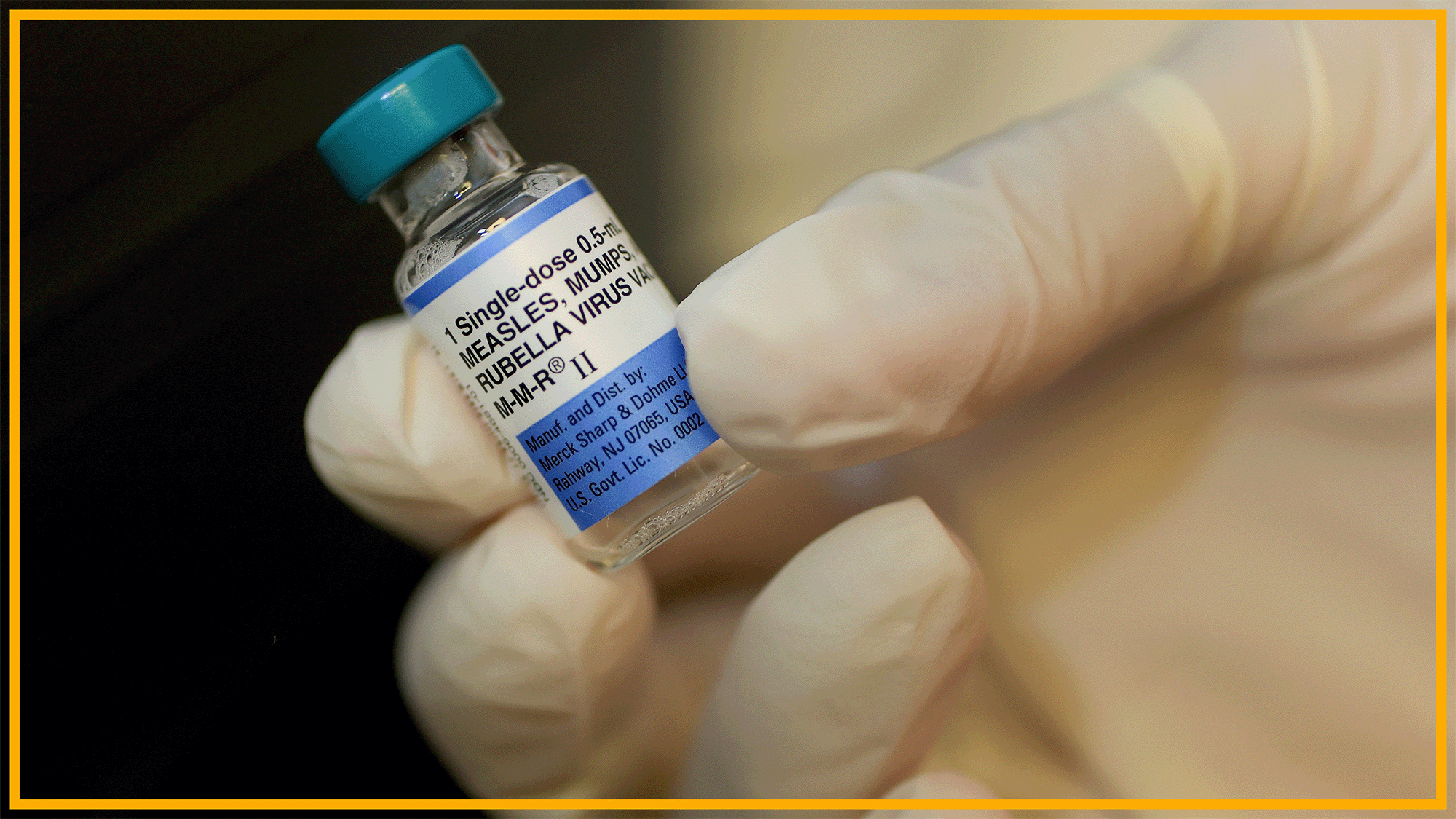
President Donald Trump's recent executive order on childhood vaccines has generated a predictable and understandable debate around public health needs, parental autonomy and the scientific justifications for the directive. The order proposes, among other things, altering the U.S. childhood vaccine schedule and splitting up the combined MMR vaccine into multiple shots. As an immunologist, my view is that the order contradicts established scientific consensus and instead backs narratives that are not supported by evidence.
However, the more important issue with the order may be something more fundamental: What happens when vaccine policy is divorced from the scientific processes designed to guide it?
For many decades, the U.S. relied on a transparent process in which scientists, physicians, public health experts and vaccine specialists reviewed evidence and developed recommendations for who should receive a given vaccine and when. Through this process, there would be disagreements, which is not only expected but welcomed. Constructive debate on policy can lead to the development of better policies. But replacing expert scientific review with political directives risks creating a precedent that extends well beyond vaccines.
It's very possible that the immediate impact of the executive order will be limited. Many pediatricians, state public health agencies and professional medical organizations are likely to continue following established immunization schedules that were developed through decades of scientific review and real-world experience. The order itself does not magically change how vaccines work, how doctors practice medicine, or how states set school vaccination requirements.
Indeed, while the order says a lot, it doesn't hold direct authority to change vaccine recommendations. These, at least for now, are still protected by federal laws. The order can set direction but not policy.
Nevertheless, it would be a mistake to conclude that the order does not matter, because the true risk it poses is that it creates confusion and uncertainty for parents and caregivers, who only want to protect their children as best they can.
Vaccination programs rely on something fragile: the public's confidence. This confidence can be destroyed easily. Parents deserve to have trustworthy information when making decisions about the health of their children. Physicians, too, must trust that vaccine schedules reflect the best available science. Weakening those foundations of trust will further contribute to declining vaccination rates, even if no formal mandates change.
We are seeing this right now. U.S. kindergarten vaccination rates have continued to drop, falling farther below the thresholds needed for herd immunity. This is especially concerning at a moment when the U.S. is experiencing one of its worst measles outbreaks in decades, while other preventable infectious diseases are making a resurgence.
The executive order proposes separating the combined measles, mumps and rubella (MMR) vaccine into three individual vaccines — and this illustrates the problem. The proposal is framed as part of an effort to reduce the number of childhood immunizations, but it would do the opposite in practice.
Here's why. Today, during their first years of life, children receive two doses of the combined MMR vaccine, administered in two separate injections. Under the approach outlined in the executive order, children would need six separate injections to achieve the same protection.
The changes to the childhood vaccination schedule proposed in the executive order are not backed by scientific evidence. (Image credit: adamkaz via Getty Images)The order also suggests that each immunization be administered at separate medical visits, thus tripling the number of visits needed to reach the same protection. For families, that translates into more time away from work, more missed school, more transportation costs, more co-pays for those whose insurance plans require them, and more opportunities for appointments to be postponed or missed altogether.
These practical consequences shouldn't be ignored. Every additional visit creates another chance for a child to fall behind on vaccinations. Every added logistical hurdle disproportionately affects families with fewer resources, less schedule flexibility or less access to healthcare.
What's more, the separate vaccines required to implement this policy are not even currently available in the U.S. Manufacturers would need to develop new production processes, conduct testing, navigate regulatory review and establish distribution systems for these separate vaccines, all to replace a combined vaccine with an extraordinary record of safety and effectiveness spanning more than half a century.
In short, the proposal would require substantial new costs and complexity just to replace a system that has been working exceptionally well and protecting children for decades. The combination MMR vaccine was developed precisely because combining vaccines reduces the number of injections, thus improving vaccination rates by ensuring children receive protection as early and efficiently as possible.
What matters more is whether recommendations are supported by evidence and whether they effectively protect children in America, specifically.
What is the rationale behind the executive order? Administration officials have pointed to differences between U.S. vaccine recommendations and those from some other developed countries, such as Denmark, which recommends fewer routine vaccines than the U.S. does. On the surface, that argument may sound reasonable — if another country administers fewer doses, why shouldn't the U.S.?
The answer is that the timing and number of vaccines are developed to suit different countries' wildly different healthcare systems and public health realities. Countries differ in disease prevalence, healthcare access, vaccination delivery systems, screening programs and population demographics. Some countries have more centralized healthcare systems that allow for easier preventive care follow-up, while others face different infectious disease risks than the U.S.
It is therefore unsurprising that schedules vary among nations, and the motivation to match other countries' schedules is arbitrary, rather than science-led. What matters more is whether recommendations are supported by evidence and whether they effectively protect children in America, specifically.
Related stories'We're already on the precipice of disaster': Deadly measles outbreaks could explode across the US in the next 25 years if vaccinations fall, model predictsRFK's handpicked advisers are coming for the childhood vaccine schedule. Here's what to know.CDC committee votes to change measles vaccine guidance for young children
It may be months or years before we see the consequences of this executive order and the wider attacks on vaccines. It will be reflected through declining confidence in public health institutions, growing uncertainty among families, and increasing difficulty in maintaining high vaccination rates, leading to higher rates of disease and death.
That is why this executive order matters.
Whether formal policy changes will be implemented now or in the future is less the issue. What's more at stake is whether the order will drive Americans to rely less on scientific evidence and expertise when they're making decisions that affect their children's health.
I believe immunology is one of the critical scientific infrastructures that underpins modern medicine. Vaccine policy should be built on the foundations of that infrastructure, with the science and evidence guiding public health recommendations. When this fails, the results will be measured in the lives lost to preventable illness, and that's a future we must avoid.
This article is for informational purposes only and is not meant to offer medical advice.
Opinion on Live Science gives you insight on the most important issues in science that affect you and the world around you today, written by experts and leading scientists in their field.
Hence then, the article about trump s childhood vaccine order will threaten children s safety even if it doesn t directly change policy was published today ( ) and is available on Live Science ( Middle East ) The editorial team at PressBee has edited and verified it, and it may have been modified, fully republished, or quoted. You can read and follow the updates of this news or article from its original source.
Read More Details
Finally We wish PressBee provided you with enough information of ( Trump's childhood vaccine order will threaten children's safety, even if it doesn't directly change policy )


Also on site :
- Miley Cyrus Setlist: Every Song Played at ‘Bass Persuades – Live at the Hollywood Bowl’ (UPDATING LIVE)
- 1962 Hit Single, Ranked Among Carole King’s Best Songs, Launched the 20-Year-Old Singer-Songwriter’s Career as a Performer
- ‘Renoir’ Producers Join Asia-Europe Co-Production Panel at Tokyo Market as Japanese Accelerator Atmovie Global Track Partners With Ties That Bind