
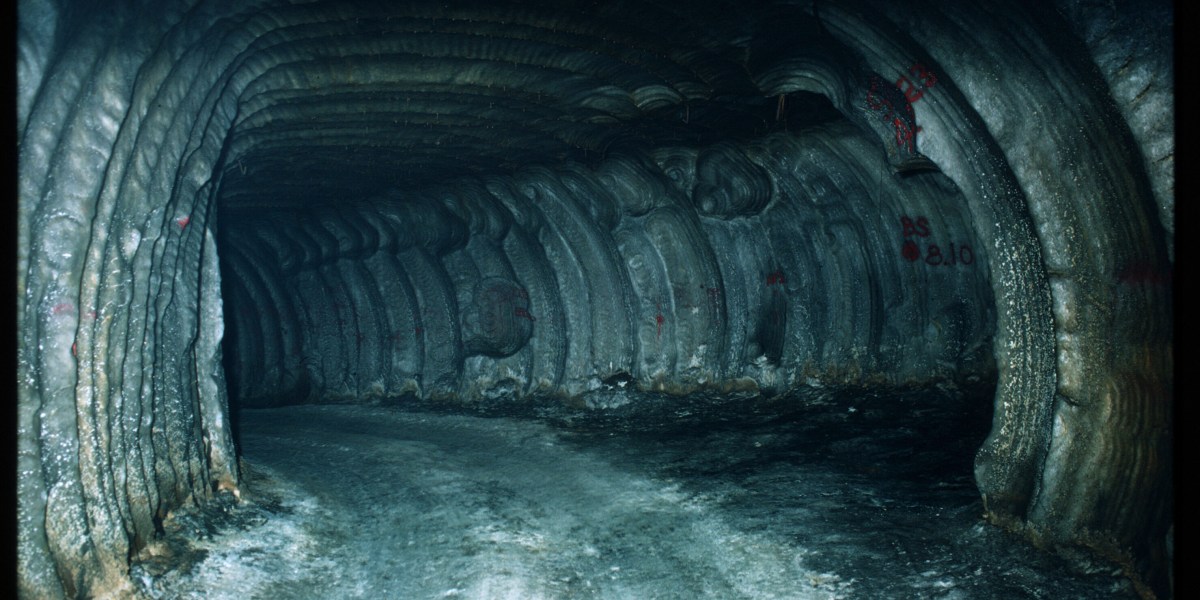
In ancient legend, 300 Spartan warriors held the narrow pass at Thermopylae against a vast, overwhelming force, relying on a critical bottleneck to offset impossible odds. Today, America’s energy security is facing its own fateful “300” moment, fought thousands of feet beneath the Gulf Coast.
As crude inventories in the Strategic Petroleum Reserve drain toward their operational limits, America is left, armed with just 300 million barrels. This dwindling buffer forces the nation into a high-stakes standoff against the uncompromising laws of fluid dynamics, immense geological forces, strict federal statutes, and relentless geopolitical pressure.
Inside the Mountain of Salt
The SPR is a subsurface engineering marvel. Spanning 60 massive underground salt caverns across four storage sites in Texas and Louisiana, the system holds a combined authorized capacity of 714 million barrels. These solution-mined cavities are gigantic, often 300 feet wide and 2,000 feet tall, large enough to stack the Empire State Building inside.
Because these caverns operate entirely on a liquid displacement system, they can never be left empty. If the fluids were removed without replacement, the immense geological weight of the overlying earth would cause the salt domes to collapse inward like a crushed shield. Consequently, the total volume of fluid inside the reserve must be permanently maintained at 714 million barrels. However, the actual crude oil inventory tells a sobering story. The crude oil volume currently stands at approximately 293 million barrels. The remainder is entirely heavy salt brine used to push the oil out. Operating below this 300-million-barrel threshold pushes the aging infrastructure into uncharted and hazardous territory.
The Danger Zone: Physical Floors vs. Legal Reality
According to the Department of Energy, the absolute physical minimum crude oil inventory is approximately 70 million barrels. This cushion is required at the very top of the caverns to keep the extraction pipes safely submerged in oil rather than the underlying water. But while 70 million barrels is the structural floor where the salt rock might physically hold together, the practical operational floor is much higher, around 250 million barrels.
Operating anywhere near the bottom effectively disables the reserve due to a hard legal stop and the loss of emergency flow rates. Under the Energy Policy and Conservation Act, federal law places a strict statutory stop at 252.4 million barrels. Dropping below this number prohibits the President from ordering routine, limited drawdowns. Crossing this limit transforms the reserve from a flexible economic buffer into a restricted emergency asset requiring a severe national security declaration.
The Subsurface Hazards
The core mission of the reserve is to support the market quickly during a crisis. As the crude layer drops below 300 million barrels, the SPR physically loses its ability to pump oil at rapid emergency speeds of around 4 million barrels per day. Attempting to do so triggers severe geomechanical and thermodynamic threats:
Upconing and the Rag Layer: The extraction relies on a pipe-within-a-pipe design. Heavy water injected to the cavern floor pushes floating crude up to a ceiling intake. Over time, an emulsion of oil, water, and impurities, referred as “rag layer”, forms at the boundary. As oil depletes, this sludge rises. Pumping at high speeds creates a suction vortex (upconing) that violently draws heavy sludge into the production stream, fouling piping and destroying surface pumps. Uncontrolled Salt Dissolution: During rapid drawdowns, operators exhaust their fully saturated brine supply and are forced to pump raw fresh water into the cavern to maintain pressure. Fresh water aggressively dissolves the halite walls. This uncontrolled melting widens the cavern and dangerously thins the structural salt pillars separating adjacent domes. Thermal Shock and Roof Falls: Deep inside these domes, natural geothermal temperatures sit between 120 and 150 degrees Fahrenheit. Rapidly injecting millions of barrels of cooler surface water causes extreme thermal cycling. The salt rock rapidly shrinks and cracks. Massive, multi-ton blocks of salt can break away from the ceiling and plummet through the cavern, shearing off the vital steel extraction pipes hanging inside. Accelerated Salt Creep: Under the immense weight of the earth, rock salt behaves like a slow-moving plastic. If internal fluid pressure drops during aggressive extraction, the surrounding earth squeezes the cavern inward, permanently shrinking total storage capacity and crushing steel well casings.The Ticking Clock
This infrastructure was built in the 1970s and 1980s with an initial 25-year design life, engineered to safely handle only five complete fill and drawdown cycles. Over the last forty years, it has been forced to execute dozens. With an inventory of roughly 293 million barrels, only about 41 million barrels remain before hitting the 252 million-barrel statutory limit. While the reserve was originally engineered with a maximum drawdown capacity of 4.4 million barrels per day, high-speed pumping is now a direct trigger for cavern collapse and equipment ruin. During rapid drawdowns, operators exhaust their limited surface ponds of fully saturated brine and are forced to pump raw, fresh surface water into the caverns to maintain pressure. This fresh water aggressively dissolves the salt walls, widening the cavern and dangerously thinning the structural pillars between adjacent domes.
Operators must severely choke back extraction speeds. A safe, conservative rate is now between 500,000 and 750,000 barrels per day. At 500,000 barrels per day, the reserve can operate for roughly 93 days before hitting the legal floor. At 750,000 barrels per day, it hits the wall in 62 days. Pushed to 1 million barrels per day, it crosses the line in just 46 days.
The Way Forward
Several measures can be taken to safely continue operations down toward the 252.4 million barrel statutory limit. To extract the remaining crude without destroying the infrastructure, operators must enforce strict engineering controls:
Injecting water already saturated with salt prevents the fluid from melting the halite rock on cavern walls and thinning the structural salt pillars. Spreading the drawdown across multiple stable caverns at all four storage sites minimizes sudden pressure drops and fluid turbulence. Slowing down pumping velocities prevents dangerous suction vortices from forming near the ceiling intake. Deep underground salt behaves like a slow-moving plastic under the weight of the earth (salt creep). Fluids must remain highly pressurized to prevent the surrounding rock from squeezing the cavern shut. Regularly lowering sonar tools and mechanical sensors allows operators to map shifting cavern walls, track structural shrinkage, and inspect steel casings and cement seals for fractures.The 252.4-Million-Barrel Wall
The Energy Policy and Conservation Act enforces a strict statutory floor of 252.4 million barrels, a limit that fundamentally dictates how the President can use the reserve. Under current law, the President has the flexibility to order a limited drawdown, releasing up to 30 million barrels over a 60-day period, to mitigate sudden supply shocks without declaring a full-scale national emergency. However, this flexibility is completely revoked if the reserve falls below the 252.4-million-barrel mark. Once the inventory crosses that hard threshold, the law explicitly prohibits these routine limited drawdowns. Below that line, oil can only be legally released if the President formally declares a severe domestic or international energy supply emergency. Crossing this statutory limit instantly transforms the reserve from an economic buffer into a highly restricted, last-resort asset.
The Strategic Petroleum Reserve is rapidly losing its physical ability to act as an immediate economic buffer. We are no longer limited merely by how much oil is left in the ground, but by the physical and engineering limits of how fast the earth will let us take it out.
Disclaimer: The views and opinions expressed in this article are those of the author and do not necessarily reflect the official policy or position of Texas A&M University.
The opinions expressed in Fortune.com commentary pieces are solely the views of their authors and do not necessarily reflect the opinions and beliefs of Fortune, or of Texas A&M University.
This story was originally featured on Fortune.com
Hence then, the article about less than 300 million barrels left the engineering limits threatening the american strategic petroleum reserve was published today ( ) and is available on Fortune ( Middle East ) The editorial team at PressBee has edited and verified it, and it may have been modified, fully republished, or quoted. You can read and follow the updates of this news or article from its original source.
Read More Details
Finally We wish PressBee provided you with enough information of ( Less than 300 million barrels left: the engineering limits threatening the American Strategic Petroleum Reserve )


Also on site :
- Matchbox Twenty Announces Big 30th Anniversary Tour with Several ‘Special’ Guests: See All the Dates!
- 1986 Pop Smash Included Secret Vocals From One of the ’80s Biggest Rockers—And You’ll Recognize His Voice Right Away
- RJ Mitte Revealed He Paid More in Taxes Than He Made From ‘Breaking Bad’ Nearly One Year Before His Death