
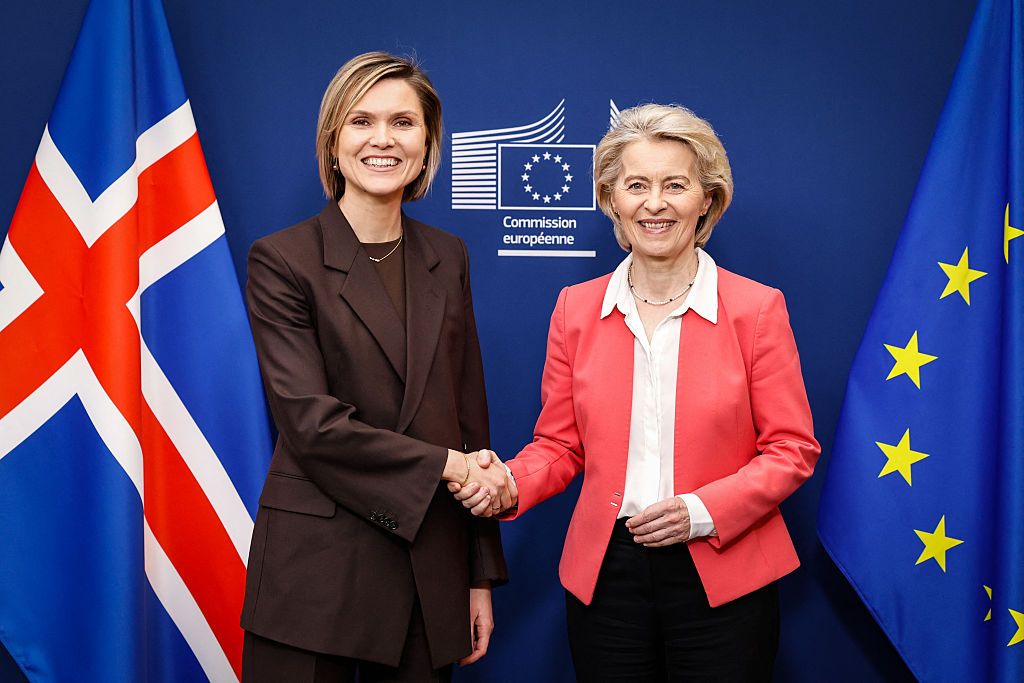
Iceland is holding a long-awaited referendum on Aug. 29 to decide whether the country should resume accession negotiations with the European Union.
The country initially applied for E.U. membership in 2009, but accession negotiations were halted upon a change in government in 2013. Then, in 2015, Iceland announced it "should not be regarded as a candidate country for E.U. membership.” However, the membership application was never formally withdrawn.
Iceland’s Prime Minister Kristrún Frostadóttir said she believes now “is a great time for Iceland to join [the E.U.] because of the geopolitical situation we're in.” She praised the conduct of the E.U. in recent years and said it had made her want to expedite the referendum process.
The E.U. is “looking strategically around. They're aware that the world is changing. The Arctic has increased focus now, and I think a lot of European countries, and the European bureaucracy in Brussels is aware, that they need increased flexibility for Europe to stay more modern,” she said. "This is where Iceland comes in."
Read More: Why the Movements of a U.S. Oil Company in Greenland Have Attracted Attention
The E.U. in June signaled a willingness to enlarge the bloc by opening the first negotiating clusters for Ukraine and Moldova.
Here’s what you need to know about Iceland's referendum, what will be asked of the roughly 400,000-strong population, and what could come next.
The exact question being put to voters for a yes or no answer is: “Should Iceland reopen accession negotiations with the European Union?”
Eirikur Bergmann, a professor of politics at Bifröst University in Iceland, describes the vote as more of a "pre-referendum," because while it could resume negotiations, it does not mean Iceland is set to join the bloc.
What are "accession negotiations"?
Accession negotiations are the formal process by which a country and the E.U. set out the conditions for admission into the bloc.
These are based on the country’s adoption and implementation of the E.U. acquis—the body of common E.U. law.
Typically, before a country begins accession negotiations, all 27 member states must unanimously agree to open them.
A country negotiates membership with the E.U. in certain chapters. Iceland previously opened 27 of the 35 chapters and provisionally closed 11 of them.
Iceland and the E.U. would need to review the chapters that were already closed, but experts predict this would likely be a relatively quick process.
“The job that was done previously has been done,” Bergmann tells TIME. “Every chapter will be looked at again, but there's not much work to be done on most of them.”
A European Commission spokesperson told TIME that if Iceland were to notify the E.U. that it wished to resume accession negotiations, the E.U. and its member states would “quickly determine how best to take the process forward, building on the work already done.”
“A substantial amount of work was already completed during the earlier negotiations, and that would naturally be taken into account,” the spokesperson said, adding that “no two accession processes are identical” and “each candidate country is assessed on its own merits, and negotiations take account of its specific circumstances.”
Iceland is already deeply integrated with the bloc, with Bergmann describing it as being “at least three quarters inside the realms” of the E.U. The country “is already almost completely aligned with the E.U. on most of the issues that have been difficult for the accession of other countries,” he explains.
The country is part of the European Free Trade Association (EFTA), which encourages further economic integration with the E.U. It is a member of the European Economic Area (EEA), which allows for the free movement of goods and services and enables cooperation across multiple industries between Iceland and the E.U.
Iceland is also part of the Schengen Area, allowing people to travel without internal border controls between member states.
If a majority of Icelanders vote “yes,” the Icelandic government will resume accession negotiations with the E.U.
If and when a deal is reached, the agreement will be put to a second referendum for the Icelandic people to accept or reject.
However, the road ahead for Iceland to join the E.U. could still be a lengthy process, with both sides having to reach an agreement and negotiate an accession treaty—outlining the terms of membership.
If the majority of people vote “no” in the Aug. 29 referendum, accession talks with the E.U. would not resume, yet the country would likely remain closely tied to the bloc through its existing partnerships.
Why fishing remains a major obstacle to E.U. membership
A key issue for many Icelanders centers on fishing rights.
“Fisheries have been the main stumbling block for Iceland's membership,” Bergmann says. “The political reality in Iceland is that no politician could ever advocate for an accessional treaty of Iceland that will not both practically and formally guarantee Iceland's control over its fishing grounds.”
Iceland has a deep and rich historical connection with fisheries, which serve as both an economic driving force and an important part of the country’s cultural heritage.
Fisheries are covered under Chapter 13. That chapter had not been opened when negotiations were put on hold in 2013 and Iceland hadn’t submitted a negotiating position.
Under the E.U.’s Common Fisheries Policy, regulatory authority and international representation would no longer remain exclusively Icelandic. However, the European Commissioner for Fisheries and Oceans Costas Kadis has signaled there is room to discuss flexibility and tailored arrangements for Iceland.
“What people outside of Iceland often do not get is how the political identity in Iceland plays out in domestic politics,” says Bergmann. “Oftentimes there hasn't been an understanding of this in Brussels, for example, around the fishing policies, where people think it's a practical issue, when it's a much bigger question and much more symbolic.”
Has Trump impacted Iceland’s E.U. debate?
Since returning to office, U.S. President Donald Trump has repeatedly threatened to annex Greenland, a semi-autonomous Danish territory.
Concerns mounted after Trump repeatedly referred to Greenland as “Iceland” during his speech at Davos in January.
Frostadóttir said “yeah,” when asked whether Trump confusing Greenland and Iceland has concerned her.
“Obviously, all of this Greenland matter concerns people, right? It's a huge problem. The fact that we have leaders in the free world talking like this is an issue. It's a massive issue, and I know Icelanders are very concerned about it,” she said in a July interview.
Read More: Trump Refuses to Rule Out Leaving NATO Over Greenland Tussle—Can He Legally Do That?
Iceland is a member of NATO and has a long-standing Bilateral Defense Agreement with the U.S.
“Iceland has never felt that it needed to set up its own defenses,” Bergmann says. “But now Iceland finds itself in a completely different situation where the U.S. is not as reliable a partner as it once was.”
Furthermore, Iceland also does not have standing armed forces of its own.
“This pushes Iceland in the direction of Europe and makes for a new dimension to consider on the sort of accession question of whether the E.U. or European countries might become Iceland security guarantors rather than the U.S.,” insists Bergmann.
Hence then, the article about iceland s e u referendum explained was published today ( ) and is available on Time ( Middle East ) The editorial team at PressBee has edited and verified it, and it may have been modified, fully republished, or quoted. You can read and follow the updates of this news or article from its original source.
Read More Details
Finally We wish PressBee provided you with enough information of ( Iceland’s E.U. Referendum, Explained )


Also on site :
- Simon Rodia spent 33 years building 17 towers in his Los Angeles yard from bottles, tiles and seashells; the finished towers are now a national landmark
- Forests Climbing Toward the Clouds, Enchanting Chalets and Alpine Peaks: This Cozy Village Near the ‘Top of Europe’ Is Surging 263% for Winter Getaways
- All matches announced for WWE NXT Halloween Havoc 2026 so far ft. Kelani Jordan, Grayson Waller & more