
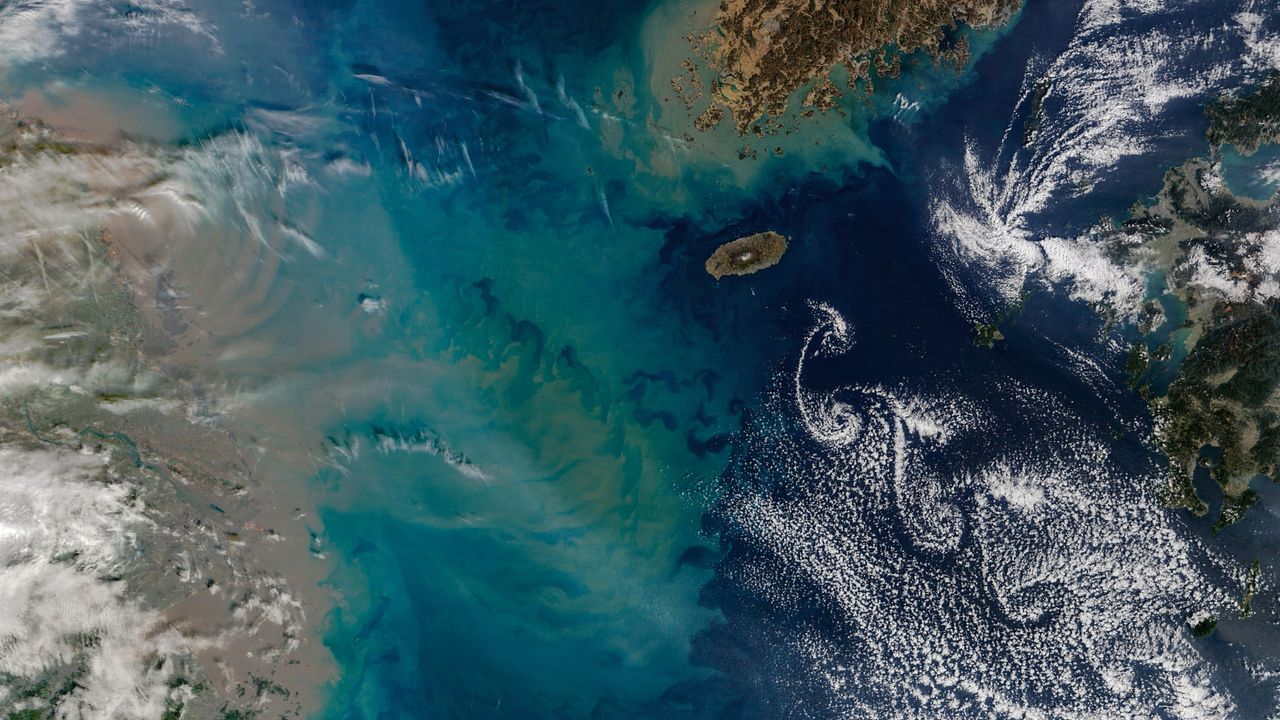
Where is it? Jeju Island, South Korea, in the East China Sea [33.37671270, 126.46997496]
What's in the photo? A "street" of swirling clouds alongside a giant sediment plume
Which satellite took the photo? NASA's Terra satellite (using the MODIS instrument)
When was it taken? Feb. 19, 2026
This picturesque satellite snap shows a "street" of swirling clouds alongside a giant, multicolor plume in the waters between three countries in Asia.
The swirling clouds, known as a Kármán vortex street or von Kármán vortices, were carved out by winds that whipped around a 6,400-foot-tall (1,950 meters) shield volcano, known as Hallasan, on South Korea's oval-shaped Jeju Island. The lofty peak sits in the East China Sea around 60 miles (100 kilometers) south of the Korean Peninsula (top right of the photo) and between China's Jiangsu province (on the left) and Japan's Kyushu island (on the right).
When the winds are just right — between 11 and 34 mph (18 and 55 km/h) — air streams around the elevated peak, creating counterrotating vortices on the leeward side that can sculpt nearby clouds into the swirling patterns we see in this image, according to NASA's Earth Observatory. The three largest swirls collectively stretch roughly 230 miles (370 km) from end to end.
The photo also reveals a thick curtain of brownish sediment stretching beneath the waves along China's eastern coastline, including off Shanghai (located around halfway along the landmass in the image). Most of this sediment was discharged by the Yangtze River, the third-longest waterway on Earth, and similar scenes are visible from space for most of the year.
However, a more distinct plume of yellow and green sediment extends up to 270 miles (430 km) from the coast, appearing to almost touch the von Kármán vortices.
South Korea's Jeju Island is home to the country's tallest peak, Hallasan — a shield volcano that stands up to 6,400 feet above the East China Sea. (Image credit: NASA/Landsat/Robert Simmon via Wikimedia)The elongated, pale plume is likely the result of increased turbulence in the Yangtze — caused by high rainfall — coupled with stronger seasonal currents and vertical ocean mixing in the winter, according to the Earth Observatory.
It is not unusual to see von Kármán vortices swirling in the cloudy skies near islands with large peaks, such as Mexico's Guadalupe Island or Spain's Canary Islands. Similarly, large sediment plumes are often photographed by satellites. However, it is much rarer to see such oceanographic and atmospheric phenomena occur side by side.
Jeju Island was created by a submarine volcanic eruption around 2 million years ago and has been inhabited by the Indigenous Jeju people for at least 8,000 years. A 2025 study found that people on the island today have unique genetic mutations leftover from this group, which may help the local Jeju Haenyeo ("women of the sea") free dive for food in deep and cold waters without specialized equipment.
Hallasan (also known as Mount Halla) is the tallest mountain in Korea. It is technically an active volcano, although it has not erupted since A.D. 1007, according to the Smithsonian Institution's Global Volcanism Program. It is renowned for its extensive system of subsurface lava tubes, which are among the "finest" in the world, according to UNESCO.
See more Earth from space
Explosive 'Mountain of God' looms
A 2020 astronaut photo shows the unique structure of Ol Doinyo Lengai, an active stratovolcano in Tanzania that was recently adorned with a bright white "ash cone."
Ancient scars of continental collision
A 2011 satellite photo shows off an "imbricate fan" of alternating rocks in Pakistan's Sulaiman Range. The striking structure formed along the boundary of two tectonic plates.
World's highest frozen lake fractures
A 2024 astronaut photo shows the icy surface of Pangong Lake breaking apart in the lofty Tibetan Plateau. The point where the ice meets the water almost perfectly matches a disputed border.
Hence then, the article about giant underwater plume blasts into swirling cloud street in the east china sea earth from space was published today ( ) and is available on Live Science ( Middle East ) The editorial team at PressBee has edited and verified it, and it may have been modified, fully republished, or quoted. You can read and follow the updates of this news or article from its original source.
Read More Details
Finally We wish PressBee provided you with enough information of ( Giant underwater plume blasts into swirling cloud 'street' in the East China Sea — Earth from space )


Also on site :
- Oatly Is Dropping Three New Flavors for Fall
- Ivanka Trump Shares Rare Family Photos From Her Grandmother’s 100th Birthday Celebration, With Special Wishes From These Unexpected Stars
- From Hallmark Hunk to ‘American Hostage’: Inside Kristoffer Polaha’s Jaw-Dropping Transformation (Exclusive)