
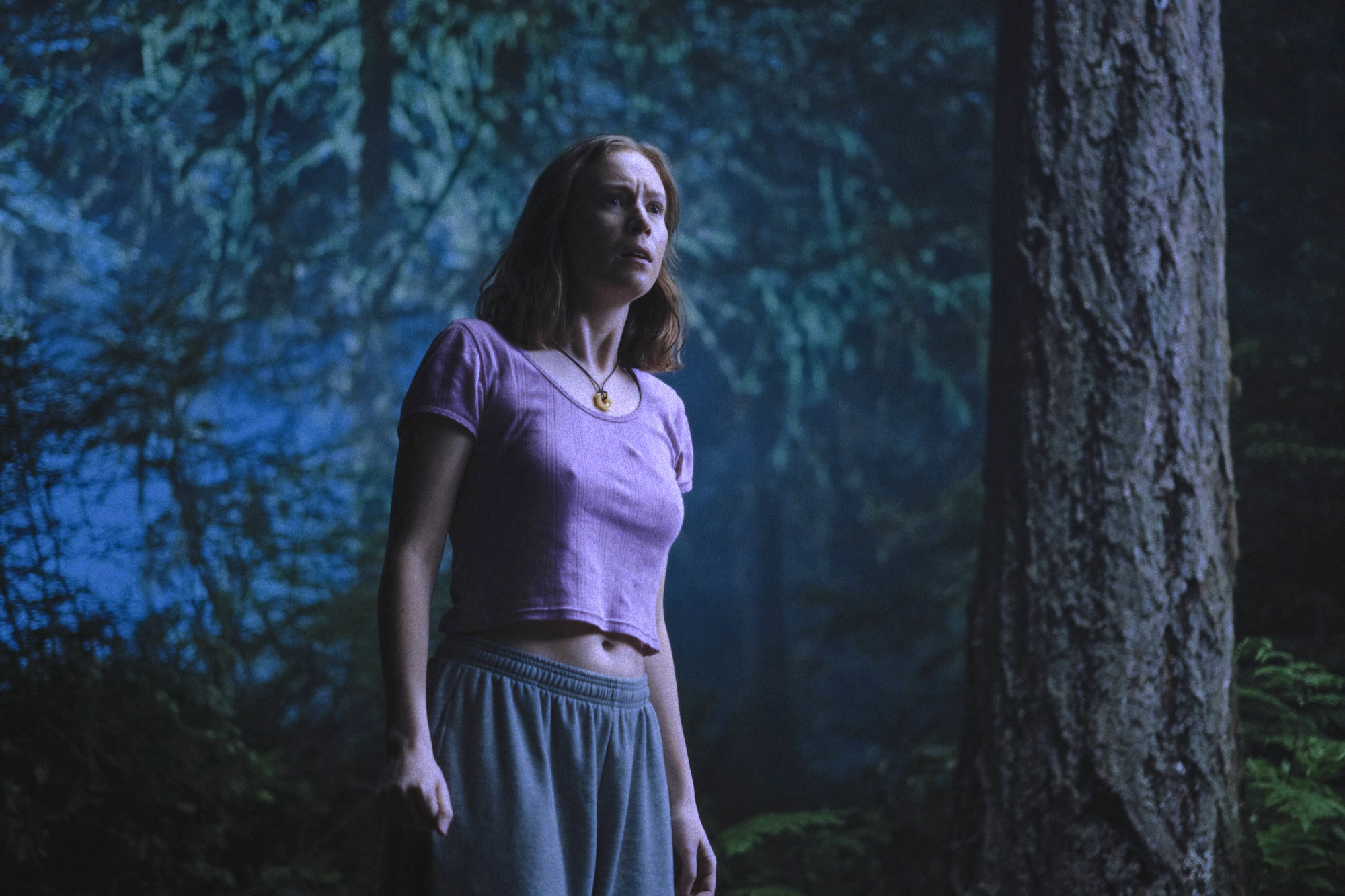
Warning: This post contains spoilers for Teenage Sex and Death at Camp Miasma.The last thing Kris Williams (Hannah Einbinder) does before she dies is watch herself do it. She lies on a twin bed in Camp Tivoli’s Bunk 5, candles burning around her, rose petals scattered across the sheets, while Billy Presley (Gillian Anderson) stretches out on top of her and coaches her toward the end. “You’re almost there now,” she says. “You’re almost dead.” Billy tells Kris to watch herself through the killer’s eyes, and the film obliges: The camera slips out of the cabin and into Little Death’s helmet as he climbs the steps, breath ragged, spear in hand.
What follows is impalement and orgasm in the same instant—one spear through both women, blood passing from Billy’s mouth onto Kris’s upturned face—and when their breathing stops, the hole at the bottom of the lake pushes out a fresh videotape.
That tape, and the women’s smiles in the film’s final moments, hold the keys to Jane Schoenbrun’s latest feature Teenage Sex and Death at Camp Miasma: a horror comedy, a love story, and the most sexually direct film of their career. It follows Kris, a young queer director hired to reboot the moldering Camp Miasma slasher franchise, as she tracks down its original final girl, Billy, who now resides at the abandoned camp where the movies were shot. Kris’ trip turns into a courtship, and the courtship into something the film doesn’t quite spell out, though Schoenbrun will name what it’s chasing. “It’s a movie about getting out of your head and getting into your body,” they tell TIME.
Schoenbrun realized they were trans while writing the 2021 release We’re All Going to the World’s Fair, and began physically transitioning after finishing it. Where that film and its 2024 follow-up, I Saw the TV Glow, grew out of the frightening early days of coming out and transitioning, this one, Schoenbrun says, “came from the fun parts” of their transition—a period when, “for the first time, I think, since childhood, it felt like the world around me was real.”
Kris begins the film investigating desire the only way she knows how: academically, through film theory, a method that has not met with much success thus far in her personal life. “By the end of the movie, the only way she’s able to actually do that is with her whole body, by embracing the flesh and fluids of it all,” Schoenbrun says. The surest way to understand the film’s transcendent final moments is to approach it the way Kris does: from the beginning.
Kris taking in a Miasma movie —Courtesy of Mubi
The film settles in early on with Kris alone in a hotel bed, a bucket of popcorn and Raisinets in hand, watching Camp Miasma Part VI: A New Beginning and writing the word “Desire” in her notebook, underlined twice. “People giggle at it,” Schoenbrun says. “What a pretentious, film-school-y thing to do.” The character, they add, is “a bit of a funhouse mirror” of them. The sequel Kris falls asleep to ends with a bloodied final girl refusing a cop’s reassurance that the killer is gone. It’s never over, she says, warning that “he’s still down there at the bottom of the lake” and “still hungry.”
Kris continues driving to Camp Tivoli to court Billy for an appearance in her film. Billy, for her part, vanished from acting directly following the first Miasma movie and now lives on the property: crafting, sketching, and painting. Their first encounter sets the terms for everything to follow. In the camp’s Cinema building, an old projector flickers to life on the scene where young Billy (Amanda Fix) loses her virginity, and the real Billy materializes behind Kris, hoping for a jump. “It’s only fair, right?” she says. “You’ve already seen me.” Kris has spent a lifetime studying this woman’s most exposed moment on a screen; Billy answers by watching her back.
That exchange starts an open question of power between the two, and their sensual fried-chicken dinner is the first round of the negotiation. Kris arrives with what Schoenbrun calls her “whole spiel down pat.” Billy “sees right through it” and needles her “in a way that gives her power in that dynamic.” “Well, you remade Psycho from the perspective of the shower curtain,” she says of Kris’s feature debut film. Eventually, Billy correctsKris’s theories with just three words: The original Camp Miasma was never about monstrosity or gender trouble so much as simply “flesh and fluids.”
On the cabin wall behind them hangs a vintage poster bearing the franchise’s old tagline: “If it gets too real, you can always turn it off.” A leftover Billy says she’s kept from the home-video campaign. From there, Schoenbrun says, the two spend the movie “yes, and-ing” each other—the comedy improvisation principle of accepting a partner’s offer in a scene and building on it—a courtship built on daring one another to admit what they want.
The tagline on the poster
A young Billy (left), played by Amanda Fix —Courtesy of MubiThat night, with the fire burning and the snacks close by, the film’s tagline gets put to the test. Smoking a joint in front of the mirror, Kris glimpses the young boy Little Death used to be, the bullied camper who, by franchise lore, was drowned in the lake. She emerges blissfully stoned, flirts with Billy, then confesses an intimate truth she has never told anyone: She can only approach pleasure by leaving herself, imagining her way into an old slasher film, becoming either the bookworm in Camp Miasma: Part II, or the girl in the outhouse in Camp Miasma: Part IV, or even young Billy in bed with that look in her eye.
She calls it dissociation, stupid and misogynistic. It’s all just play, Billy assures her, and if it gets too real, you can always turn it off. Then she urges Kris’s gaze up at the Little Death mannequin looming over the room and tells her to look into his eyes and make them her own. “Let’s make a movie,” Billy says.
For Schoenbrun, the meaning of this line is simple. “It’s about consent,” they say. One way to think about the film is that it is “structured like queer sex”: the long hangout, the shared joint, the rises and rests, the breaks for junk food. Good sex, in their view, involves “stopping and laughing for a while in the middle.”
What the tagline promises is the shared understanding that all of this is performance and play, and that play only works when you are fully inside it and free to step out of it at any moment. The promise, in Schoenbrun’s terms, extends even to “places that feel taboo or embarrassing or traumatic,” the ones people who have experienced sexual trauma often have to revisit to come out the other side: “You can go to those places, and then we’ll eat some candy and have some aftercare.”
Kris and Billy watch the original film together —Courtesy of Mubi
The next day, the courtship escalates: Billy screens her personal print of the original Camp Miasma for Kris. The film-within-the-film’s campfire story invents Little Death as a gender-confused child, mocked by campers, drowned in the lake, their death covered up. The killer that legend produced wears a camper’s uniform sheathed in plastic, a drowned thing the lake never quite gave back. “This part’s transphobic,” Kris announces, ever the annotator. Billy tells her to shut up.
As the film approaches young Billy’s sex scene, the older Billy’s pencil digs harder into her sketchbook until the tip snaps, and she murmurs a single word at the screen—“Rise”—and the movie-within-the-movie erupts.
Until this moment, the old film was styled as a half-remembered ’80s slasher, a collage of borrowed images. Then, in one roving, unbroken take set to the Counting Crows’ “A Long December,” the camera becomes Little Death, surfacing from the lake and cutting down counselor after counselor, the fuzzy, faded look of an old print giving way to a sleek, furious sequence that moves like a dance. Here, the movie hands the massacre to the monster the franchise built out of transphobic panic, and lets him move like a star. Schoenbrun grew up on that era’s horror villains imagined as men in dresses and gender-confused boys, from Sleepaway Camp to The Silence of the Lambs, and the sequence plays like those villains taking the wheel.
The power cuts out just as young Billy starts to climax. Walking through the snow afterward, Kris finally drops the pitch for good. That look in Billy’s eye, she admits, she doesn’t want to just watch it anymore; she wants to experience it. “Will you show me how?” Kris asks.
The hole where the movies come from
Billy delivers a monologue that holds the key to the film —Courtesy of MubiKris will have to wait another night for Billy’s answer. First, Kris torches her career. On a video call from her parked car, she delivers her reworked pitch to the studio: There is a hole at the bottom of Lake Miasma where the movies come from, and it predates the first film, predates even the murders that inspired it. When a sympathetic executive, Tracy (Jess McLeod), offers Kris a way out of her heady vision for the film—it’s a meta take, like Wes Craven’s New Nightmare—Kris refuses it flatly. The hole is realer than this call, she insists. If anything, the call is the movie. “You all are characters in a movie,” she tells them.
As she speaks, the film cuts to the chamber beneath the lake: pink, pulsing walls lined with shelves of VHS tapes, and Little Death at the center, unmasked and unclothed. He doesn’t need the helmet down there. “We’re his little playthings,” Kris says, unraveling and arriving at once. “We are a movie for him to edit, and he has final cut.”Has Kris lost her mind? “Kris is right,” Schoenbrun says. “Kris is a character in my movie.” So, they add, is Tracy. What plays on the call as a breakdown is, in Schoenbrun’s telling, closer to an anarchic clarity: Kris has seen through the fourth wall of her own life and begun to play with it, and what looks like madness from the outside feels, from the inside, like creative freedom.
Underneath the bit is the film’s densest idea, the one the tape will make literal. “You think that you created these movies, but really these movies created you,” Schoenbrun says. Little Death, they explain, is the “eternal embodiment of desire, or of the orgasm.” It’s right there in the name, which in French is “la petite mort,” the old euphemism for climax. And he is forever restless for the next picture: “All right, now time for another one. Let’s pop another VHS in the slot.”We flatter ourselves, they say, that we steer the deep drives humming under everything we make. The thing under the water “is creating what we create, through us, as a vessel.” Translated out of theory: We don’t tell stories about desire so much as desire tells stories through us.That evening, back at camp beside a fire, Billy answers Kris’ question with the monologue that is the film’s spine. Filming the original’s sex scene at 24 and playing a character aged 17, she went somewhere far away in her head to survive a joyless first time with a creep on a grimy mattress—and something answered. “I caught a signal,” she says.Suddenly she was watching herself from across the room, creeping closer: the watcher and the one being watched at once. She was the killer, leering and breathing hard, and she was the girl on the bed with that look in her eye. “And then I came,” Billy recalls.
It was her first orgasm, she tells Kris, and still the biggest of her life. Note the mechanism the film keeps returning to: the signal could only reach her once she had stepped out of herself. The question she has spent decades circling—why did he make it feel like that, “so good, so close to magic”—is the question the ending exists to answer. Kris, listening, murmurs the joke that is no longer a joke: “Psycho, perspective of the shower curtain.”
Little Death rises from the lake —Courtesy of Mubi
Then the lake opens. A vortex churns the surface, and a wave of light rolls across the snow, turning winter to summer, the “Welcome to Camp Tivoli” sign into “Welcome to Camp Miasma.” The women haven't slipped into a fantasy so much as crossed into the world of the original films—the summer camp slasher Kris grew up watching—and they direct it together as it happens. If the swerve feels characteristic, it is: Like Schoenbrun’s two previous films, We’re All Going to the World’s Fair and I Saw the TV Glow, this one turns on someone crossing into a fiction—this time, the Camp Miasma slasher franchise itself. From here until morning, the movie plays it absolutely straight: Whatever this realm is, it is real enough to kill in.
When Little Death’s spear breaks the water, Kris, a director suddenly inside the picture, asks what should happen next. Billy comes up with the next move: Kris could fall down the hill, so she really has to run from him. Then Billy pushes her. Kris tumbles, scrambles up, and, in the movie’s best throwaway, apologizes to the advancing killer. “Sorry, I’m like, I’m a fan, obviously,” she says. Then she strips to her T-shirt and underwear and runs through the woods in slow motion, an ’80s synth line pulsing under her breath, a scholar of the final girl actually becoming one.
What she runs into are people she knows. Her partner Mari (Jasmin Savoy Brown) arrives in a truck and is decapitated moments into the reunion by Little Death; Mari’s boyfriend Thor barely gets through a friendly hello before his blood sprays the headlights. Kris’s agent (Sarah Sherman) turns up hoping to workshop the failed pitch and takes four arrows. The studio executives appear in the trees with notes—they get the allegory of her film pitch, they’d just like it a “little bit more commercial”—before being speared mid-sentence.
The kills are gushing and rhythmic. “You tee up these things early in the movie, and then you get to surprise people once they’ve forgotten about it,” Schoenbrun says. By this point, they argue, the audience has traveled too far past these briefly spun characters to grieve them. “We’re not like, no, Mari, you had such a rich inner world,” they joke. “We want to watch a bunch of people get killed at that point in the movie. That’s the joy of the slasher film.” While Kris runs, Billy is occupied in Bunk 5, laying rose petals on a twin bed and lighting candles to Sade’s “No Ordinary Love,” setting the stage for the film’s transcendent climax.
What actually happens in Bunk 5
Billy sets the stage for the climax —Courtesy of MubiKris bursts into Bunk 5 gasping. You made it, Billy soothes, adding that it’s just play. “It doesn’t feel like play, Billy,” Kris says. “I know,” Billy answers. “But it is.” Everything the film taught them converges on the bed. Billy lies over her, tells her she’s almost there, almost dead, and asks her to do what Billy did on that mattress decades ago: watch herself through his eyes. Kris does. Billy once left her body to survive a scene; Kris leaves hers to arrive in one.We enter Little Death’s perspective, taking in the blue door, the candles on the railing, the slow approach down the hallway, while Kris narrates her own stalking in a mounting gasp: He’s walking inside, he’s coming closer, she can see herself now. Terror is no longer distinguishable from arousal. “Billy, I don’t want to die,” she pleads, and then, in the same breath, “Billy, please don’t leave me.” Billy stays. The spear comes down through them both, and Einbinder plays the instant of it with astonishing precision: Kris’s face moving from something like surprise into unmistakable release, her eyes fluttering as the blood arrives.
For a long moment they lie still. Little Death jostles the spear, satisfied, and carves a fifteenth notch into the wall. Below the lake, the pink wall dilates and delivers its newest production, cased and labeled, Kris and Billy’s faces already printed on the sleeve. The mythology closes its circuit, and the signal finally has a name: It is desire’s own broadcast, transmitting from the hole beneath the lake through anyone open enough to receive it. Billy caught it on a film set four decades ago; Kris tuned into it as a child in front of a television; and the desire that made them both has cut its picture together.
Little Death had final cut, and this was it. For anyone who left the theater asking who made the movie, that is the answer: he did.
The morning after —Courtesy of Mubi
Morning comes. Birds chitter. Andy Shauf’s “Satan” drifts over sunlit woods as the camera calmly inventories the bodies, Mari and Thor and the agent and the executives, and Little Death wades back into the lake, going home. The film spends one brief flashback on an 8-year-old Kris on the floor of a dark room, transfixed by young Billy’s scene in Camp Miasma, while Shauf sings about the worst parts of a person being what make them strong. In Bunk 5, Billy lifts her head, exhales, and looks down at the woman underneath her. “Good morning, sleepy head,” she murmurs.
Were Billy and Kris ever really dead? “They die, but it’s not a permanent death. It’s fictional in some way. It’s in the land of metaphor, poetry,” Schoenbrun says. “It’s a little death. It’s not the same thing as a big death, and it allows them a shedding of something, probably shame. That’s quite healthy.” By the killer’s own name, it could never have been otherwise.
The two women rise and walk hand in hand through woods that no longer pretend to be real: mountains and orange sky now plainly a painted backdrop, the film’s handmade make-believe carried out of the night and into daylight. Painted skies like these have hung over the fantasy throughout the film; letting one stand in ordinary morning light is the movie’s way of saying the enchanted state was never a place the women visited, but a way of seeing they get to keep. The walk ends where Kris’s story began, at the gas station.
What happens there seems minor but for Schoenbrun, close to the bone. Still bloody in last night’s clothing, the two fill a cart with candy and bicker contentedly about the state of the candy industry—arguably also a wink at the state of film. “We’re living in the golden age of gummy candy,” Kris says. A man at the coffee stand stares and shakes his head—a nod to Schoenbrun’s own experience. “The way that dude by the coffee stand is looking at these two women in their underwear covered in blood is kind of how I always feel at a roadside gas station as a trans person,” Schoenbrun says.
The cashier, Flo, offers the counterweight: “I like your guys’ outfits.” She greets them, in Schoenbrun’s words, as if “this is a crazy thing to see, but a normal thing to see.” That’s the morning’s tender verdict on both women. “They’ve gotten a little less self-conscious about their freakiness,” the director says, and the two can stand out now without it costing them anything, shame loosening its hold at last, which for Schoenbrun is the heart of the film’s whole journey, and especially Kris’s.
Then Kris drifts outside, her face clouding, followed by Billy. “He’s still down there, you know, at the bottom of the lake,” she says. “He’s still hungry.” It is, nearly word for word, the warning the final girl gave at the end of Camp Miasma: Part VI, the one Kris heard half-asleep in a hotel bed four days and a lifetime ago—except the warning now belongs to Kris, and it is about to stop being a warning at all. “Can you feel it? He’ll be back soon to feed again,” Kris says. Her expression tips from worry into wonder, and the wonder becomes a smile, and the smile widens. Billy, watching her, smiles too.
Desire isn’t defeated at the end of this horror movie; it triumphs. It’s permanent, hungry, waiting under the water—and that is the good news where Schoenbrun is concerned. A Betty Who cover of “I Love You Always Forever” swells, Kris takes Billy’s hand, kids with water guns tear past the pumps, and the camera lifts over the gas station into a clear sky before the title card lands like a punchline: this, all of it, was Teenage Sex and Death at Camp Miasma.
The person in the movie
Seen whole, the ending is a transfer of ownership. Kris appeared toward the start of the film alone in a bed, annotating desire from a safe distance; she closes it inside the frame she used to study, holding the hand of the woman whose look she spent a lifetime decoding, speaking what may be the franchise’s scariest line with a grin. The line completes its long rotation, too. What began as a reassurance—none of this can touch you—was never quite true. The movies touched Kris as a child, before she could spell out their titles. What Billy made of the words instead was a promise between two people at play: go as far as you need to, because you can always stop. Here, by the final shot, nobody wants to stop.
Schoenbrun saved one more detail for the ending, and it doubles as a request. The second-to-last shot uses a “split diopter,” an old lens trick that holds two faces in sharp focus at once, one near, one far: Kris in the foreground telling us he’s still hungry, Billy behind her. It’s the same shot Kris called out at the screen earlier in the film, saying “split diopter” to the movie-within-the-movie like the true fan she is.
“Now she’s entered the movie,” Schoenbrun says. “She’s no longer the person in the audience calling out ‘split diopter.’ She’s the person in the movie who people are going ‘split diopter’ to.” That choice, as they see it, is a “beautiful” one and very much in the larger “language” of their film. Schoenbrun has started saying this—“split diopter!”—at screenings, and they’re serious about it. If the film is playing somewhere in 10 years, they hope audiences will treat Teenage Sex and Death at Camp Miasma the way longtime fans treat The Rocky Horror Picture Show, hurling the line back at the screen with glee, a ritual they’d like to “lightly encourage” starting now.
It’s the rare ending that comes with instructions for loving it, and they suit the film. Somewhere down the line, in a theater at midnight, a crowd may see Kris’s blood-streaked face fill the frame once again, calling out to her the way Kris once called to the film-within-a-film—and the signal, still hungry, will have found its next set of eyes.
Hence then, the article about breaking down the euphoric ending of teenage sex and death at camp miasma was published today ( ) and is available on Time ( Middle East ) The editorial team at PressBee has edited and verified it, and it may have been modified, fully republished, or quoted. You can read and follow the updates of this news or article from its original source.
Read More Details
Finally We wish PressBee provided you with enough information of ( Breaking Down the Euphoric Ending of Teenage Sex and Death at Camp Miasma )


Also on site :
- Lindsay Clancy Returns to Court Today, 3 Weeks After Her Mistrial
- Netflix’s New K-Drama ‘Take Charge of My Heart’ Pairs a CEO With a Dying Artificial Heart and the One Woman Who Can Recharge It
- Walmart Has a ‘Beautiful’ 8-Piece Patio Set That Can ‘Stand Up to Wind and Rain’ for Over 50% Off Right Now