
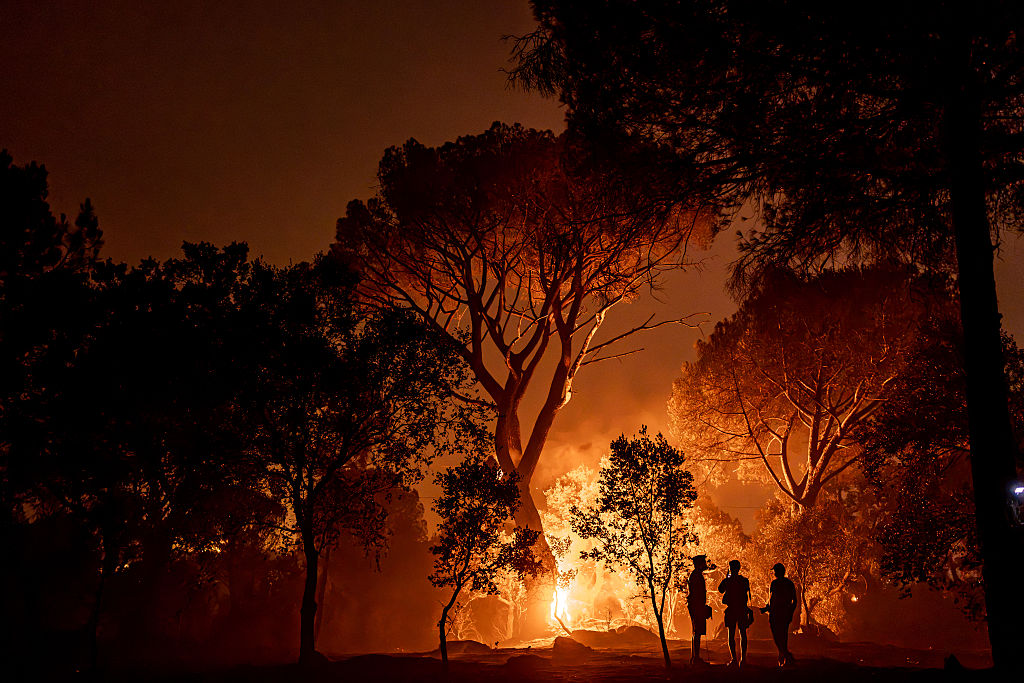
Water bombers, the air cavalry of wildfire fighting, buzz the treetops like air show stunt pilots as they save the day with surgical drops of water or orange retardant.
But what happens when those drops have no effect? When, as a pilot working the massive Gironde Fire just west of Bordeaux, France, described it, “The environment above the fire is so hot that my payload of 10,000 liters of water evaporates in the air.”? Mathieu Jomain, a commander and 26-year veteran in Gironde’s fire service, compared the fire’s intensity to “a meteorological nuclear bomb.”
This is the new reality of wildfires in the 21st Century: they hit different. And, too often now, the water doesn’t hit at all.
From America to Algeria, dangerous blazes are occurring around the world, giving us a glimpse into an age ablaze. We should all be asking the question: What will this age entail?
Flames engulf trees as a wildfire burns during overnight in La Adrada, Spain on July 26, 2026. —Diego Radames—Anadolu/Getty ImagesIn Spain, where several massive fires recently began burning with comparable ferocity, Interior Minister Fernando Grande-Marlaska declared, “We are facing the most significant and aggressive fire in Spain’s history.” Spain is more than 500 years old.
Across France and Spain alone, approximately a third of a million people have been displaced, the largest evacuations since World War II, but that is just the one among many examples. This summer, evacuations are ongoing across Europe, from Portugal to Turkey. Earlier this summer in Germany, evacuations were ordered in record-breaking heat after a wildfire triggered explosions in a nature reserve strewn with leftover ordnance from World War II.
Between drought, heat, and wildfire, much of the world is summering in record-breaking territory. The U.K., its iconic green landscape now parched to desert brown, is suffering one of its worst droughts since record-keeping began. Eight time zones away, Spokane, Washington, endures similarly outlandish temperatures as it continues to battle the most destructive wildfire the city and state has ever seen. With no relief in sight, there is, according to the city’s mayor, Lisa Brown, a years-long recovery already baked in. British Columbia, which has suffered several of the worst fire seasons in its history over the past decade, is bracing itself for the worst one yet. In Utah, fire officials are saying the same thing. In Russia this month, temperatures broke 90°F. at two different weather stations at the Arctic Circle, nearly 3,000 miles north of Miami, where such temperatures are the norm for this time of year.
Fire phnonemon
We are witnessing, live and in person, a terrible convergence of prolonged drought and record-breaking temperatures across the Northern Hemisphere. It is a convergence expressed most emphatically by unfightable fires racing across tinder-dry landscapes, fanned by high winds that are, increasingly, generated by the fires themselves. Just as warm waters fuel hurricanes, hot landscapes alive with roaring fire energize a wildfire’s chimney-like central column by burning all available fuel—grassland, forests, and neighborhoods alike—with explosive speed, and irrepressible ferocity that can produce flames higher than a thirty-story building and radiant heat approaching 1,000°F.
The ultimate expression of such a fire (so far) is the pyrocumulonimbus fire cloud or pyroCb, a colossal fireborne weather system that rotates like a hurricane, can shroud a major city in choking smoke, and puncture the stratosphere, allowing its mushroom cloud to achieve altitudes normally reserved for intercontinental jets. In order to oxygenate themselves, these massive systems inhale huge volumes of fresh air from the surrounding area, much as a hurricane does, and with similar effects on windspeed.
These massive fire weather systems, once an anomaly only seen over volcanoes, did not enter the vocabulary of fire scientists until the late 1990s, when atmospheric CO2 reached 370 parts per million (ppm)—about 30% higher than pre-industrial levels. It was only in the 2000s that wildfires, formerly seasonal events for which there was a well-rehearsed response, became able to generate these self-perpetuating and uncontainable firestorm clouds on a regular basis. Since 2016, they have become a feature of major fires across the North American West, but until the past year or two, they were virtually unknown in Europe. Matchstick-dry pine plantations in Gironde, France generated what is believed to be that country’s first-ever pyroCb just last week. Today, atmospheric CO2 is pushing 430 ppm, more than 50% higher than pre-industrial levels.
This matters to all of us because once a fire generates a pyrocumulonumbus cloud, it can perpetuate itself almost indefinitely by creating its own fiery weather, including ember blizzards and lightning strikes able to ignite fuels well beyond the current perimeter of the fire. Nothing and no one can stop a pyroCb save for a regional change in the weather, or an ocean-sized body of water.
With infernos burning so hot that water evaporates before even reaching the flames, firefighting operations are devolving, increasingly, into lifesaving operations. Whether you’re in the suburbs of Athens, Bordeaux, or Spokane, evacuation is often the only viable option. Over the past decade, millions of unsuspecting people have found themselves in the path of these hyper-scaling flames and, from Valparaiso, Chile to Fort McMurray, Alberta, victims are astonished by the speeds at which these fires move—speeds which photos and even video clips can fail to adequately convey.
This is climate breakdown, and its expressions are manifold. We can now expect everything from yellow and orange air and failed crops to buckling railways and the forced shutdowns of nuclear plants due to low water. When temperatures exceed 110°F, passenger planes must consider lightening their loads. At 120 degrees (an increasingly common summer temperature across the Middle East and the American Southwest), flights are often canceled altogether. Such temperatures also ground firefighting aircraft, leaving cities, towns and forests even more vulnerable to a wildfire’s whims.
Bearing the brunt of our new climate reality, of course, is the simmering countryside, desert dry and ready to ignite from the first mechanical spark, hot muffler, or flying ember. In many parts of the world—such as southern Europe, North Africa, and the Middle East—many charred and desiccated landscapes are no longer able to support the agriculture they have nurtured for thousands of years. As a result, for instance, wine production is decreasing globally, not just because of changing tastes but because heat, drought, and increasingly unstable weather are disrupting this ancient crop and craft.
However, there is another, slower and more insidious evacuation taking place, and that is the steady migration from rural areas all around the world to burgeoning cities, which now host more than half the world’s population. Left behind, landscapes previously managed by seasonal harvesting, pruning, burning, and grazing have gone feral: overtaken by scrub brush and weeds, they are terrifically flammable under current, much hotter weather conditions. Exacerbating this situation in regions like southern Europe and California is what’s being called “weather whiplash.” That is, heavy winter rains and snowfalls that encourage abundant spring growth, only to be dried to tinder by the now-successive heatwaves baking southern Europe and the American Southwest.
With this brutal heat comes another 21st-century chimera: the “flash drought,” a combination of searing, triple-digit temperatures and high wind that can turn a green field brown in the space of a workday.
A destabilized climate poses an existential threat to human civilization, pushing agrarian populations off their traditional lands into contact—and, often, conflict—with their neighbors. Take the recent war in Syria. The conflict had deep political roots, but it was exacerbated by internal migrations driven by failed harvests and drought.
Both Europe and North America are now beginning to see similar situations without—as yet—the armed conflict. In addition to already stressful and divisive cross-border migration, we are experiencing a second wave of internal migration in the form of mass evacuations due to fire. More than 800 homes have been destroyed and more than 60,000 people displaced thus far by the fires in and around Spokane, Washington. In Utah, thousands more evacuations have been ordered as that state faces record-breaking heat, high winds, and the worst fire season in its history. North of the border, in British Columbia, hundreds more homes were lost this week, and 15,000 people are currently under evacuation, with extreme fire weather conditions predicted to worsen in the coming days.
Fire prone regions such as these are already seeing an exodus of so-called “climate refugees.” As fires grow more frequent and destructive, we are going to see more people leave—driven out, because they can’t rebuild, or opting out because the price and risk of staying feels too high.
The role humans play
I wish I could say this summer was an anomaly or an outlier, but it clearly isn’t, and there’s more on the way. Our world is changing rapidly, and we are torn between adaptation, and clinging to the status quo.
In fairness, it’s hard to know where to look, and what we should be reacting to. Often ignored in discussions about drought, fire, and climate change in general, are the world’s oceans, which are warming just as the air is. Significant marine heatwaves have been recorded this year in the North Pacific and Atlantic oceans, and in the Mediterranean. It is ocean temperatures in the Pacific that generate the El Niño effect, and the next one, due this fall, is expected to break all previous records. Consider this summer a preview. But how did we get here?
Fossil fuels enabled modern civilization and got us where we are today. Had we never moved beyond wood-fueled steam power, there might scarcely be a tree left standing. Had we relied solely on coal, the air in our cities and towns would likely be as toxic as Pittsburgh’s in the 1940’s. Oil and gas has enriched and expanded our lives in such profound and far-reaching ways that renowned energy historian Daniel Yergin coined a new name for our species: Hydrocarbon man. From road paving to running shoes, lingerie to jet fuel, petroleum products are integral to our society—ubiquitous, affordable, and very well represented in Washington.
But the immeasurable gains fossil fuels have given us over the past century are now being taken away in real time, hundreds of houses, thousands of evacuations, and billions of dollars at a time, leaving behind mass trauma, ravaged landscapes, impoverished communities, and a tattered social fabric. Senator Sheldon Whitehouse (D-RI) summed up this dilemma more succinctly than anyone: “It’s not complicated,” he said at a Senate Budget Committee hearing in 2024. “Climate risk makes things un-insurable. No insurance makes things un-mortgageable. No mortgages crashes the property markets. Crashed property markets trash the economy.”
When will the oil and gas industry’s eye-watering profits be outweighed by all the losses their emissions incur?
Cumulatively, they already have. Spain’s prime minister, Pedro Sanchez, who speaks with hard-won authority on this matter, put a finer point on it: “Climate change kills: it kills people, as we’ve seen; it kills our ecosystem, our biodiversity, and it destroys the things we as a society hold dear—our houses, our businesses, our livestock.”
If there is a glimmer of hope in the smoke, it can be found in the relatively low mortality rates for these recent urban fires, and their largely successful evacuations, which demonstrate real social cohesion and admirable courage and civic spirit.
On the energy front, there is real and tangible good news, but neither the White House nor the CEOs of oil majors and their army of lobbyists are keen to share it: the energy transition to reliable, affordable renewable energy is underway and irreversible. Deploying renewables paired with intelligent energy conservation and grid management, individuals, businesses, municipalities, and entire countries are earnestly curbing their CO2 emissions. Arguably, the biggest hurdle will be curbing the appetites of the wealthiest 10%, not just at the extremes—vanity rockets, super yachts, and spurious wars—but two-day shipping, budget jet travel, F-150s, and the most casual wish granted with the click of a button.
As long as we burn fossil fuels without limits, wildfires will do the same in our forests, cities, and towns. But we are not passive bystanders, and these genuine “trials by fire” are Nature’s stern invitation to mature as a society, to confront with intelligence and courage the daunting energies we’ve unleashed with our own.
Fire is, at its core, an ambitious, energy-burning appetite. But so are we. Our future depends on whether this ambition is used to reinforce a now-maladaptive status quo, or to evolve, adapt, and conserve as so many among us are already doing.
Hence then, the article about what happens when the world is on fire was published today ( ) and is available on Time ( Middle East ) The editorial team at PressBee has edited and verified it, and it may have been modified, fully republished, or quoted. You can read and follow the updates of this news or article from its original source.
Read More Details
Finally We wish PressBee provided you with enough information of ( What Happens When the World is on Fire )


Also on site :
- ‘Harry Potter’ Producer David Barron Backs AI Adaptation Of ‘The Call Of The Wild’
- Oil prices surge after Trump rejects Iran’s plan to reopen Strait of Hormuz
- Walmart Sells a Beautiful Toi Et Moi Birthstone Necklace That Instantly Upgrades Your Jewelry Collection