
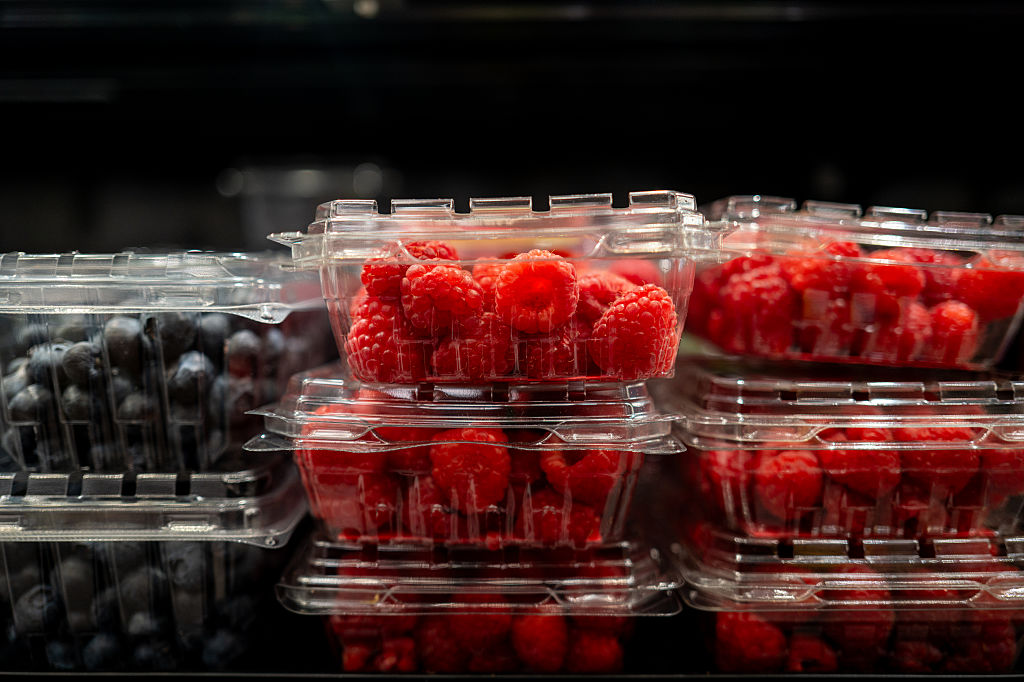
No more fresh raspberries this summer, one of the few foods toddlers reliably eat. Health advisors now say you should cook them in pies and jam to be safe. And that convenient bagged salad? Needs to be replaced with the full head, painstakingly washed.
As an economist studying women’s lives, I’ve railed against the unfair division of labor in American households, where women still tend to shoulder the majority of the domestic load despite growing earning power. But in this case, there’s another actor not pulling its weight: the government.
Cyclosporiasis, and the attendant time burden for parents that comes with it, can be directly linked to recent pullbacks in the food safety system that has kept us safe for decades.
Food safety is a classic “public good”—something that it’s more efficient for the government to provide than for each household to manage on its own. If a chemical is harmful, say BPA in pouch linings, it’s much more efficient for the government to ban it than for each family to have a designated baby food policer reading labels and parenting blogs to find out which brands to avoid. And the government can provide safety at scale that parents cannot provide themselves. We cannot test for possible bacterial or parasitic contamination of frozen food products or fresh vegetables without a lab.
For more than 120 years, since the publication of Upton Sinclair’s The Jungle, we’ve been moving in the direction of greater food safety oversight. Recently, that movement switched direction. The division of labor between families and their government that parents have relied on is being dismantled.
In Feb. 2025, roughly 89 people were fired from the FDA’s human foods program. The FDA then delayed by 30 months a new rule that would require tracing contaminated foods and yanking them off store shelves and the U.S. Department of Agriculture (USDA) withdrew a rule designed to limit salmonella in poultry.
Meanwhile, more than 15,000 employees at the USDA signaled their intention to resign by accepting the offer proffered by the Department of Government Efficiency (DOGE). Not satisfied, the agency pushed through a reorganization that would force workers from Washington, D.C. to regional hubs, which unions filed in court represented another attempt to gut the agency.
In July 2025, the CDC ceased mandatory tracking of six pathogens causing food-born illness. Among them? Cyclospora. In November, inspections of foreign food manufacturing facilities hit historic lows. Consumers noticed. During the 2025 fiscal year, food safety complaints for meat, poultry, and eggs (including things like wood in corndogs) went up 40%.
When the government steps down, parents have to step up—and safety becomes a private good. A staff of 18,000 for the FDA only sounds large when you don’t compare it to the 63 million American parents whose time, worry, and stress can be saved by a reliable food safety system.
And the problem isn’t limited to food safety. Since the start of President Donald Trump’s second term, vehicle safety rules were rolled back, and transportation investigations were cancelled. Air and waterway protections were decimated. Policing of predatory tech companies has been sidelined.
In a better world, parents would be able to trust the government not only to monitor existing threats, but to keep up with new science and adjust accordingly. Instead, Trump EPA administrator Lee Zeldin recently announced they would roll back the Biden rule regulating “forever chemicals”—now widely linked to cancer—in tap water.
From my vantage point, safety is becoming the latest DIY project, instead of a common goal we all invest in. The CDC’s official website on the COVID vaccine now unhelpfully states that the vaccine is recommended “for people ages 6 months and older based on individual-based decision-making.”
Over the last year, much of the conversation about regulation has focused on its costs to the federal budget and firm productivity. But left outside the picture has been the cost to parents of having to monitor and mediate these issues on our own. The advice given to overwhelmed parents is often to do less, and be more “free-range,” letting kids play outdoors unsupervised.
But this advice relies on the safety of our lived environment. The more real dangers exist in our children’s surroundings, the more time parents must spend protecting our kids. We are tasked with choosing safer foods and cleaning products, endlessly reviewing labels and ingredients, following content creators to guide us through chemicals and their exact level of endocrine disruption, monitoring our children’s phone usage, researching smart watches instead of phones, keeping our children indoors when air quality is bad, washing lead dirt off tiny hands before they put them in their mouths, and keeping kids busy with structured activities because the street is too full of huge SUVs for unsupervised bike-riding.
I would love to be able to cut loose as a parent. To do that, I need to know the government has my back: That they’ll handle the air, water, pandemic, and diarrhea-causing parasites, while we do the parenting.
Hence then, the article about when the government outsources safety families pick up the slack was published today ( ) and is available on Time ( Middle East ) The editorial team at PressBee has edited and verified it, and it may have been modified, fully republished, or quoted. You can read and follow the updates of this news or article from its original source.
Read More Details
Finally We wish PressBee provided you with enough information of ( When the Government Outsources Safety, Families Pick up the Slack )


Also on site :
- 1976 Rock Song, Lasting Nearly 9 Minutes, Recorded in a Munich Basement, Is Still a Generational Hit 50 Years Later
- Glynis Johns Earned a Supporting Actress Oscar Nomination for This 1960 Outback Drama, Years Before Her Mary Poppins Fame
- Add Homey Elegance to Any Bedroom With This ‘Cozy’ $26 Patchwork Comforter Set With Cottagecore Charm