
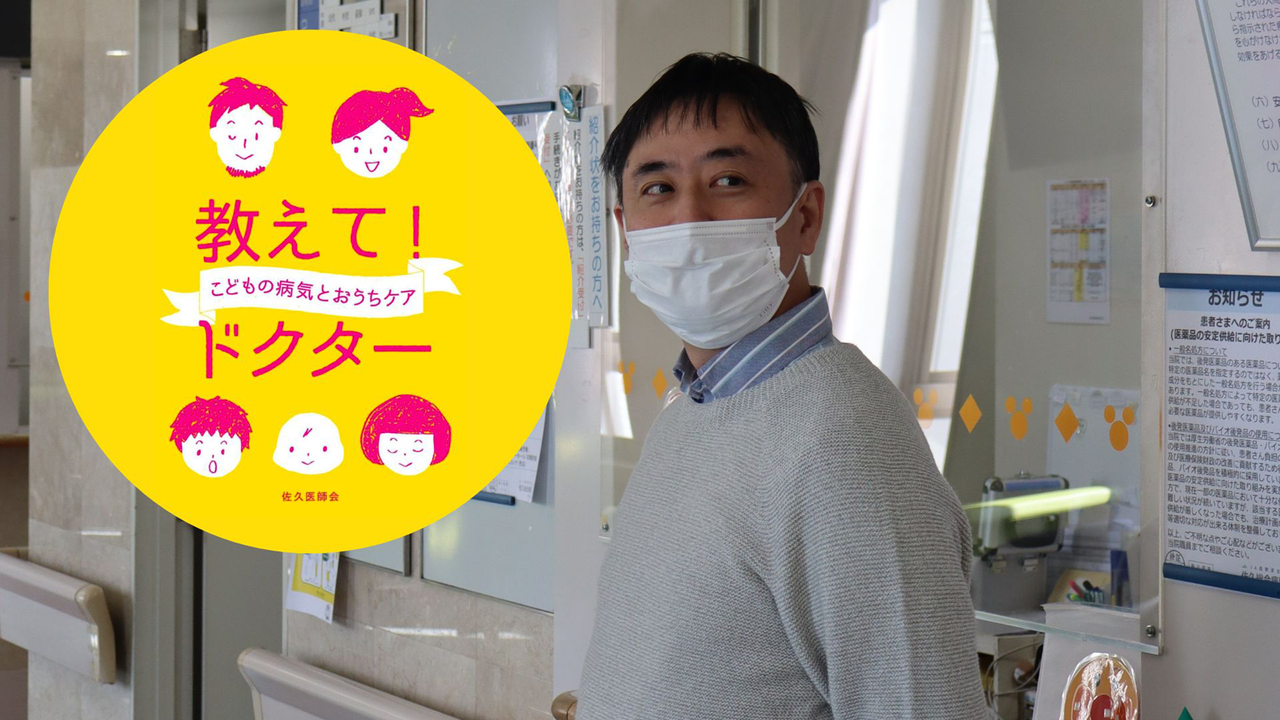
This is the fourth story in a series about antibiotic use in Japan and the U.S. I've explored how a Japanese program reduces antibiotic misuse, what research shows about the social dynamics behind the problem, and what pediatricians and parents think about the issue. Now, I'll spotlight a doctor with a passion for educating parents about children's health. This report was supported by a fellowship from the Association of Health Care Journalists and The Commonwealth Fund.
One winter night in 2011, pediatrician Dr. Masahiko Sakamoto met two parents and a feverish infant who would shape the course of his career.
Sakamoto was working at a rural hospital in Japan's Fukushima prefecture, roughly 160 miles (260 kilometers) northeast of Tokyo. Around midnight, as a heavy snowfall coated the ground outside, two parents arrived with their young child. The infant had a mild fever but was otherwise in good shape, Sakamoto determined. There were no signs of an emergency that warranted a doctor's attention.
Then, Sakamoto learned that the parents had driven 1.5 hours from a small mountain village to reach the hospital.
"Driving a car, with such snow accumulated on the road — that's a very risky behavior," Sakamoto said. He told me he was shocked by the "imbalance" between the infant's mild case and the parents' decision to make a three-hour round trip on dangerous roads out of concern that their child might need emergency medical care.
The experience alerted Sakamoto to a broader pattern: Parents with a limited understanding of childhood illnesses can become especially anxious when their child gets sick and end up seeking unnecessary medical care. Pediatricians in both Japan and the U.S. have described a similar trend to me in the context of antibiotics; parents sometimes request antibiotics that aren't needed, in part because they believe the drugs will alleviate their child's suffering.
Many doctors make the effort to explain the basics of childhood illnesses and appropriate antibiotic use to children's caregivers. But given that they're pressed for time and those conversations can be tricky to navigate, doctors told me that it would be helpful if parents came to appointments equipped with that information. Since that snowy night, Sakamoto has made it his mission to help educate parents about childhood illnesses before they arrive at a medical facility.
"What I am currently most interested in as a pediatrician," he said, "is how to provide accurate medical information to the parents or guardians of the children."
Nicoletta Lanese/Live ScienceNicoletta Lanese/Live ScienceNicoletta Lanese/Live ScienceNicoletta Lanese/Live ScienceBy the time parents arrive at a doctor's office or hospital, the chance to avert an unnecessary visit has been missed, Sakamoto recognized. So he wanted to help give caregivers the information needed to weigh whether a visit is necessary. He hoped to relay which symptoms of serious disease should prompt medical intervention and teach them appropriate at-home care for mild symptoms.
He started giving public lectures on these topics. Later, he wrote manuals of childhood illness, featuring adorable illustrations and plain-language explanations. In 2016, those manuals went digital. The free "Oshiete! Doctor" app, whose name translates to "Teach me! Doctor," has been downloaded more than 500,000 times in Japan, with approximately 100,000 active users, Sakamoto told me.
"It's quite famous around here," Risa*, a mother of two in Saku, Japan, said of the app. Sakamoto now works at Saku Central Hospital, and the city provides funding for the app's operation and promotes its use at health centers and events aimed at children and their caregivers.
"As a parent, I'm really grateful to have something like that — a resource that makes it easy to access information — right at my fingertips," said Rie Shinohara, another mother of two in Saku.
The app's content gets updated annually and applies to children and teens up to about 15 years old. It provides information on hygiene, immunization schedules and disaster preparedness, such as how to care for kids' health while evacuating for a natural disaster. (The team translated the app's disaster preparedness content for caregivers affected by the war in Ukraine.)
The app also includes guidance on when children should visit a hospital and explanations of common childhood illnesses and injuries, such as what medications might reasonably be prescribed and how to manage mild symptoms at home.
As a parent, I'm really grateful to have something like that — a resource that makes it easy to access information — right at my fingertips.
Rie Shinohara, Saku-based mother of two
For similar help with differentiating emergencies from minor ailments, parents in Japan can also look to online resources from The Japan Pediatric Society, or call #8000, a hotline that gives caregivers advice about whether to bring their child to a hospital. Japan's Ministry of Health, Labour and Welfare has recognized the "Oshiete! Doctor" app as a helpful complement to its national #8000 hotline and also awarded the app's developers for its design and impact.
Sakamoto and colleagues have studied the app's impact on caregivers. For instance, they've found evidence that app users utilize the emergency department more appropriately than nonusers do. In that study, 87% of users said the app made it easier to decide whether to visit the hospital, and 94% said they'd recommend it to others.
Challenges of educating parents
The team has also studied how the app's users feel about fever — the symptom that compelled the infant's parents to drive on snow-laden roads that night.
"The phenomenon known as 'fever phobia' among parents has long been recognized, and it is not unique to Japan," Sakamoto said. Notably, the American Academy of Pediatrics offers similar guidance to the "Oshiete! Doctor" app regarding fever, emphasizing that the symptom doesn't always require medical care and giving tips for when a doctor should be called.
Parents' worries about pediatric fever can be outsize compared with the threat it poses. Most fevers in kids are caused by viral infections that go away on their own, Sakamoto said, but caregivers can be compelled to seek care because they're concerned about fever triggering seizures or brain damage. This is especially true of first-time parents and parents with other children who'd had febrile seizures in the past, he added.
"With the first child, you just don't know. Why does he have a fever?" Shinohara noted. Of her firstborn, she added, "I probably took him to the doctor more often than necessary." But by her second, she felt she developed a better sense of when to seek medical care. Sakamoto's hope is that his app can help fill that information gap sooner.
Courtesy of Dr. Masahiko SakamotoCourtesy of Dr. Masahiko SakamotoCourtesy of Dr. Masahiko SakamotoIn a survey-based study, Sakamoto and colleagues polled hundreds of caregivers in Saku about their understanding of fever, taking stock of which parents had downloaded "Oshiete! Doctor." Between 2017 and 2024, a greater proportion of parents understood that fever alone does not necessarily mean a child needs medical care. Plus, a lower percentage of parents thought that antibiotics are always needed to treat fever. On the latter point, users of the app were most likely to answer correctly, although nonusers also improved between the two survey years.
Sakamoto credits some of that improvement to the incentive offered to pediatricians to avoid unnecessary antibiotics, which requires that doctors explain appropriate antibiotic use to caregivers. He thinks the message is likely more powerful for parents when it comes from their pediatrician, rather than government information campaigns. That said, Sakamoto emphasized that it's important to have strong educational materials available to help support doctors' explanations to parents.
Despite these improvements, Sakamoto also observed that parental anxiety about fever complications increased between the two survey years — although, notably, the COVID-19 pandemic took place in that time frame, which could be a piece of the puzzle.
"Their knowledge about fever, how to manage fever, and also the appropriate use of antibiotics was enhanced, whereas the fear about the children's fevers worsened," Sakamoto said. "Even when knowledge improves, emotional anxiety does not easily disappear; this is one of the challenges of public education."
Related stories'They didn't question it': Why doctors prescribe too many antibioticsJapan's bold experiment to curb antibiotic misuse has been a huge success. Could it work in the US?Antiseptic-tolerant germs spread through the air in hospitals, early study hints
Other challenges include the rising use of AI chatbots among parents, Sakamoto noted. He's encountered parents whose anxiety was triggered by erroneous information from a chatbot that suggested their child's prognosis was worse than it was, for instance. "It is rather rare to see that the parents have holistically accurate information from AI," he told me.
If he can secure more funding for "Oshiete! Doctor," Sakamoto hopes to someday make the app multilingual. In the long run, he remains committed to providing parents with this vetted information to both alleviate their worries and optimize their use of the healthcare system.
"We have the responsibility to check how the information is delivered to the parents or guardians and how it leads to behavioral changes," Sakamoto said. "So it is not just us disseminating information but whether or not it is truly received."
Editor's note: Risa (marked with an asterisk) asked that only her first name be used for privacy.
This article is for informational purposes only and is not meant to offer medical advice.
Hence then, the article about even when knowledge improves emotional anxiety does not easily disappear pediatrician dr masahiko sakamoto on educating parents about childhood illnesses was published today ( ) and is available on Live Science ( Middle East ) The editorial team at PressBee has edited and verified it, and it may have been modified, fully republished, or quoted. You can read and follow the updates of this news or article from its original source.
Read More Details
Finally We wish PressBee provided you with enough information of ( 'Even when knowledge improves, emotional anxiety does not easily disappear': Pediatrician Dr. Masahiko Sakamoto on educating parents about childhood illnesses )


Also on site :
- Stockton high school teacher arrested in child sexual abuse material case, CHP says
- Famous Beer Secures Top Ranking in YouGov’s 2026 Alcohol Survey; The 153-Year-Old Dutch Lager Edged Baileys to Lead America’s ‘Most Considered’ Brands
- The ‘Intermittent Kindness’ Pattern People Miss When Dealing With a Gaslighter, According to Psychologists